
Triumph Tracker 400 test ride: what I liked and what I didn't
Half an hour on the Triumph Tracker 400, compared with my 2011 Bonneville SE: riding position, agility in traffic, engine, suspension and brakes. And why a different bike ended up in my garage.
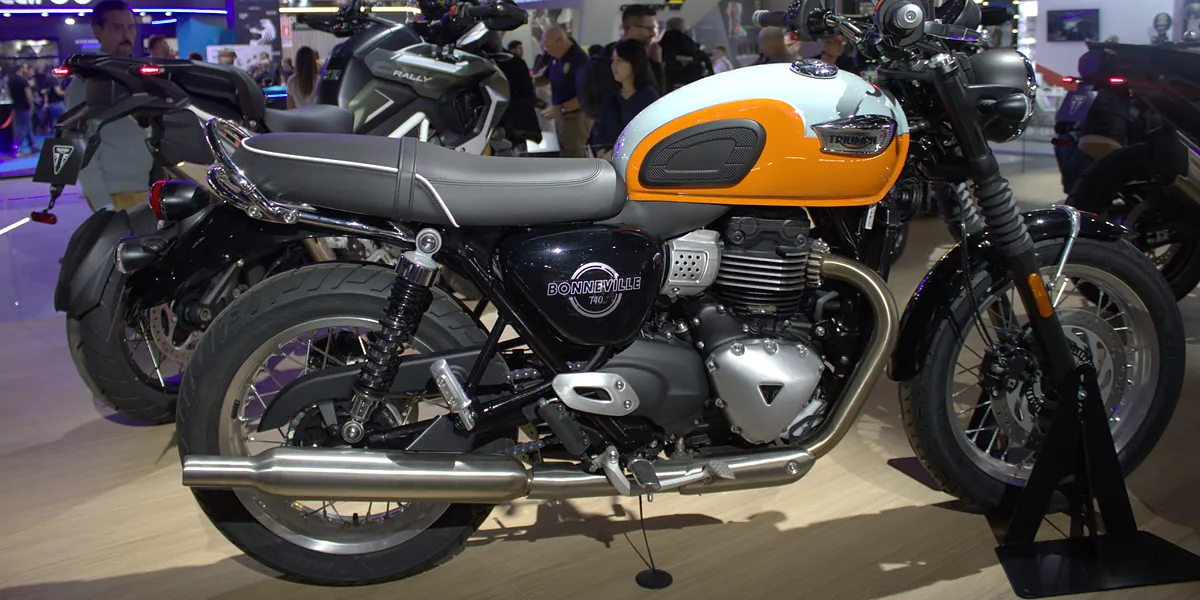
When I started looking for a bike to sit alongside my 2011 Triumph Bonneville SE, I knew pretty much what I wanted: something lighter and more agile, mainly for town, the daily commute and the odd short ride out of the city. The Triumph Tracker 400 went straight onto the list, so I booked a test ride. Here's how it went.
A bike that gets noticed
The Tracker caught my eye with its lines, which I think are really well done. It has a look of its own, different from the usual naked bikes, and it stands out without chasing fashion. It doesn't go unnoticed and, on looks alone, it won me over.
That's why I wanted to ride it, and I used every minute I was given: about half an hour. That's enough to get a fairly clear idea of how it behaves day to day, although it's still a short ride with its limits. I'm saying this up front because on a couple of points, further down, I'd rather not commit myself.
The Triumph Tracker 400 in a nutshell
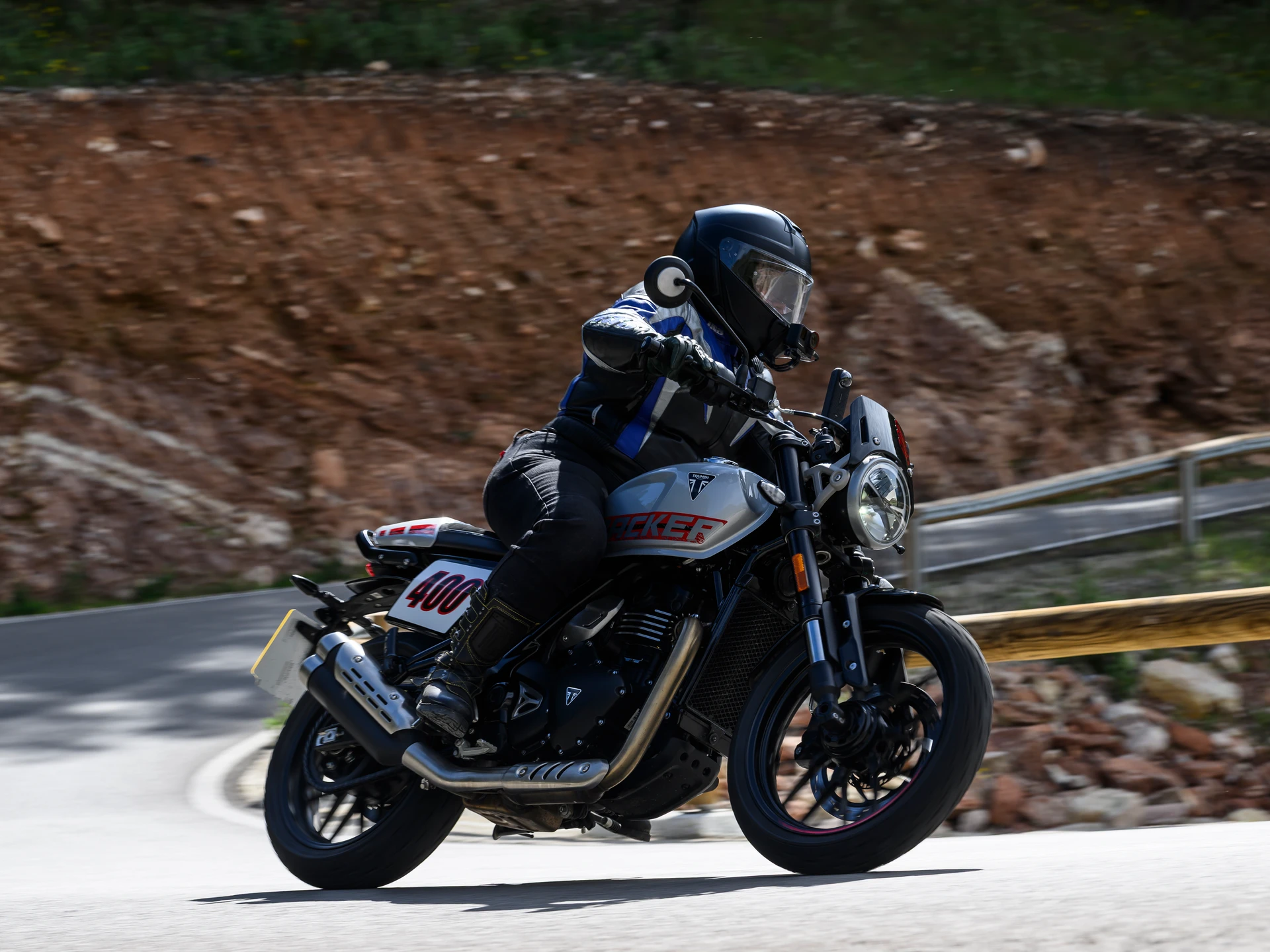
Before the impressions, a quick word for anyone who doesn't know it. The Tracker reached dealers in May 2026 and is the flat track styled member of Triumph's 400 family, the one that started with the Speed 400. Flat track is racing on dirt ovals, hugely popular in the United States: that's where the side number boards, the flyscreen above the round headlight and the cowl over the pillion seat come from.
- Liquid-cooled 398cc single, 42 PS at 9,000 rpm and 37.5 Nm at 7,500: two horses more than the Speed 400.
- 173 kg ready to ride, 805 mm seat height, 13-litre tank.
- 43 mm upside-down forks, monoshock, 300 mm front disc with a radial four-piston caliper, ABS.
- 17-inch wheels on Pirelli MT60 RS tyres: road rubber, but with a knobbly tread pattern that nods to flat track.
- Compared with the Speed 400, the bars are 2.3 cm wider and 13.4 cm lower, and the footpegs sit 8.6 cm further back and 2.7 cm higher.
- A2 licence friendly straight out of the crate, no restrictor kit needed.
That footpeg figure made me smile, because it explains one of the first things I noticed in the saddle. For the full spec sheet and prices, see the Tracker 400 page.
Riding position and seat
The Tracker puts you slightly over the front end, but it doesn't load your wrists and it feels natural to ride. The switchgear is intuitive and easy to reach. The footpegs, though, at least for my build and habits, are set a bit too far back, and the gear lever and rear brake pedal also sit quite low. It takes some getting used to.
The seat is on the firm side: on longer rides it could become uncomfortable.
Getting back on my Bonneville, the difference is obvious straight away. The Bonnie gives a much more relaxed position, with less bent legs and a more natural posture. On the Tracker you feel pushed towards the front, and the leg position, for my habits, is less comfortable. You notice it on the first lap, and after several hours in the saddle it could matter more.
Agility in traffic
The Tracker is simple and intuitive, and it's easy to move around even at a standstill. In traffic it's extremely agile, almost scooter-like in the way it slips between cars. The riding position helps too: you feel in control and changes of direction come naturally.
Here the comparison with the Bonneville is clear cut. My British twin weighs about fifty kilos more, and you feel every one of them when manoeuvring at walking pace and in town traffic. On the Tracker, those missing kilos make all the difference.
Overall the bike gives you confidence from the very first miles. My only reservation is the knobbly-pattern tyres: personally they didn't give me the sense of security I'm used to, especially on tarmac. That's a purely personal impression, and probably one of the trade-offs that come with a bike of this style and setup.
The Triumph Tracker 400 engine
The single isn't especially powerful, but it's very responsive, particularly low down. At first, I'll admit, it felt a bit snatchy: the throttle response at low revs is so sharp that for the first few minutes you treat your right hand with care. You get used to it quickly. After just ten minutes I felt as if I'd been riding it for years.
Once you're tuned in, the throttle response is immediate and linear, with no obvious flat spots. It's an engine built for responsiveness and ease of use rather than outright performance.
Next to the Bonneville the difference shows. The 865cc twin also pulls well low down, but it has a noticeable on-off effect: when you roll off and open the throttle again there's a small gap in the response, which makes the ride less smooth, especially on twisty roads.
On vibration, though, the Bonneville wins. Its twin sends very little through, even at higher revs. On the Tracker I felt more as the speed went up, although I can't rule out that part of it comes from the knobbly-pattern tyres.
Suspension and brakes
The suspension is one of the things that impressed me most. The forks have a well-judged setup, not too stiff, soft enough to soak up rough town tarmac without jolts or kicks through the bars.
The rear shock also felt well balanced. It holds the back end up properly and gives confidence in faster sweeping bends, while over potholes and speed bumps it doesn't send harsh knocks up your spine.
The brakes felt excellent. I didn't find any flaws or weak points during the ride, and the system gave me a good sense of security. Another point in the Tracker's favour.
At higher speeds: verdict on hold
Here I'd rather not give a final verdict. In half an hour I didn't get the chance to take it to really high speeds. As the pace went up I felt a bit too much vibration, but I can't say how much that would affect comfort on a long run. It would need a proper, longer test.
Otherwise, the limits are what you'd expect from this engine size. The strong low-down pull makes it enjoyable every day, but I wouldn't call it the ideal choice for anyone who regularly covers long distances or tackles demanding trips. For that kind of riding, a bigger bike is probably the better bet.
Why I ended up with the KTM 390 Duke
The Tracker won me over. I like the look of it, it's different from the usual, it's remarkably easy to ride and it has everything it takes to be a good companion for daily riding. I'd seriously consider it if I wanted an agile, undemanding and fun bike for commuting and short rides out of town.
So why didn't I buy it? The answer came from comparing it with another bike in the same class: the 2025 KTM 390 Duke, with its 399cc single.
In the end I chose the Duke. Both can be ridden on an A2 licence, and that mattered to us, because my son had to be able to ride it too. What made the difference was character. The Duke is much sportier, has a different personality and a setup that matches what he wanted. Even so, it's still very agile and practical, and perfectly at home in town.
For anyone unfamiliar with it, the A2 licence allows bikes of up to 35 kW, about 47 PS, with a power-to-weight ratio of no more than 0.2 kW per kg. With 31 kW and 173 kg, the Tracker sits comfortably inside both limits, with no restrictor kit.
So the choice didn't come from disappointment. Between two bikes with different strengths, I simply picked the one my son wanted.
My verdict on the Triumph Tracker 400
The Triumph Tracker 400 is still a bike I really liked, and a good alternative for anyone after something a little different, easy to ride and suited to everyday life. If it appeals to you, the two things to check carefully are the ones I found: the riding position with its rear-set footpegs, and the knobbly-pattern tyres on tarmac.
Because you can like a bike a lot, but the right one is the one that feels closest to the way you ride and what you want to do with it.
Ride safe, everyone!