

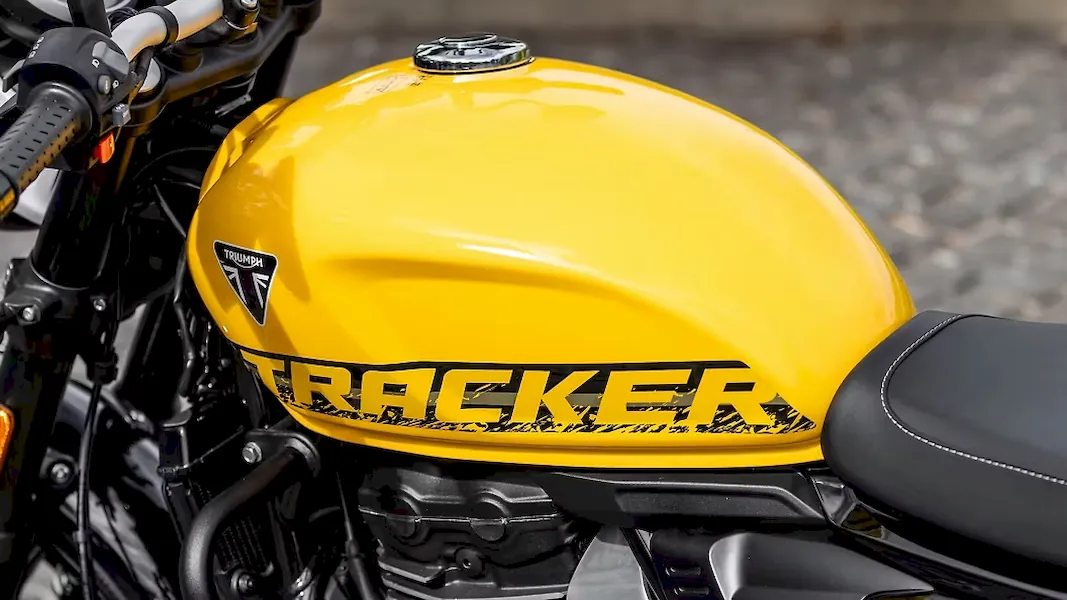
Triumph Tracker 400, the 400cc flat tracker
Triumph · 2026-present · 398cc
Description
Features and technical evolution
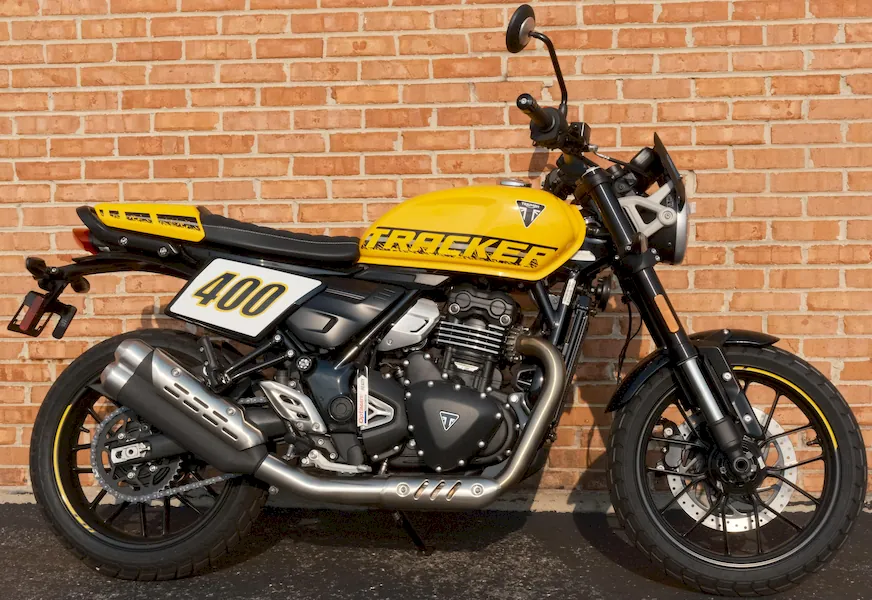
The Triumph Tracker 400 is the 400 inspired by flat track bikes, the racers of dirt ovals: number boards on the sides, wide low bars and a single-seat cowl. Underneath is the 398cc single in its 42 PS at 9,000 rpm tune, the same as the Thruxton's. It weighs 173kg ready to ride, has an 805mm seat and is A2 licence-friendly.
What changes from the Speed 400
Triumph didn't just swap the bodywork. The frame has its own geometry: a wheelbase 6mm shorter and a head angle 0.2 degrees steeper, according to Bennetts. The bars are 23mm wider and 134mm lower than the Speed's, and the pegs are 86mm further back and 27mm higher. The tank is new and more angular, still 13 litres, and the 17-inch fourteen-spoke wheels wear Pirelli MT60 RS, block-pattern tyres designed mostly for tarmac.
The engine gets a different cam profile and mapping: 42 PS instead of 40, with torque unchanged at 37.5 Nm but at 7,500 rpm instead of 6,500. The 43mm Big Piston upside-down fork has 140mm of travel and the preload-adjustable shock 130mm. Brakes are as on the Speed: a 300mm disc with a four-piston radial caliper up front, 230mm at the back, ABS and switchable traction control.
My test ride
I rode it for about half an hour, looking for a nimbler, lighter bike to sit alongside my 2011 Bonneville SE for town, commuting and short trips. The position puts a little weight on the front but doesn't tire the wrists. For my build the pegs are too far back, and the gear lever and rear brake pedal sit rather low. The seat is fairly hard.
In traffic it's incredibly nimble, almost like a scooter, and easy to move around at a standstill. At first the engine felt a bit snatchy, very eager low down, but after ten minutes I felt as if I'd always ridden it.
The fork and shock won me over: they soak up potholes and speed bumps without jolts and feel secure in fast sweepers. The brakes were excellent. The block-pattern tyres less so: on tarmac they didn't give me the confidence I'm used to.
As speed rose I felt more vibration than on the Bonneville, and the tyres may play a part in that. I won't judge it at high speed: in half an hour I couldn't really try it.
What the tests say
The magazine tests point the same way. inSella and Moto.it describe an engine that's lively low down and in the midrange, vibration above 6,000-7,000 rpm and a hard, thinly padded seat. MCN and Rider Magazine note a soft initial bite from the front brake. For MCN and Autotrader it's the most rideable and the most fun of the Triumph 400s.
Historical context
The Tracker 400 is the fifth bike in the family born from the partnership between Triumph and Bajaj Auto, after the Speed 400, Scrambler 400 X, Scrambler 400 XC and Thruxton 400. The European version was unveiled on 16 December 2025 alongside the Thruxton 400 and reached Italian dealers in May 2026 at €6,345. In the United States it's sold as a 2027 model.
The reference is flat track, racing on dirt ovals. The Tracker borrows the look and the riding position, but it's a road bike: frame, brakes and tyres are designed for tarmac.
Within the family it sits between the Speed 400 and the Scrambler 400 X, in price and in character. Outside it, the rivals most often mentioned are the Royal Enfield Guerrilla 450, which 1000PS tested it against, and the Husqvarna Svartpilen 401, both cheaper as Bennetts points out. In my case the comparison was with the KTM 390 Duke.
Main versions
- Tracker 400, European version (from 2026): 398cc, 42 PS at 9,000 rpm and 37.5 Nm at 7,500, 173kg ready to ride, 805mm seat, Pirelli MT60 RS. Three colours: Racing Yellow, Phantom Black and Aluminium Silver. In Italy from May 2026; in the United States it's a 2027 model.
- Tracker 400, Indian version (April 2026): despite the name, it has a 349cc single, the smaller capacity Triumph uses for the models it sells in India, with around 40 PS and 32 Nm according to Autocar India. Launched at 2.46 lakh rupees. It's a different bike from the one sold in Europe, so keep that in mind when reading Indian tests.
Trivia and anecdotes
In India the Tracker 400 name is a small trap: there the bike has a 349cc engine, not 398. Autocar India titled its test "Mistaken identity", partly because there's no real dirt-bike hardware under the number boards.
Visordown, which compared it with the Thruxton 400, gave the Thruxton the win on style and the Tracker the win for everyday riding, calling it more comfortable and more fun on a good road.
In the end I didn't buy it. A 2025 KTM 390 Duke went into the garage instead, a sportier bike, chosen mainly because it was the bike my son wanted, and he rides it too. I liked the Tracker, and I'd seriously consider it if I were after a nimble bike for commuting and short rides.
What it's worth today
Indicative prices, November 2026
In November 2026, used Tracker 400s in Italy are almost all pre-registered or dealer demo bikes, registered in 2026 with a few hundred kilometres. They sell for €5,000 to €5,900, against a list price of €6,345. A real used market doesn't exist yet: prices will depend on mileage, service history, remaining warranty and accessories.
What to check
- Warranty: on a 2026 bike it should still be running, with services recorded.
- Number boards, mirrors and levers, the first things to get marked in a tip-over.
- Single-seat cowl and pillion seat, if you want to carry someone.
- Condition of the Pirelli MT60 RS: with a block pattern, wear is easy to see.
- Non-homologated exhausts and remapped ECUs.
Strengths and weaknesses
- Original flat-track look, different from the usual naked bikes.
- Incredibly nimble in town and easy to move around at a standstill.
- Well-judged suspension that soaks up potholes and feels secure in corners.
- Effective, easy-to-modulate brakes.
- Eager engine low down and in the midrange, with 42 PS and A2 compliance.
- Finish worthy of a pricier bike, according to MCN and 1000PS.
- Hard, thinly padded seat.
- Rear-set, high pegs and a low gear lever and brake pedal take some getting used to.
- Vibration above 6,000-7,000 rpm.
- Block-pattern tyres that inspire less confidence on tarmac than a pure road tyre.
- Soft initial bite from the front brake, according to MCN.
- Basic LCD display and no quickshifter.
Anyone after a nimble, light bike for town, commuting and short trips, perhaps alongside a bigger bike. Riders on an A2 licence. Anyone who wants a look that stands out from the usual naked bikes and a bike that feels natural after just a few minutes.
Riders who often cover long distances or demanding trips: the hard seat and vibration as speed rises soon tell, and for that kind of use a bigger engine makes more sense. Anyone who wants the feel of a pure road tyre. Riders after the sportier character of a naked like the KTM 390 Duke.
Before signing, take a proper test ride, at least half an hour: the position of the pegs and controls is what divides riders most, and I noticed it straight away. Dealers' pre-registered bikes cost a few hundred euros less than list and come with full warranty. If the block-pattern tyres don't convince you, ask the dealer what alternatives they offer.
The Tracker 400 has been on sale since May 2026 and the sources we checked report no recurring faults or recalls. The engine is derived from the Speed 400's, around since 2023 with no serious documented problems, with revised cams and mapping. Tests only mention vibration at high revs, which makes the mirrors hard to read at some speeds.
Services every 16,000 km (10,000 miles) or 12 months, with a two-year unlimited-mileage warranty. The rest is the routine of a chain-driven bike: clean, lube and adjust the chain, plus brake pads, coolant and tyre pressures. For exact intervals, the Triumph handbook is the reference.
The bike is in current production and parts come through Triumph's official network. Most of the mechanicals are shared with the other 400s, so the main parts shouldn't be hard to find. The tank, number boards and seat cowl are specific to the Tracker. The 110/70 and 150/60 tyres on 17-inch rims are common sizes, road-pattern versions included.
€5,000-5,900 pre-registered and nearly new (November 2026, Italy)
At €6,345 in Italy the Tracker costs €600 more than the Speed 400 and €250 less than the Thruxton. In return you get the liveliest engine in the family, its own geometry and a look you won't mistake for anything else. Autotrader calls it the best of Triumph's 400s. Cheaper rivals exist, as Bennetts notes, though it also points out that not every brand in this class cares about quality as much as Triumph.
The Tracker 400 won me over: it's good-looking, different from the usual and surprisingly easy to ride. It isn't a touring bike and doesn't pretend to be. It's the right companion for anyone whose days are spent in traffic, on A-roads and on the odd trip out of town, on a bike that turns heads. I went another way for family reasons, not out of disappointment.
Accessories
Thicker or gel seat
Comfort
The standard seat is hard and thinly padded, as the tests say and as I noticed too. A seat with more padding or a gel insert makes rides of more than an hour easier to bear. Keep an eye on the height when choosing, so it doesn't rise too much.
Tank bag or soft tail bag
Luggage
With the single-seat cowl and little space under the seat, commuting calls for some luggage. A small tank bag or a soft bag on the pillion seat is enough for an open-face helmet, a rain jacket and papers, without weighing down such a nimble bike.
Frame sliders
Protection
In traffic a tip-over can happen. Frame sliders protect the tank, number boards and engine covers. Choose ones made specifically for this frame, with mounts that don't require drilling the bike.
Rear paddock stand
Maintenance
The bike only has a side stand. To clean and lube the chain, check its tension and pump up the tyres in peace, a rear paddock stand is the most useful thing you can buy. Choose one with supports that suit the aluminium swingarm.