

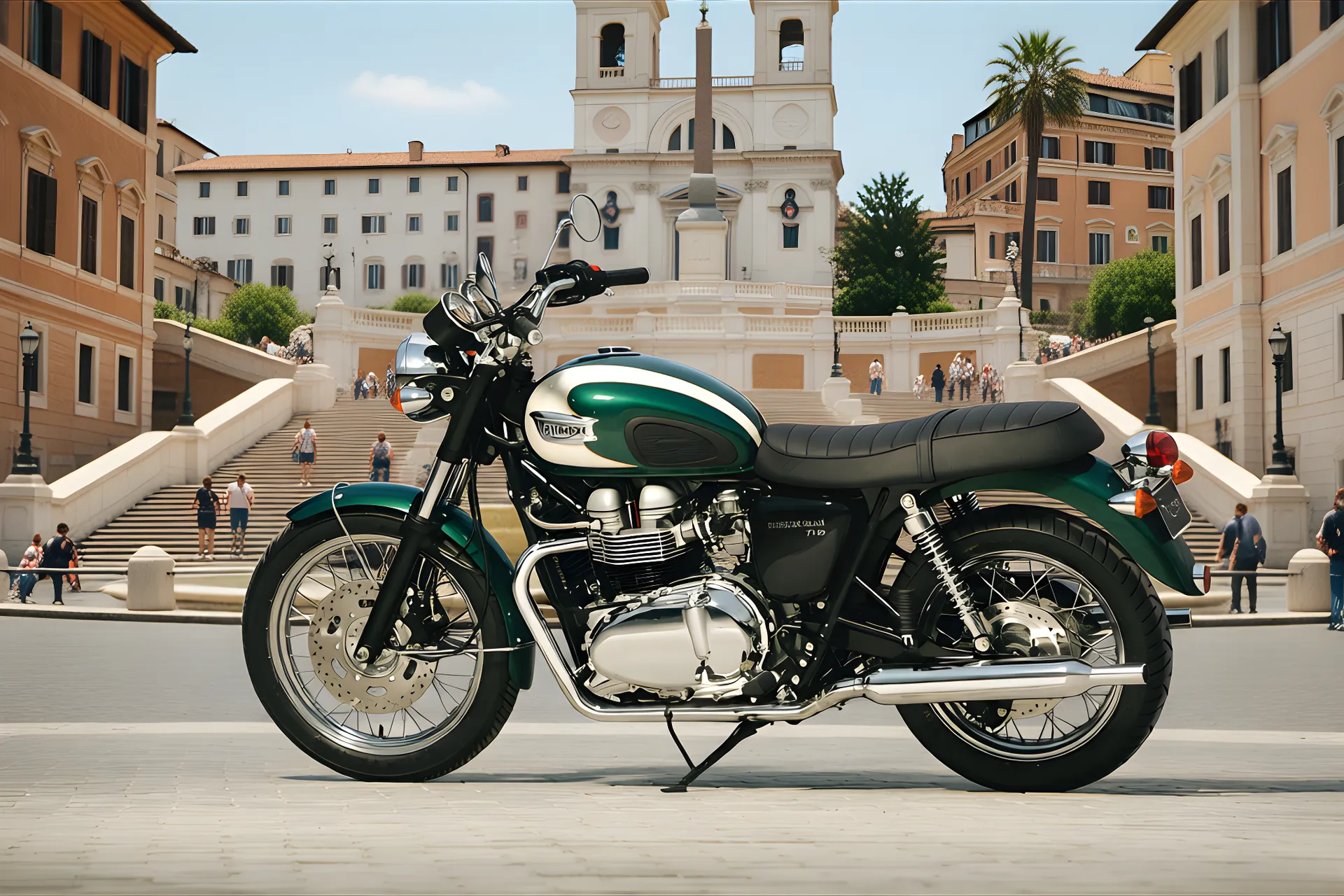
Triumph Bonneville: The Story of the British Legend from 1959 to Today
Triumph · 1959 - present · 649 cc (T120) / 744 cc (T140) / 865 cc (EFI) / 1200 cc (T120 Modern)
Features and technical evolution
The Triumph Bonneville is the very essence of the British motorcycle: clean lines, teardrop tank, wide handlebars and the unmistakable parallel-twin engine. From its birth in 1959 to the latest High Torque versions, the "Bonnie" has passed through three eras of manufacture, keeping its stylistic identity intact while renewing itself completely under the skin.
1. The Classic Meriden Era (1959 - 1988)
The first series, the celebrated T120 (1959-1974), grew out of an idea by Edward Turner. It has a 649 cc pushrod twin fed by two Amal carburettors, delivering 46 bhp. The chassis is based on a tubular steel cradle frame, telescopic forks and manual drum brakes. With the T140 (1973-1988) displacement rises to 744 cc for 50 bhp, a 5-speed gearbox is introduced, along with the revolutionary Oil-in-Frame structure, in which the lubricating oil circulates directly in the frame's central spine.
2. The Hinckley Rebirth: The Air-Cooled Era (2001 - 2015)
After years in the wilderness, John Bloor relaunched the marque at Hinckley, completely redesigning the Bonneville. The Bonneville 790 / T100 (2001-2007) uses an air-cooled DOHC twin with a 360° crankshaft, a solid steel-tube frame, 41 mm Kayaba suspension and a single 310 mm Nissin front disc brake. From 2005 displacement grew to 865 cc. In 2008 the Bonneville 865 EFI (2008-2015) made its debut: to meet emissions regulations, Keihin electronic fuel injection was adopted, masterfully hidden inside dummy die-cast aluminium carburettor bodies.
3. The Modern Era: Liquid-Cooled & Tech (2016 - Present)
With the move to liquid cooling, the radiator is perfectly camouflaged between the frame tubes. The Bonneville T100 (900 cc) produces 65 bhp and generous torque at low revs, with ride-by-wire, switchable traction control, ABS and an assist clutch. The range-topping Bonneville T120 (1200 cc) raises power to 80 bhp with 105 Nm (77 lb ft) of torque, twin front Brembo discs and selectable engine maps (Road and Rain), offering the safety and reliability of a modern bike without losing a gram of its vintage charm.
Historical context
The Bonneville takes its name from the iconic salt expanses of Utah, the Bonneville Salt Flats, where in 1956 rider Johnny Allen broke the world speed record, reaching 345 km/h (214 mph) in a streamliner powered by a Triumph engine. In the 1960s the bike became the absolute symbol of British youth culture: it was the undisputed queen of the Rockers and the ton-up boys, the lads who challenged each other to top 100 mph (160 km/h), racing from one café to the next along London's ring road, with the legendary Ace Cafe a regular stop. It was also the bike loved by Hollywood stars, made famous by Steve McQueen, Marlon Brando and Clint Eastwood.
Main versions
- Bonneville T120 (1959-1974): The first and purest, with 19" wire wheels, chrome finishes and a two-tone tank.
- Bonneville T140 (1973-1988): The 750 cc version with disc brake, 5-speed gearbox and Oil-in-Frame chassis. Includes the special editions Silver Jubilee (1977) and Royal Wedding (1981).
- Bonneville T100 Air-Cooled (2002-2015): The great comeback with a 790 cc/865 cc engine, available with wire wheels or in SE version with 17" alloy rims.
- Bonneville T100 Liquid-Cooled (2016-Present): 900 cc High Torque engine, ideal for everyday riding with low fuel consumption and the latest electronics.
- Bonneville T120 Liquid-Cooled (2016-Present): The 1200 cc flagship with twin front discs, extra-luxury details and hand-brushed engine finishes.
Trivia and anecdotes
Edward Turner, Triumph's legendary designer, was at first strongly opposed to the name "Bonneville". He feared that an American name might distort the typically British pride and identity of the marque. He had to change his mind when he saw the incredible sales success in the United States.
The very first 1959 versions had a heavy, enveloping front mudguard (called a nacelle). The young rockers of the day detested it so much that they smashed it off the moment the bike left the dealership, to make it look more aggressive. Triumph got the message and from 1960 completely redesigned the front end.
During the switch to fuel injection in 2008, the Hinckley designers made throttle bodies shaped exactly like the old 1960s Amal carburettors, managing to fool even the eyes of the most experienced riders.
What it's worth today
Indicative prices, September 2026
The market for Bonnevilles is extremely solid and continually growing among collectors:
- Meriden T120 models (1959-1970): Restored examples with original parts or perfectly preserved ones range between €12,000 and €18,000, with peaks above €20,000 for the very first 1959 series.
- T140 models (1970s-'80s): More accessible prices, on average between €5,500 and €8,500 depending on the condition of the frame and engine.
- Hinckley Air-Cooled series (2001-2015): The carburettor versions (2001-2007) are increasingly sought after by custom builders and hold a value between €4,500 and €6,500. EFI versions sit between €5,000 and €7,000.
- Modern Liquid-Cooled series (2016-Present): Recent used T100s and T120s hold their value excellently, valued at €7,000 - €9,000 (T100) and €9,500 - €12,500 (T120) respectively.