My 70s and 80s motorcycles: from the Caballero to the Super Bol d'Or
Nine motorcycles from the 70s and 80s, from a Fantic Caballero in an olive grove to a Honda CB 1100 F bought used in 1992: real memories, a shaft-drive crash, kickstarting an XT 500 and the lessons that still count if you're choosing a classic today.
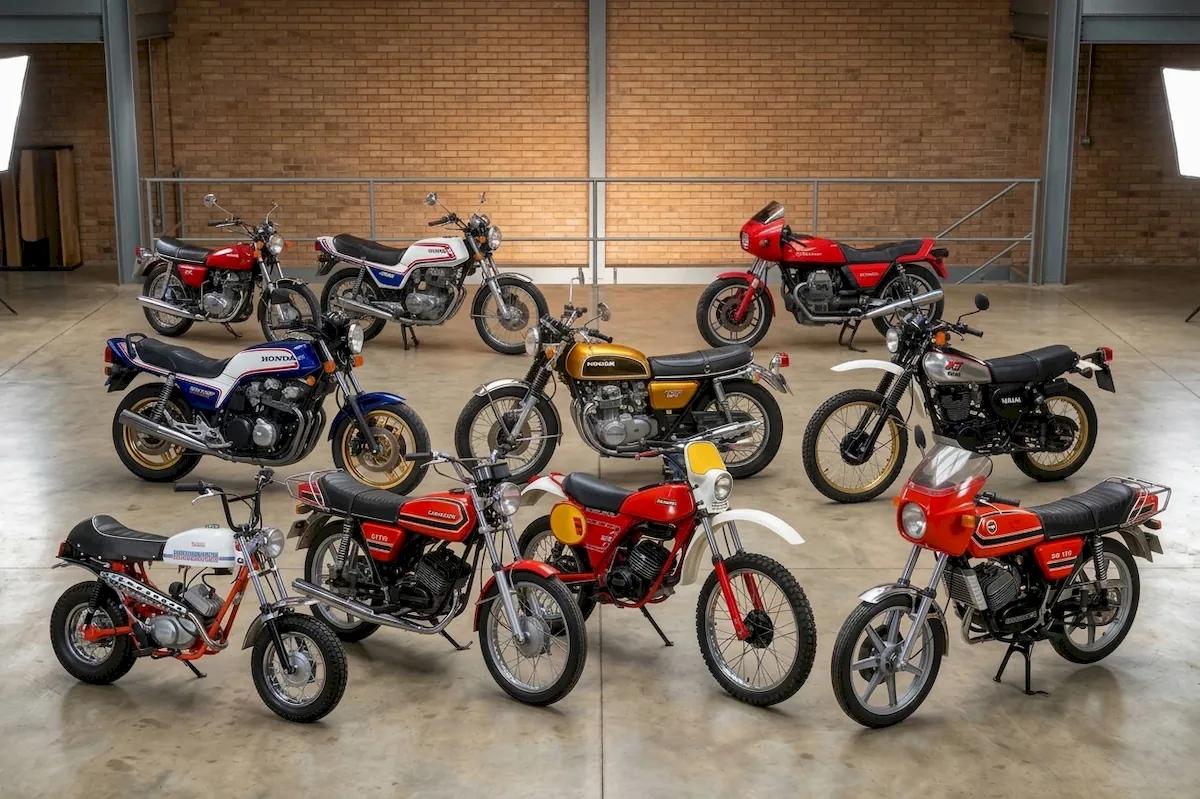
Every rider has a list they know by heart. Not the list of the most beautiful bikes ever built, but the list of their own bikes, one after another, with their flaws, the crashes and the afternoons that never come back.
This is mine: nine motorcycles from the 70s and 80s, ridden between 1976 and 1997, from the first fifty I rode on the quiet out in the countryside to the four-cylinder that turned every head outside the bar. It isn't a ranking and it isn't a road test. It's the story of how I learnt to ride, and of what each of these bikes can still teach anyone thinking about buying a classic today.
Fantic Caballero 50: my riding instructor
I was 13. Mine was the four-speed Caballero, and I dreamt of the six-speed the way people dream of a superbike today. Even so, it was the best riding instructor I've ever had. Until I was 15 my parents wouldn't let me take it on the road: countryside only. My friends and I had marked out a little track in an olive grove, with a few hand-built jumps, and we spent whole afternoons there after school.
Looking back, my parents' rule was a gift. On dirt you learn everything tarmac hides from you: the rear stepping out, shifting your weight, feeding in the throttle on the way out of a corner. You get it wrong at 20 mph, land on soft ground, pick yourself up and go again. Anyone starting out today on a 50 bhp bike misses out on exactly that training ground.
Fantic 50: my school run
Then came the road, and with it the Fantic 50 I rode to school. I remember how proud I was parking it outside the school gate: I loved arriving on it so much I almost didn't want to bunk off any more. Almost. It was my first real taste of freedom: getting about on my own, choosing my route, taking the long way round to ride past someone's house.
It was also the first time a bike became transport rather than just a toy: rain, cold winter mornings, rush-hour traffic. That's where you learn to read the road: the wet manhole cover, the car turning without indicating, the gravel at the exit of a building site. No course teaches you that like a year of school runs.
Italjet Buccaneer 125: my first grown-up present
I got my motorcycle licence just after turning 16 and Dad gave me the Buccaneer. It was Italian with a Japanese heart: frame and styling by Italjet, Leopoldo Tartarini's Bologna firm, and a Yamaha engine, a two-stroke twin with oil injection.
A cantankerous thing, but with terrific torque for its size. Off the line it was phenomenal; at the lights nobody could touch it. The flip side was the carburation: it tended to go out of tune, and it cost me more than one Saturday with oily hands.
If you've never owned a two-stroke: oil injection means a small pump feeds oil to the engine according to revs, so you no longer have to mix petrol and oil at the pump. Handy, but it needs watching: keep the oil tank topped up, check the lines, keep the pump correctly adjusted.
A two-stroke that smokes too much or fouls its plug almost always has its carburation out, and on these bikes the difference between a crisp engine and a spluttering one comes down to a jet or a needle clip position. And a twin has two carburettors: if they aren't balanced, the engine will never run sweetly however much you fiddle with it.
Zündapp 175: motorway legal
An odd capacity, 175 cc, but with one huge advantage: it was over 150 cc, so it was allowed on the motorway. A friend of mine had a Laverda 125, which wasn't.
So before the toll booth we'd swap my left side panel, the one with the 175 badge, onto his bike so the attendant would read the "right" capacity. Nobody ever stopped us. I tell it with a smile, and just as honestly I'll say: don't try this. Times were different, and nobody would find that trick funny today.
Honda CB 350 Four: the coolest kid on the block
The 350 Four took me into another world: four cylinders, Japanese, refined. With an aftermarket four-into-one in place of the four stock silencers it was simply gorgeous, and riding past you felt like the coolest kid on the block. It was a bike to look at even before you rode it, and it's one of the reasons Honda's fours from that era still have such a loyal following.
A tip if you're looking for one today: four cylinders means four carburettors. If they aren't balanced the bike vibrates, runs hot and drinks fuel, and plenty of people judge it badly because of that. A proper carb balance with vacuum gauges transforms it.
Yamaha XT 500: need I say more?
An icon of its era, and there isn't much more to say. Its only flaw was starting: kickstart only, with a decompression lever. If you weren't careful, the kickback could break your ankle, and that's not a figure of speech.
The drill, for anyone who's never seen it:
- ease the kickstarter down until you feel compression;
- pull the decompression lever and nudge the piston just past top dead centre (there's a little sight window on the engine with a mark for exactly this);
- let go of the lever, bring the kickstarter back up and give it one firm, full kick, all the way through.
A timid half-kick is precisely what makes it kick back. Once you've got the knack it starts first time; until you have, the bike is in charge.
Moto Guzzi V35 Imola: the one I never made peace with
I didn't keep it long, because I never really got on with it. The shaft drive in particular never let me relax. I came off on a slip road onto the Olimpica: I shut the throttle mid-corner, the rear lost grip and I found myself on the ground. A shame, because the engine was willing and full of character.
Now I know that crash had a technical explanation and wasn't just bad luck. On a shaft-drive bike, opening and closing the throttle makes the rear rise and squat.
Snapping the throttle shut while leaned over adds that movement to engine braking and to the weight transfer onto the front, and the rear tyre goes light at exactly the wrong moment. The rule applies to any bike, but with a shaft it counts double: through a corner keep a trace of throttle on and be smooth, no sudden inputs.
Honda CB 400 N: the forgiving one
The easiest bike to ride I've ever owned. It forgave you almost anything, barely vibrated, and even though the engine wasn't particularly punchy you didn't notice, because everything else worked. It was the bike I did the real miles on, the everyday ones, never thinking twice before turning the key.
It's the kind of bike I'd recommend to anyone coming back after years away or getting into bikes now: it won't thrill you on the first ride, but it makes you ride well, and that's how you learn.
Honda CB 1100 F Super Bol d'Or: the bar bike
I bought it used in 1992, when it was already nearly ten years old, and I never regretted it. I called it the bar bike: park it and everyone looked. Acceleration was progressive, almost polite, but once the engine came on the torque it nearly pulled your arms out of their sockets.
Despite that, it gave you a huge sense of security: it would reach around 220 km/h (about 137 mph) and stay composed even up there, which was far from a given for a bike that powerful back then.
A word for anyone buying a period big bike like this today: the engines from that era often still feel current, the brakes and suspension don't. Before you enjoy the horsepower, check discs, pads, hoses and brake fluid, the state of the forks and shocks, and learn to brake earlier than you would on a modern bike. Today's tyres in the original sizes make a huge difference.
With it I reach 1997, and this chapter of the story closes. It was the bike of someone who had finally learnt to ride, and who had earned that confidence by falling off, getting his hands dirty and learning from every bike before it.
What 70s and 80s motorcycles taught me
Looking back over the list, every bike left me with a lesson, and nearly all of them still apply if you're eyeing up a modern classic at a dealer or a genuine old bike in a classified ad.
- You learn better slow than fast. The Caballero in the olive grove taught me more than the Bol d'Or did. If you're starting out now, a light, easy bike will make you a better rider faster than a powerful one.
- Easy doesn't mean boring. The CB 400 N proved it then, and plenty of mid-size modern classics prove it today.
- Real classics need looking after. Carburettors, kickstarts, period brakes: all manageable, but you need to know before you buy. A modern classic gives you the style with fuel injection, ABS and an electric start; a genuine old bike gives you the whole experience, flaws included.
- Confidence matters more than the spec sheet. The V35 Imola had a lovely engine, but it never worked for me. Test ride before you buy: if you don't feel at home after half an hour, you probably never will.
I don't remember my bikes for their horsepower, but for where they took me and who was there with me.
Motorcycles from the 70s and 80s weren't perfect, and that's exactly why we remember them so well. What about you? What was your first bike, and which one is still in your heart even though it's long gone? Write and tell me: the best stories might end up in a future article.