
Royal Enfield
United Kingdom / India · Bikes since 1901
A history spanning 125 years
Few brands have a story like Royal Enfield motorcycles: born in England at the turn of the twentieth century, they outlived the British motorcycle industry and found a second life in India, where the Bullet kept rolling out of the factory almost unchanged for decades. Anyone riding an Interceptor 650 or a Classic today is riding the latest chapter of that story.
A cannon in the badge
It all starts in Redditch, Worcestershire. In 1891 Albert Eadie and Bob Walker Smith take over a small firm making needles and bicycle parts. Two years later they win a contract for precision parts for the Royal Small Arms Factory at Enfield, the government's gun works. That is where the company name, the little cannon in the logo and the motto Made like a gun come from.
After bicycles and quadricycles, the first motorcycle arrives in 1901: a 239cc engine clamped ahead of the front down tube of a sturdy bicycle frame. The first V-twin follows in 1909, and during the First World War the factory supplies motorcycles and sidecars to the Allied armies.
The Bullet is born
In 1932 Royal Enfield launches the Bullet, a four-stroke single offered as a 250, 350 and 500. It is the name that runs through the whole history of the company. In the Second World War Redditch turns out more than 55,000 military machines, including the little 125 two-stroke nicknamed the Flying Flea, designed to be dropped by parachute with airborne forces.
After the war the 350 Bullet, with its sprung rear end, makes its name off road. In 1948 it helps the British team win the International Six Days Trial Trophy, and Johnny Brittain wins the Scottish Six Days Trial twice, in 1952 and 1957.
The last years in England
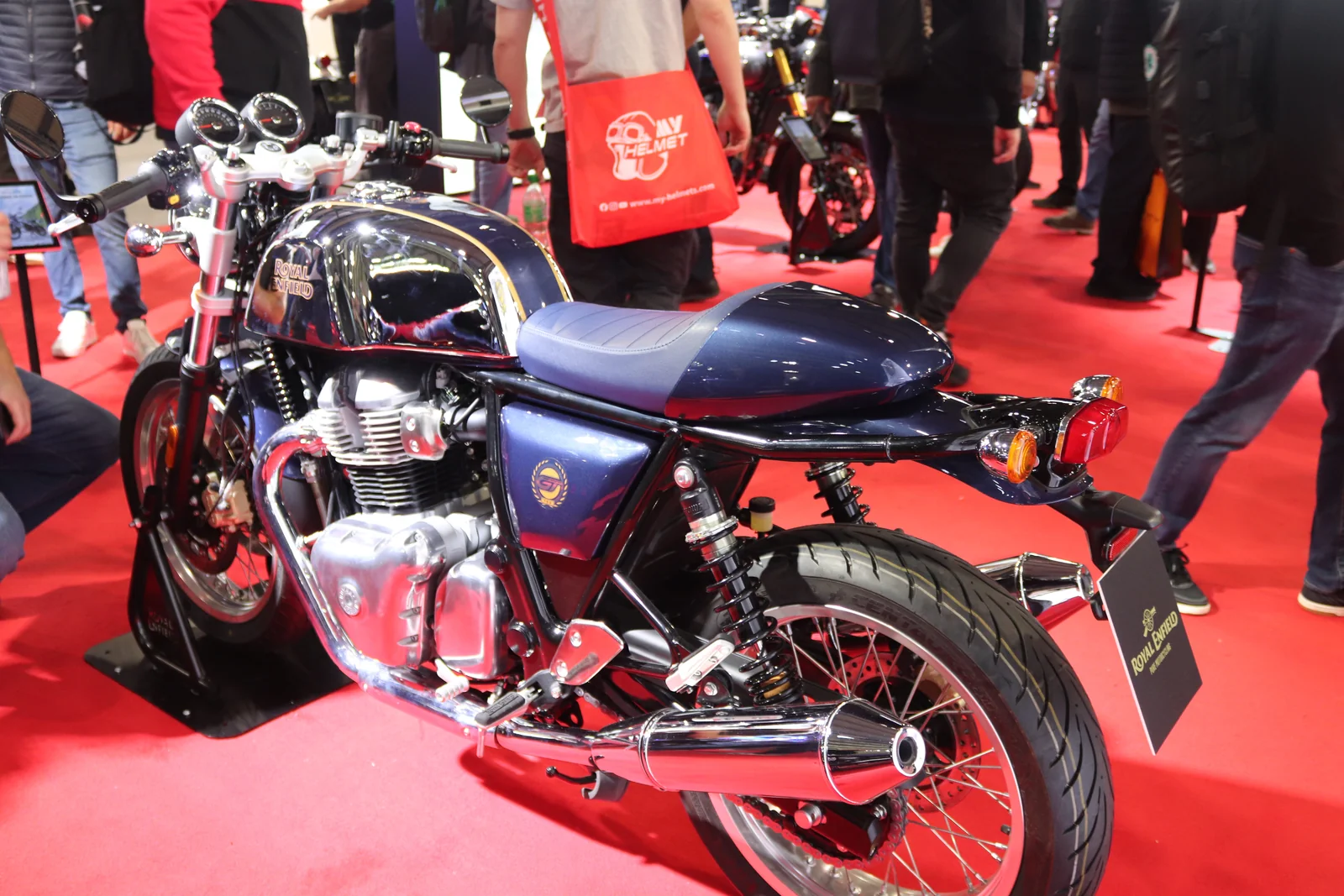
In the sixties Royal Enfield goes after young riders and the American market. The Continental GT arrives in 1964, a 250 with clip-ons, a red tank and a flyscreen straight from the factory: a café racer ready for lads on their first licence. For the United States there is the Interceptor, a 736cc twin.
It is not enough. Like Triumph, BSA and Norton, Royal Enfield struggles against the Japanese and the decline of British industry. The Redditch works close in 1967 and the last Interceptors are built at Bradford-on-Avon, in a plant set up inside an old stone quarry. British production ends in 1970.
A second life in India
By then the brand had already sailed for India. In the early fifties the Indian Army picks the 350 Bullet for border patrols, and in 1955 Redditch and its distributor Madras Motors set up Enfield India. From 1956 the Tiruvottiyur factory near Madras, now Chennai, builds the Bullet under licence, and within a few years makes every part of it locally.
For decades the Indian Bullet barely changes, and that is exactly what turns it into a legend: from 1977 it goes back to Britain and on to the rest of Europe, a brand-new old bike. In 1994 the Eicher group takes over the company, which becomes Royal Enfield Motors.
From the Classic to the twins
The revival comes with the new century. The UCE engine, with engine and gearbox in one unit, appears in 2008, the Classic in 2009 and the Himalayan in 2016. In 2017, at the Milan show, Royal Enfield unveils the 650 twin of the Interceptor and Continental GT, developed partly at its UK technical centre at Bruntingthorpe. In the 2024-25 financial year the company sold more than a million motorcycles for the first time.
EICMA 2026 brought the next step, a 743cc twin fitted to the Himalayan 750 and the new Continental GT 750. I saw it on the stand and you will find it on its own page here on the site: a name born in Redditch in 1964, back again and bigger sixty years later.