

- Torquey, long-lived engine if looked after
- Shaft drive: no chain to oil
- Comfortable riding position, good for touring
- Simple mechanics a good mechanic can handle
- The forefather of every Guzzi V-twin
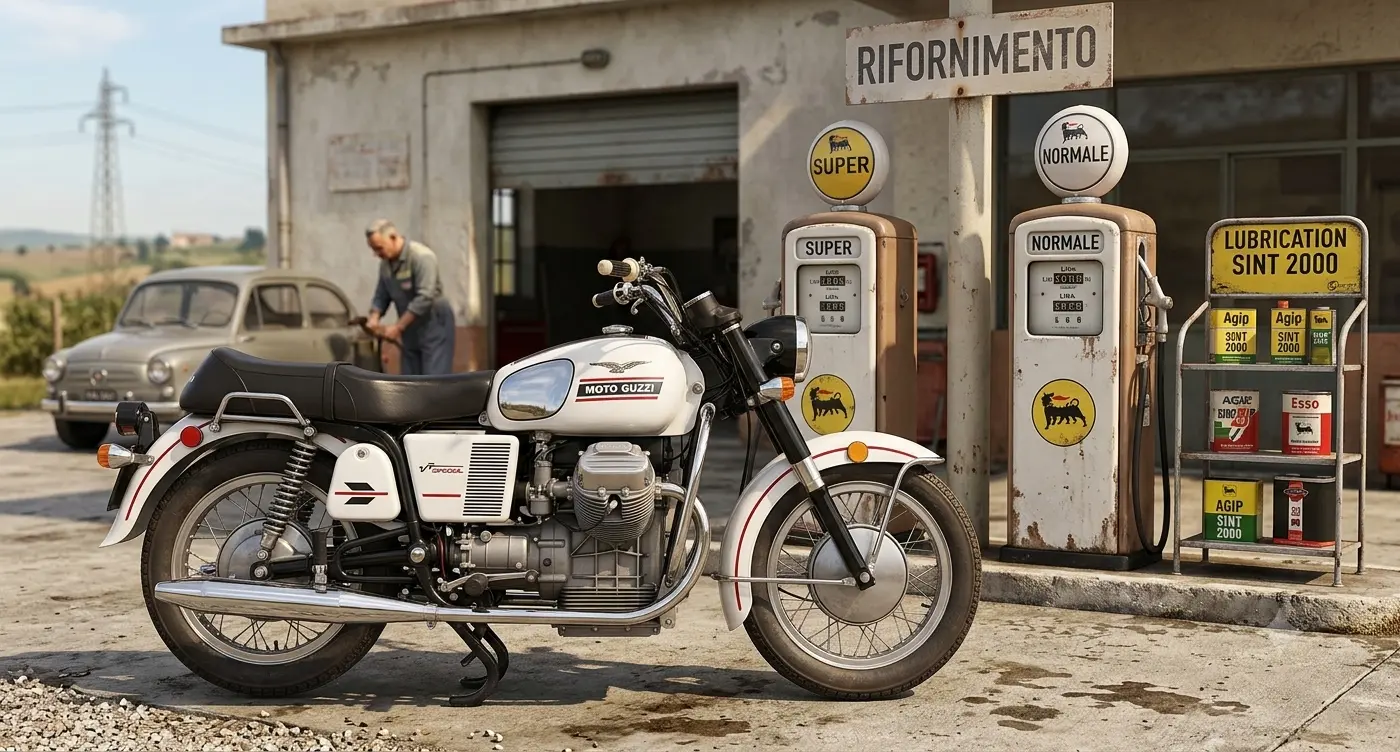
Classic Moto Guzzi V7 700 (1967-1969)
Moto Guzzi · 1967-1969 · 703.3cc
Description
Features and technical evolution
The Moto Guzzi V7 700 is where everything we now link to the Mandello del Lario factory began: the 90° V-twin mounted across the frame, with the cylinders poking out either side of the tank, and a drive shaft instead of a chain. Shown at the Milan Show in November 1965 and built in series from 1966-67, it was Italy's first post-war big bike.
The engine was designed by Giulio Cesare Carcano: 703cc, 80 mm bore and 70 mm stroke, pushrods and rockers, air cooling and two Dell'Orto carburettors. At the time Guzzi claimed 50 bhp (SAE) at 6,300 rpm; other sources quote around 40 bhp, measured with a different method. The gearbox has four speeds and the clutch is a dry, car-type unit.
The chassis is sturdy rather than sophisticated: a duplex cradle frame, telescopic fork, drum brakes front and rear and 18-inch wheels. It weighs around 230 kg and you feel it, above all when parking or pushing it around. Once rolling it is stable and relaxed, with plenty of low-down torque. It was built to eat up the miles, not to win the traffic-light drag race. Period road tests put it at around 170 km/h.
Its faults are those of a brand-new design. Early crankcases tended to weep oil, the engine vibrates more than you might expect and the gearchange is slow. The shaft drive also makes the rear end rise and squat as you open and close the throttle: after a few days you stop noticing.
Changes during the short life of the civilian model were minor: from 1968 Dell'Orto VHB carburettors replaced the SSI type, the tappet covers and seat were revised, and a white colour scheme appeared. In 1969 the 700 made way for the 757cc V7 Special, while the police and military versions stayed in production for many more years.
Historical context
By the mid-sixties motorcycling in Italy seemed to have hit a dead end: families were buying the Fiat 500 and 600, and the books at Mandello del Lario did not add up. Guzzi had quit racing in 1957 and needed a model that could get the factory going again.
The push came from men in uniform. The traffic police, the Carabinieri and the Corazzieri presidential guard needed a tough, comfortable bike that was cheap to run, to replace the old Falcone. Carcano later said the first spark came from the Corazzieri; other accounts tell of a traffic police tender won by the bike with the lowest maintenance costs. The two stories are not mutually exclusive.
The market that really mattered, though, was America. In the first full year of production just over 1,000 V7s were built, and more than 800 of them went to the United States. There it took on Harley-Davidson and the big British twins, with one extra selling point: a clean shaft drive with no chain to oil.
In Italy it cost 725,000 lire in 1967, serious money at the time, and civilian production stayed below 7,000 bikes.
Main versions
- V7 700 first series (1966-1967): the earliest bikes, many of them for the US, with 29 mm Dell'Orto SSI carburettors.
- V7 700 (1968-1969): Dell'Orto VHB carburettors, new tappet covers and seat; a white colour scheme joins the earlier ones.
- V7 Polizia Stradale: light green with white trim, fairing, panniers, radio and siren.
- V7 Carabinieri: the same equipment as the police bike, in dark blue.
- V7 Corazzieri: around forty bikes with special fittings for the President's escort.
- V7 Army and Guardia di Finanza: military livery. Versions for public bodies stayed in production far longer than the civilian model, with the last batches assembled in the mid-seventies.
From 1969 the story continues with the 757cc V7 Special (sold as the Ambassador in the US) and, in 1971, with the V7 Sport, which has its own page.
Trivia and anecdotes
In 1969 a faired V7, already fitted with the 757cc engine, set a string of world records at Monza, including 100 km at an average of over 218 km/h. In 1970 the Los Angeles Police Department chose the V7 for its fleet.
Many ex-army and ex-police V7s were sold to private owners years later, which is why some carry a first civilian registration from the eighties. The real build date comes from the certificate of origin issued by the Moto Guzzi archive.
And then there's mine. It's a 1968 V7 built for the Italian Army, originally green, which someone repainted black and silver. It turned up in an old farmhouse on the border between Lazio and Tuscany, where it had been left untouched and forgotten for more than 25 years: the last road tax disc on it dates from 1993. I bought it for next to nothing.
It's covered in rust, but the engine turns over, although it hasn't fired yet. I'm bringing it back to life with a body shop and their mechanic (or rather, I'm the one helping them) and photographing every step: once it's finished I'll write an article about it.
What it's worth today
Indicative prices, October 2026
A restored V7 700 with valid papers currently sells for around €7,000-7,500 in Italian classified ads (October 2026); prices refer to the Italian market. Original-paint first-series bikes go for considerably more: a 1967 V7 put up for auction in November 2025 was estimated at €11,000-13,000. According to enthusiasts, ex-army and ex-police bikes usually cost less than civilian ones, because so many were built.
Before buying one, check:
- oil leaks from the crankcase, sump and flywheel flange;
- the frame, especially where the factory added reinforcements;
- the gearbox: slow changes are normal, jumping out of gear or loud noises are not;
- oil pressure and the points ignition, against the figures in the manual;
- frame and engine numbers matching the documents and, for ex-military bikes, the certificate of origin.
Strengths and weaknesses
- Heavy, especially at walking pace
- Drum brakes that need planning ahead
- Slow gearchange
- Vibration and shaft-drive reaction at the rear
Guzzi fans who want the bike that started it all. Riders looking for a classic to tour on at an easy pace, two-up too, who don't mind getting their hands dirty or have a trusted mechanic who knows the old Guzzi twins.
Anyone after modern performance or brakes, daily commuting in heavy traffic, or who struggles with weight at standstill. Also anyone hoping to spend little straight away: a proper restoration often costs more than the price gap with a bike that is already sorted.
Unless you have a mechanic who knows Guzzis, a restored bike with invoices for the work is a safer bet than a project. Try it from cold, check the original plates and papers and ask whether it is registered with ASI or the FMI historic register. Ex-military bikes need the certificate of origin.
- Oil weeping from early crankcases
- Crankcase cracks caused by vibration
- Weak spots in the frame, reinforced by the factory
- Rear wheel prone to locking on hard downshifts
- Noisy, slow gearbox
The mechanics are simple: regular oil changes, valve clearances, points and timing, balanced carburettors. Always use the workshop manual for intervals, clearances and torque settings: figures from memory are easy to get wrong. If the bike has been laid up for years, have the oil, fuel system and wiring checked before you start it.
Good for the mechanical side: many parts are available from Guzzi V-twin specialists and the owners' network is large. Parts specific to the first series, such as badges, instruments, seat and original bodywork, are harder to find and more expensive.
€7,000-7,500 restored; original first series €11,000-13,000 (Oct 2026, Italy)
For the bike that founded a dynasty, prices are still reasonable. The real risk is restoration: on a V7 that needs work, costs climb quickly and often exceed the gap with a bike that is already sorted, so do the sums before you buy.
The V7 700 is heavy, brakes like a sixties bike and asks for patience with the gearbox. In return you get a torquey engine, relaxed riding and the satisfaction of owning the first Guzzi V-twin, the one every other model grew from. A classic to enjoy at an easy pace.
Accessories
Sixties-style leather panniers
Luggage
They suit the V7 and make touring easier. Choose racks that bolt to existing mounting points without drilling the frame, and leather that has been treated against water, or it will lose its shape in the first downpour.
Police-style fairing or screen
Comfort
It recalls the police versions and keeps wind off your chest on the motorway. Pick mounts that fit the 700's handlebar and fork, and a height that does not leave you looking through the screen.
Tubular engine guards
Protection
They protect the protruding cylinder heads in a tip-over, which happens with this much weight. Look for guards that do not touch the crankcase and leave the rocker covers easy to reach.
Breathable bike cover
Maintenance
Useful for a bike that spends long spells in the garage: a breathable cover avoids condensation and rust, which plastic sheeting encourages. A soft inner lining stops it scratching the tank.
Battery maintenance charger
Maintenance
It keeps the battery healthy over winter and after long breaks. Choose one compatible with the battery type fitted and the voltage of the electrical system, as given in the bike's manual.