

BMW
Germany · Bikes since 1923
A history spanning 103 years
BMW Motorrad: the boxer, the shaft drive and a hundred years of German consistency
Some marques change their skin with every generation, and then there is BMW, which since 1923 has been building motorcycles around an idea it has never abandoned: two opposed cylinders sticking out either side of the engine, shaft drive, and a firm belief that a motorcycle should be able to take you a long way. It is not a romantic approach, it is an engineer’s approach. That is why a BMW from a hundred years ago can still be recognised in one built today: just look at a boxer in profile.
From aero engines to the R32
Bayerische Motoren Werke was born in 1916-17 in Munich as a maker of aircraft engines, and its blue and white logo takes the colours of Bavaria. The picture of a propeller spinning against the sky comes from a 1929 advertisement, but it works so well that everybody repeats it now. After the war the treaties banned aero-engine production and BMW got by on what it knew: industrial engines, railway brakes, and then two wheels. In 1923 Max Friz, already a designer of aircraft engines, drew the R32, shown at the Berlin motor show: a 494 cc boxer twin mounted transversely, a three-speed gearbox, shaft final drive. With around 8.5 horsepower it managed 95 km/h (about 60 mph), but what mattered was the concept, not the numbers. The R32 already had everything: no chain to oil, compact dimensions, almost perfect balance.
Between the wars: innovations and records
The boxer became a trade. In 1935 the R12 and R17 introduced the hydraulically damped telescopic fork as standard, now a universal feature but then a genuine novelty. In 1937 Ernst Henne took a supercharged BMW to 279.5 km/h (about 174 mph), and two years later Georg Meier won the Senior Tourist Trophy. In the war years the military BMWs with driven-wheel sidecars (the R75) showed that the mechanics would stand up to anything.
The boom years: R50, R60 and R69 S
After the war production restarted in Munich, and the /2 series of the 1950s (R50, R60, R69 and then the R69 S) is for many the "right" boxer: few horsepower, proverbial reliability, and the good old Earles front end (the leading-link fork typical of BMWs built for sidecar use). These were bikes for people who wanted to cover the miles with few problems. In 1969, as the Japanese began to make themselves heard, BMW moved production to Berlin-Spandau, where it would remain for decades.
1969: the /5 series
The R50/5, R60/5 and R75/5 of 1969 marked a turning point: a new frame, a conventional telescopic fork, electric start, and sober, modern looks. It was the bike with which BMW repositioned itself in the age of the Japanese. Next came the big touring boxers, such as the R90S of 1973, with the small fairing designed by Hans Muth and the smoked orange or silver paint that makes it instantly recognisable, and the R100RS of 1976, which brought the wind-tunnel-tested fairing to the general public. In 1980 the R80 G/S invented the big trail-bike genre: between 1981 and 1985 BMW won four editions of the Paris-Dakar, with Hubert Auriol and Gaston Rahier.
K series and oilhead: the technology changes
In the 1980s BMW took a different road with the K series, liquid-cooled fours and triples nicknamed the "flying brick" because of the engine lying on its side. The boxers did not stop, though. In 1987 the Paralever system on the R80 GS removed the shaft-drive torque reaction, and in 1993 the R1100 RS introduced Telelever front suspension and the "oilhead" boxers, with oil-cooled cylinder heads, which would take the marque to the top of the touring market.
Heritage and Modern Classic
The nod to the past came with the R nineT, unveiled in 2013 for the marque’s ninetieth birthday and on sale from 2014: an air and oil-cooled boxer with top-quality components and looks that sit somewhere between café racer and scrambler. In 2020 the R 18 took the marque into big cruiser territory, with an 1,802 cc engine that looks as if it came off a 1930s drawing. It is not nostalgia for show: BMW has simply discovered that the shape of the boxer has never really gone out of fashion in a century.
A vintage BMW: what to look at
The air-cooled boxer BMWs (the "airheads", built until the mid-1990s) are among the most affordable classic bikes to keep going. You learn to set the valve clearances with two feeler gauges and an afternoon’s patience, and you learn to do the servicing without going mad. Parts are easy to find, and there is a huge community of enthusiasts and specialists. The points to check: the drive-shaft joints and bearings, the condition of the seals, the clutch, and of course that the frame and engine numbers tally. An R 80/7 or an R 100 from the middle of the range is one of the few ways into the vintage world without spending a fortune.
BMW models
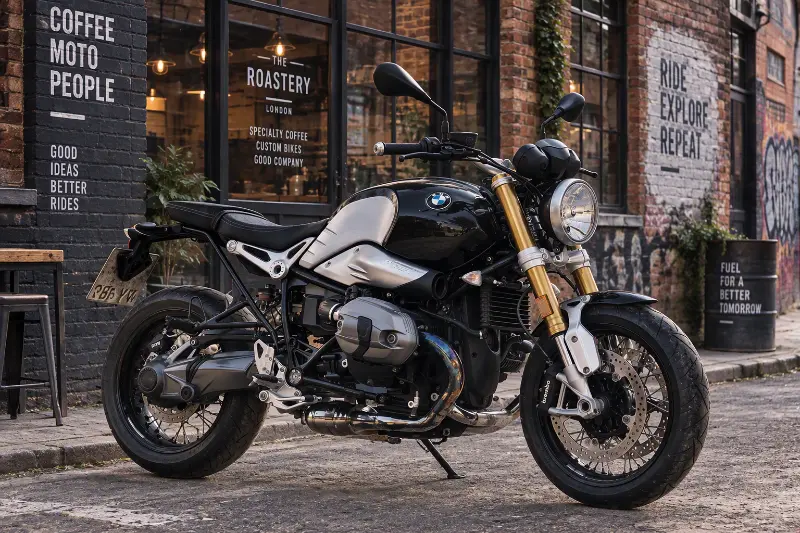
BMW R nineT
The BMW R nineT, unveiled in 2013 for BMW Motorrad's ninetieth anniversary, is Munich's answer to the demand for modern classicism: an air-cooled boxer, a no-frills roadster and an identity that…
Read the full profile →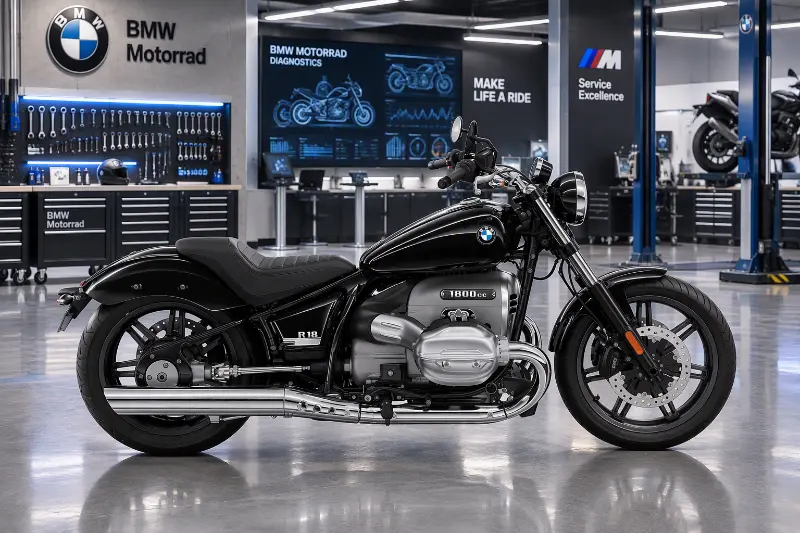
BMW R18
The BMW R18, arriving in 2020, is Munich's most extreme answer to the appeal of heritage motorcycles: a 1,802 cc Big Boxer — the largest engine ever fitted to a production BMW — dressed in 1930s…
Read the full profile →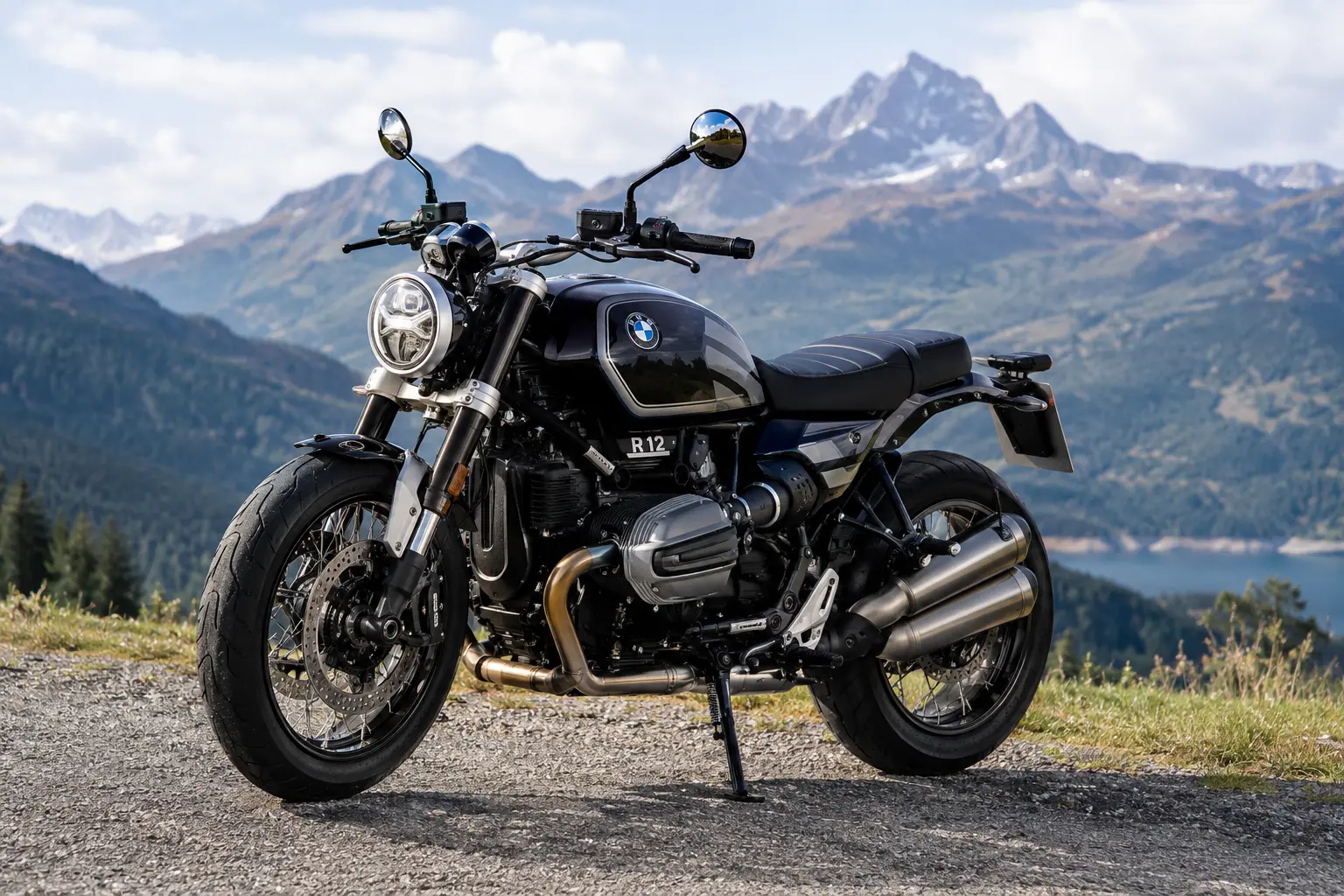
BMW R 12
The BMW R 12 is a modern classic that combines the character of the BMW boxer twin with a contemporary chassis and a Classic Cruiser layout. The teardrop-shaped steel tank, low seat, wide handlebars…
Read the full profile →