
Triumph Bonneville 865 EFI: Strengths, Weaknesses and Worthwhile Upgrades
The Bonneville 865 EFI has plenty of character, but also a few rough edges: snatchy throttle response, soft suspension and blued exhaust headers. Here is how to improve it sensibly.
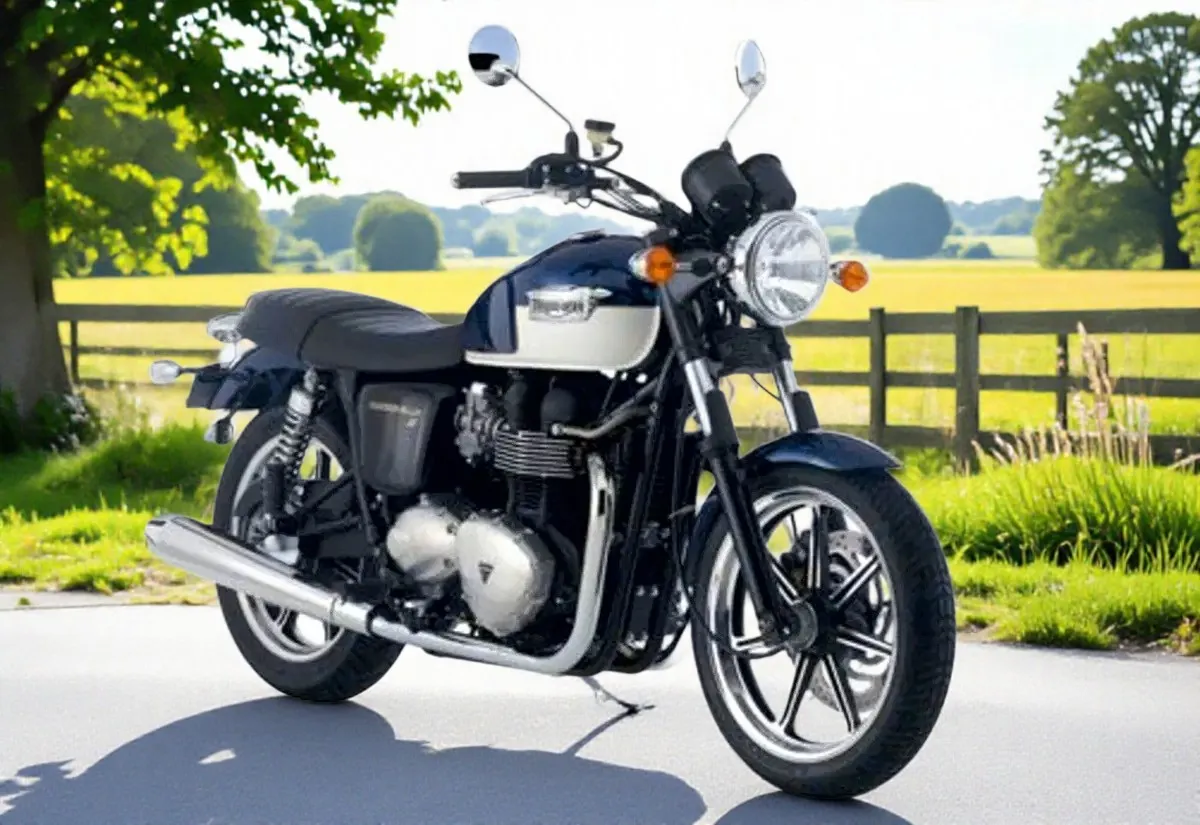
There are motorbikes you buy because you've done loads of comparisons, looked at technical specifications, fuel consumption, horsepower and prices. And then there are those that you simply like. The 【entity-Triumph¦canonical_name=Triumph】 Bonneville 865 EFI, for me, is one of those.
You look at it and find nothing over the top: an air-cooled parallel-twin engine, two cylinders, two wheels, the classic faux carburettors that actually conceal the electronic fuel injection, and a design that, even today, manages to stand out without needing to be flashy.
It’s a motorbike with a distinct personality. And perhaps that’s precisely why it doesn’t need to be perfect.
The Bonneville has a few flaws, some characteristics you get to know over time and others that you naturally want to improve. The great thing is that you don’t need to completely overhaul it. With a few well-executed modifications, it can become a much more enjoyable bike to ride, without losing what makes it a Bonneville.
After riding it for a while, especially in traffic and on busier roads, the areas where you naturally feel the urge to make changes are always more or less the same: throttle response, suspension and those exhaust manifolds that sooner or later start to turn blue.
Let’s look at them one by one, without making a big deal of it and, above all, without the usual pub myths.
Why the Bonneville 865 EFI is still so popular
The first thing I like about the Bonneville is precisely its balance. The 865 engine isn’t out to prove anything to anyone. It isn’t designed to push the rev limit, and it doesn’t need to be revved hard to be satisfying. It has plenty of torque, runs smoothly at mid-range revs and has that full, slightly mechanical sound that makes you want to stay in gear even when you could easily change. Between 2,500 and 5,000 revs is probably where it’s at its best.
It handles well in traffic, is a pleasure on country roads, and when you come across a lovely stretch of bends, it never makes you feel rushed. It lets you ride. And that is precisely one of the reasons why, even today, the Bonneville is a motorbike that makes sense.
It is a Modern Classic through and through, not just in appearance.
The riding position is comfortable, the mechanics are simple enough to be understood even by those who like to get their hands dirty with their bike and, above all, there’s a whole world of accessories and spare parts that allow you to customise it practically however you like.
You can leave it stock, turn it into a café racer, or simply improve it where needed, without turning it into a different bike.
The on/off effect of the throttle
It’s probably one of the first things you notice when you start riding a Bonneville EFI seriously, especially if you’re coming from a carburettor-equipped bike.
At low speeds, perhaps in first or second gear, when you close the throttle completely and then gently open it again, you might feel a rather abrupt response.
That slight jerk, which can become annoying in traffic, on hairpin bends or when riding with just a touch of throttle, is the classic on/off effect.
This doesn’t mean the bike has a problem. It’s the result of how the fuel injection and electronic engine management have been set up – partly in line with emissions regulations – and this is precisely where you need to avoid one of the most common modifications: simply fitting two open-exhausts in the belief that the bike will automatically perform better.
It doesn’t always work that way. If you change the way the engine breathes and exhausts, you also need to consider what happens to the electronic control system.
The approach I consider most sensible is therefore quite simple: high-quality exhausts, freer intake, and then a properly tuned map.
Not a generic map downloaded from the internet and installed because “it works for everything”, but a bespoke solution: Triumph provides ready-made, optimised maps for every configuration, available completely free of charge.
An original map developed by the manufacturer takes the bike’s actual configuration into account. That’s where you really feel the difference. The maps can be downloaded from the TuneECU OEM Map List.
The update can also be carried out independently, following the numerous guides available online, but to avoid causing problems and to ensure maximum engine reliability, it is wiser to rely on official or authorised 【entity-Triumph¦canonical_name=Triumph】 workshops.
The benefits of proper mapping lie not so much in the stated horsepower – which, on a Bonneville, is certainly not the most important thing – but in the way the engine responds: the throttle action becomes smoother, the transition from closed to open is less abrupt, and the engine seems to follow your right hand’s movements more closely.
Ultimately, it’s a modification that you appreciate far more when riding around every day than when looking at a graph on a test bench.
The suspension: comfortable, yes, but perhaps a little too much so
Here, the Bonneville once again demonstrates its philosophy. It was designed to be enjoyable, smooth and comfortable. Not for chasing lap times on mountain passes. However, when you start riding it a bit more spiritedly, the original front fork and rear shock absorbers can quite quickly reveal their limitations.
The front fork tends to compress quite a lot under braking, and the rear, especially on rough roads, can feel a bit too soft. With a passenger on board or if the rider weighs a few kilos more, this becomes even more noticeable.
The interesting thing is that there’s no need to turn the Bonneville into a stiff, uncomfortable bike. At the front, simply fitting progressive springs can make a significant difference. The front fork becomes firmer, especially when braking, but still retains that level of comfort which, in my opinion, a Bonneville should always have.
Of course, the fork oil must also be chosen carefully, taking into account the rider’s weight and the type of use. It’s one of those jobs where it’s worth listening to the advice of someone who really understands suspension.
At the rear, the difference is even more pronounced. Two good aftermarket shock absorbers can significantly alter the bike’s handling. This doesn’t necessarily mean spending a fortune. Rather than the brand or the price, what matters is having a component suited to your weight and riding style, preferably adjustable for preload and, better still, rebound as well.
The Bonneville won’t become a Street Triple, and frankly, it shouldn’t. It simply needs to become a Bonneville that handles better, remains more composed in corners and gives you a bit more confidence when you start demanding a bit more from the chassis.
Those exhaust manifolds that turn blue
Sooner or later it happens. You look at the bike and realise that the exhaust manifolds, especially near the cylinder head, have started to take on that characteristic bluish colour.
The first thing to know is that it’s not dirt. It’s the result of heat on the metal and isn’t something that a polishing paste can fix permanently.
You can polish them, improve their appearance and make them look good again for a while. Then you start the bike, ride a few kilometres, and the blue comes back.
On the Bonneville EFI, the SAI system also comes into play – that is, the injection of secondary air into the exhaust. Essentially, fresh air is introduced into the exhaust gases to promote the oxidation of combustion residues and help meet emissions limits.
It’s a system linked to type-approval and anti-pollution regulations, not something fitted to improve performance. For this reason, removing the SAI is a modification that many owners consider, especially when they are already making changes to the exhaust, intake and mapping.
But here I must make an important clarification. It is not a modification to be undertaken lightly.
Modifying anti-pollution devices can render the motorbike non-compliant with type-approval for road use. Before modifying anything, it is therefore advisable to familiarise yourself with the applicable regulations, particularly regarding MOT testing and road use.
From a technical point of view, however, the work must be carried out in conjunction with the bike’s electronic management system. Making modifications in isolation from one another is the surest way to end up with a Bonneville that may be louder, but does not necessarily perform better.
The control that isn’t quite a choke
A small detail that often causes confusion: on the Bonneville EFI, the lever near the dummy carburettors is not a choke in the traditional sense that we were familiar with on carburettor-equipped motorbikes.
It is a fast idle control, i.e. it serves to keep the engine running at a slightly higher rev during cold starts.
Personally, the best thing is to use it to start the engine without fiddling with the throttle, and then gradually reduce it once the engine starts to run smoothly.
There’s no need for any strange rituals, and above all, it isn’t true that the ECU ‘learns’ something magical in a matter of seconds. The electronic control system does its job. We simply need to provide it with the right conditions to do so.
The little things that make all the difference
The Bonneville isn’t a complicated motorbike, but that’s precisely why routine maintenance is so important.
You can really tell when a motorbike is well looked after.
Spark plugs in good condition, a clean air filter, correctly synchronised throttle bodies and checked valve clearances make a bigger difference than you might think.
And then there are those trivial things that are often overlooked. The chain, for example. Incorrect tension – especially if it’s too tight – can completely change the feel you get when opening and closing the throttle.
The same goes for the tyres.
Correct tyre pressures and tyres in good condition have a huge impact on the bike’s handling.
Furthermore, after modifying the intake, exhaust or ECU, it is important to carry out the adaptation procedure required by the installed configuration correctly and to follow the tuner’s instructions.
These are details. But it is often the details that make the difference between a simply modified motorbike and one that has been tuned.
The most important thing: don’t distort its character
In my opinion, this is the crux of the matter.
The Triumph Bonneville 865 EFI doesn’t need to be transformed into something it isn’t. It needs to be understood.
The engine has its own character. The chassis has its own philosophy. The riding position has its own rationale.
If we want to improve it, we can. But without losing its identity. Exhausts and intake, followed by proper mapping, can make the engine more enjoyable. Good suspension tuning can make it much more precise. Careful maintenance can restore that smoothness it may have lost over the years. And ultimately, that’s what I love about the Bonneville.
You don’t need 120 cavalli. You don’t need to chase absolute performance. When the bike’s in good shape, you hop on, start it up, and you simply feel like setting off. Perhaps without a specific destination. And that’s probably the real reason why the Bonneville still makes sense today.
It’s not a perfect motorbike. It’s a motorbike with character, and perhaps that’s precisely what makes the difference.
Note: modifications to the exhaust, intake, ECU and emissions control systems must be carried out by qualified personnel. Some modifications may alter the type-approval specifications, emissions and the bike’s road legality. It is always advisable to check the applicable regulations before proceeding.