
Moto Guzzi V7: History, Appeal and a Buyer’s Guide
The Moto Guzzi V7 is one of the most appealing modern classic motorcycles. From its history to modern versions, here is what to know before buying used and how to care for one.
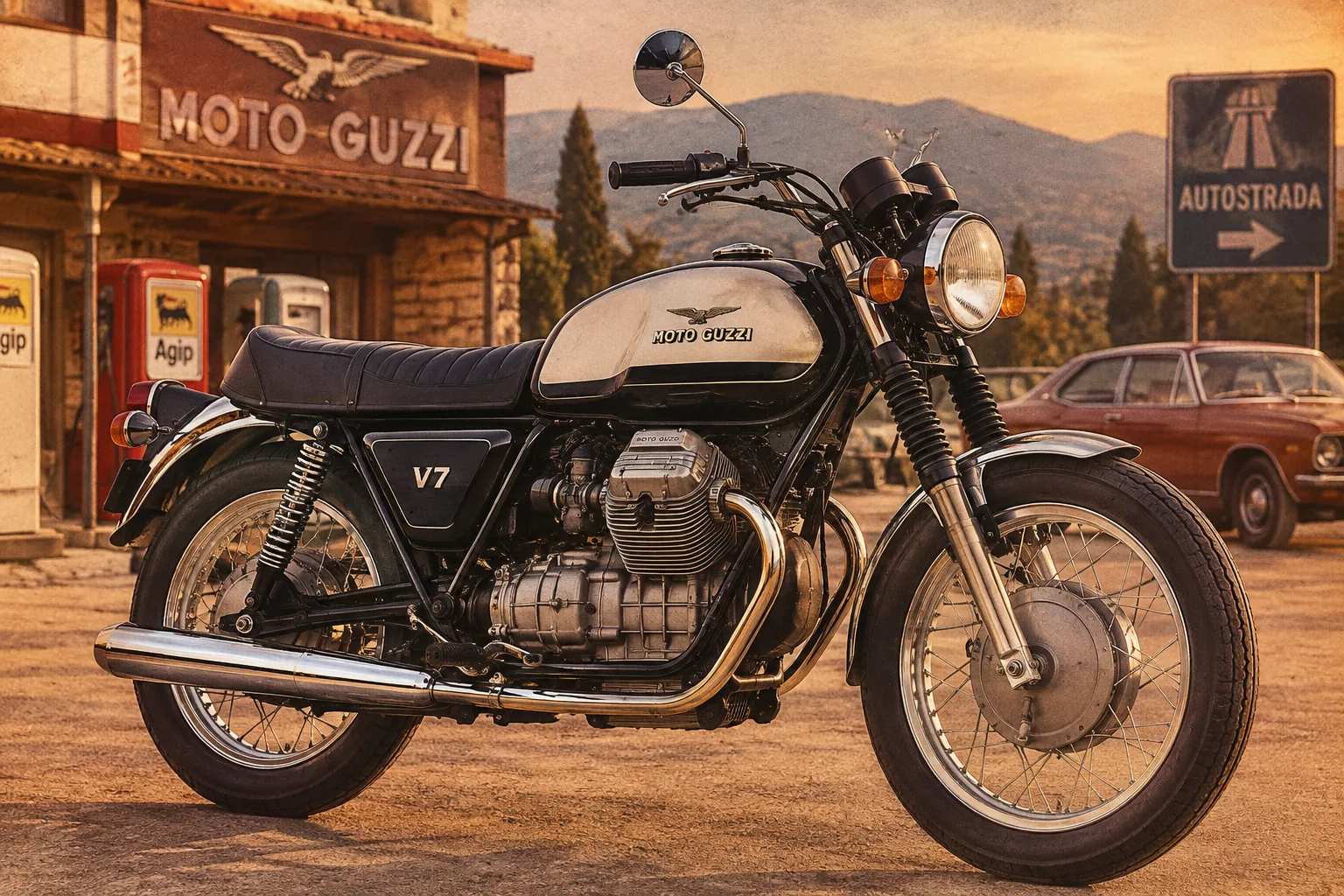
There are motorbikes you buy with your head, and others which, even before you start the engine, have already won something over inside you. The Moto Guzzi V7, in my opinion, definitely belongs to the second category.
You look at it and it doesn’t seem to be in any hurry. A substantial fuel tank, two cylinders protruding from the sides, traditional wheels and that transverse engine that needs no introduction. Then you start it up and realise that behind that vintage look lies a modern motorbike, suitable for everyday use.
And this is precisely where the appeal of Modern Classics lies: they seem to tell the story of the past, but are made to live in the present.
A story that began in 1967
The history of the V7 did not begin with today’s Modern Classics. The first Moto Guzzi V7 arrived in 1967 and was fitted with the 703 cc 90° V-twin engine designed by Giulio Cesare Carcano. That longitudinally mounted engine would go on to become one of the most recognisable symbols of the Mandello-based manufacturer.
In 1971, the V7 Sport arrived – a motorbike destined to become a true icon. From that lineage would emerge further significant developments in Moto Guzzi’s production range.
What’s interesting is that the name V7 hasn’t simply remained a part of history. After many years, it has been revived in a modern guise, retaining some of the elements that made the Guzzi tradition great.
The rebirth of the V7
The new era began with the V7 Classic, unveiled in late 2007 and on sale from 2008. It was a shrewd move: rather than trying to erase the past, Moto Guzzi used it as a starting point.
Next came the V7 II, the V7 III and, subsequently, the new generation with an 850 cc engine. Over the years, the range has branched out into various versions, from the most basic Stone to the more elegant Special, right through to the sportier models.
The result is a motorbike that has managed to become a Modern Classic without simply being an old bike disguised as a new one.
But what really makes a V7 a V7?
This is where we get to the crux of the matter. A V7 isn’t just recognisable by the logo on the fuel tank.
At its heart lies that distinctive 90° transverse V-twin engine, paired with a cardan shaft drive. It’s a technical solution that makes the Guzzi instantly recognisable even to those who aren’t great experts.
The V7 wasn’t designed to chase records at the traffic lights. Its strength lies elsewhere: in offering a pleasant, authentic ride that’s lively enough to be enjoyable on everyday roads and on trips out of town.
The latest V7 850s have also taken a step forward in terms of technology. The current range features an 853 cc engine and, in the most recent versions, offers electronic systems such as ride-by-wire, riding modes and traction control. But the bike’s character remains the same as ever.
Why it appeals to young people and boomers
It’s interesting to observe who stops to look at a V7.
There are young people who look at it because it’s different from the naked bikes and sports bikes they usually see. It doesn’t need to be aggressive to attract attention. It has personality.
And then there’s us, the boomers. For many of us, those lines evoke a time when motorbikes were mechanical objects, with analogue instruments, chrome, metal and plenty of personality. We may never have owned a Guzzi, but we’ve seen plenty of them.
And this is one of the reasons why Modern Classics work so well: they speak to different generations using different languages.
A young rider might choose a V7 because he wants something original. A more seasoned motorcyclist might choose it because it reminds him of what made him fall in love with motorbikes so many years ago.
Ultimately, the result is the same: getting on the bike and feeling the urge to set off.
Second-hand Moto Guzzi V7: what to check before buying
If you’re thinking of buying a second-hand Moto Guzzi V7, don’t let yourself be won over solely by the colour or the mileage.
First and foremost, I’d check the paperwork and the service history. A bike with a few more kilometres on the clock but which has been properly looked after may be a better buy than one with very few kilometres and an unclear history.
Then check:
- condition and date of the tyres;
- brakes and brake discs;
- front fork and shock absorbers;
- any oil leaks;
- condition of the driveshaft;
- battery and electrical system;
- cold start;
- unusual engine noises;
- any aftermarket modifications;
- servicing records and invoices for repairs.
And above all, test ride the motorbike.
A V7 should feel mechanically sound. If something seems off, don’t convince yourself that ‘it must be normal’. It’s better to miss out on a bargain than to buy a problem.
Which V7 should you choose?
There is no single ‘best’ V7. There is the one best suited to what you want to do.
The V7 Classic may appeal to those looking for a simple ‘Modern Classic’ with a design deeply rooted in tradition. The V7 II represents a significant evolution. The V7 III is one of the generations that today offers an attractive balance between second-hand price, equipment and charm.
The latest V7 850 models, on the other hand, are the choice for those who want a more modern bike, with a larger engine capacity and the latest technological features.
Between the Stone and the Special, the choice is primarily a matter of taste and intended use. The Stone focuses on a more minimalist look, whilst the Special offers a more classic interpretation of the V7 concept.
How much does a second-hand V7 cost?
Here, one must be wary of treating figures as absolute truths.
Market prices available in September 2026 show a very wide range for the V7 range. Moto.it indicates, as a general guide, private sale prices ranging from around 2,400 euros for the earliest V7s up to over 7,000 euros for the most recent models.
But the real market tells a more interesting story: a V7 III can currently be found for around €4,000–6,000 depending on the year, version, mileage and condition, whilst particularly attractive or low-mileage models can cost significantly more.
That’s why I would never buy a V7 simply because it ‘is cheap’. I would buy the one with the best history.
How to look after a V7
A Modern Classic mustn’t become a living-room ornament.
The best thing you can do is use it and maintain it properly. Regular servicing, oil and filter changes on schedule, tyres in good condition and periodic checks are far more important than obsessive washing.
The shaft drive eliminates the maintenance typically associated with a chain, but that doesn’t mean you can neglect the drivetrain. Brakes, suspension, the battery and the electrical system also deserve attention.
And then there’s a simple rule that applies to any motorbike: if you keep it clean, check it often and learn to listen to it, it’s much easier to spot a problem before it becomes serious.
Is this really the right motorbike for you?
If you’re looking for sports bike-style acceleration, extreme performance and superbike-level electronics, the V7 is probably not the answer.
If, on the other hand, you’re looking for a motorbike with character, one that’s easy to ride, looks good even when parked, and can take you from your daily commute to a Sunday ride, then it’s a different story.
The V7 makes the most sense for those who don’t measure the pleasure of riding a motorbike solely in terms of horsepower.
And this is perhaps the reason why it continues to be successful.
My conclusion
Personally, I find the success of the V7 interesting precisely because it shows that in the world of motorbikes there is still room for something simple.
Not simple in the sense of basic, but simple in the sense of straightforward. A motorbike you can look at, listen to and ride without feeling as though there’s a computer between you and the engine doing everything.
Perhaps this is what so many young motorcyclists are looking for when they choose a Modern Classic. And perhaps it’s also what we boomers are looking for when we return to the garage after so many years.
Not necessarily the most powerful motorbike.
Not necessarily the most high-tech one.
But the one that, when you turn the key, still makes you want to set off.
And a Moto Guzzi V7, from this point of view, still has plenty to offer.