

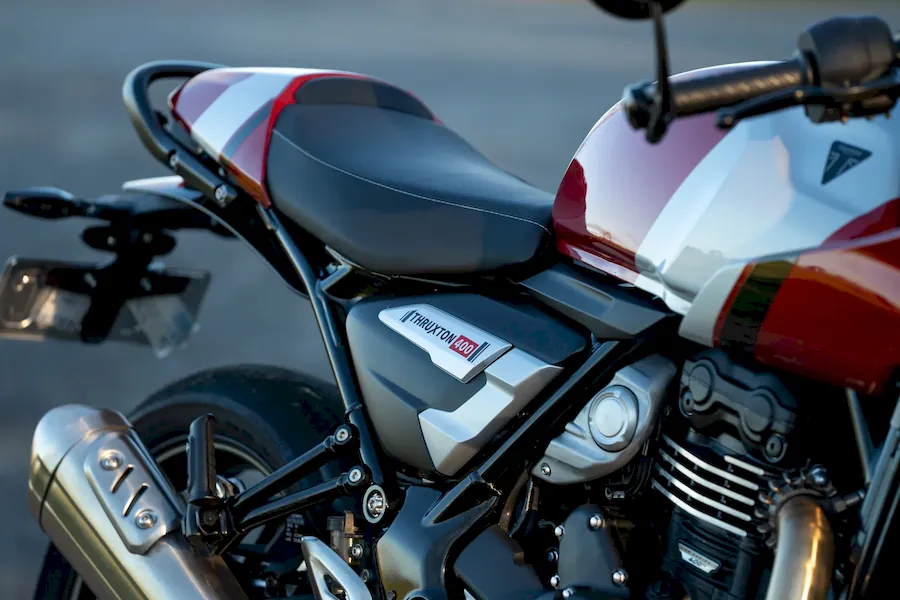
Triumph Thruxton 400, the 400cc café racer
Triumph · 2025-present (Europe from 2026) · 398cc
Description
Features and technical evolution
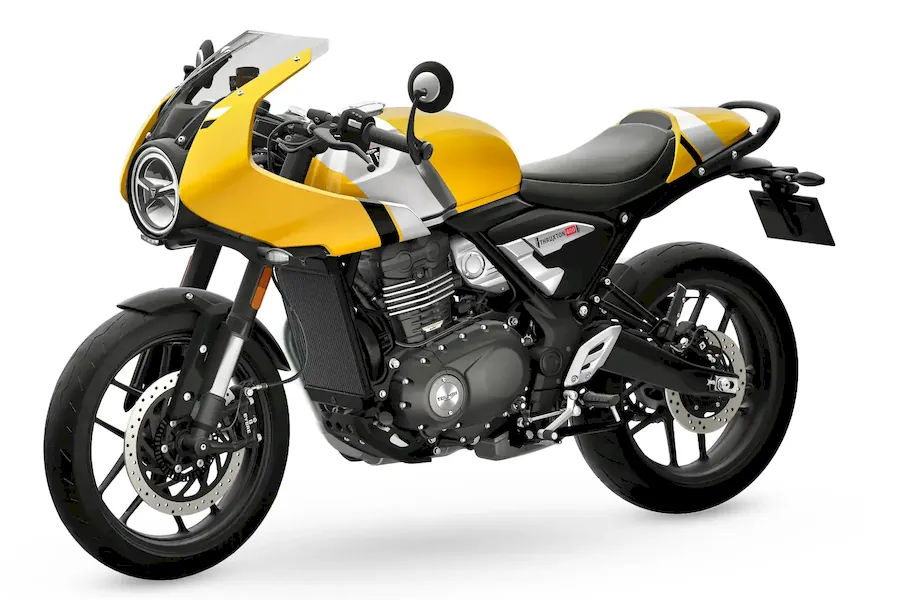
The Triumph Thruxton 400 is the café racer of the 400 family: the Speed's 398cc single, retuned to make 42 PS at 9,000 rpm, with clip-ons, a round half-fairing and a single-seat cowl. In European trim it weighs 176kg ready to ride, has a 795mm seat and is A2 licence-friendly.
Looks and riding position
The fairing is fixed to the frame, not the bars, so the headlight's weight isn't carried by the steering. The 13-litre tank is more sculpted than the Speed's, there's a colour-matched cowl over the pillion seat, and the mirrors sit on the bar ends. Every test agrees on the finish: neat, the kind you'd expect on a pricier bike.
The riding position is what you'd expect from a café racer. The clip-ons are 246mm lower and 40mm narrower than the Speed's handlebar, and the pegs are further back and higher. Your upper body tips forward and the weight goes onto your wrists: tiring in town, just right on a twisty road.
The engine
The single has four valves, twin overhead cams and liquid cooling. Compared with the Speed, the tune changes: power rises to 42 PS at 9,000 rpm, about 5% more, while torque stays at 37.5 Nm but peaks at 7,500 rpm instead of 6,500. Triumph says 80% of the torque is already there at 3,000 rpm.
Road tests describe an engine that revs more freely than its siblings' and stays easy to manage low down. On the Indian version Autocar India reports a rear sprocket with two fewer teeth, so slightly taller gearing. Above 7,000 rpm vibration comes through the pegs and levers, and on the motorway the mirrors shake a fair bit.
Chassis and brakes
Tubular steel frame, cast aluminium swingarm, a 43mm upside-down fork with 135mm of travel and a remote-reservoir shock, adjustable for preload only, with 130mm. The wheels are 17-inch, with Pirelli Diablo Rosso IV in 110/70 and 150/60 on European bikes. At 101.5mm its trail is the shortest of the 400s, Bennetts says, and inSella found it quick to change direction and stable at speed.
Up front there's a 300mm disc with a four-piston radial caliper, at the back a 230mm disc. ABS and switchable traction control are standard. Opinions on the front brake differ: inSella found it strong and easy to modulate, while MCN and Rider Magazine complain of a soft initial bite and little feel at the lever.
Historical context
At Triumph the Thruxton name has meant café racer for twenty years: the Thruxton 900 of 2004 and the Thruxton 1200 of 2016, which bowed out with the Final Edition announced at the end of 2023. The 400 carries the name onto a very different base, the single developed with Bajaj Auto and built in India, and puts it on a bike you can ride at eighteen.
It made its debut in India on 6 August 2025 at 2.74 lakh rupees, just above the Speed 400. A few days later Motorrad reported that Triumph had no plans to sell it in Germany and Austria because demand was too low. That changed: on 16 December 2025 Triumph unveiled the European version alongside the Tracker 400, and the Thruxton 400 reached Italy in April 2026 at €6,595.
Small-capacity café racers are few and far between. In India the rival most often mentioned is the Royal Enfield Continental GT 650, which costs around 50,000 rupees more. In Europe the comparison is mostly within the family: in the UK the Thruxton costs £750 more than the Speed 400 and £250 more than the Tracker 400, and MCN reckons the difference is almost all style.
Main versions
- Thruxton 400, Indian version (August 2025): 398cc, 42 PS at 9,000 rpm and 37.5 Nm at 7,500, 183kg ready to ride according to Autocar India, Indian-made tyres. According to Motorrad, frame, suspension, brakes and tyre sizes follow the Speed 400.
- Thruxton 400, European version (2026 model year, in Italy from April 2026): same claimed power, 176kg ready to ride, Pirelli Diablo Rosso IV, fork with 135mm of travel. Four colours: Phantom Black, Carnival Red, Pearl Metallic White and Metallic Racing Yellow, paired with silver or grey.
- The sources we checked report no special editions. Autocar India lists a quickshifter among the optional accessories.
Trivia and anecdotes
Thruxton is a circuit in Hampshire, in the south of England, built on an old RAF airfield. It hosted the Thruxton 500, an endurance race for production bikes, and to contest it Triumph built a small run of racing Bonnevilles in 1964-65, called Thruxtons. From those bikes the name passed to Hinckley's café racers.
Autocar India timed it and rates it the quickest of the Triumph 400s: 6.62 seconds from 0 to 100 km/h, recorded on a damp road during the monsoon with the traction control switched off.
MCN's verdict is the most entertaining: the Thruxton 400 doesn't go like a proper factory-built A2 sports bike, but it does a convincing impression of one.
What to check before buying one
In Italy the Thruxton 400 has been on sale since April 2026 and used examples are very rare: in November 2026 we found just a couple, at dealers and with next to no mileage. We couldn't find enough listings and valuations to give a credible value. For now the reference is the new list price.
What to check before you buy
- Services every 16,000 km (10,000 miles) or 12 months, and warranty still running: on a bike this new it should be.
- Fairing, bar-end mirrors and levers, the first things to suffer in a tip-over.
- Single-seat cowl and pillion seat: both should be there if you want to carry someone.
- Non-homologated exhausts and remapped ECUs.
- Tyres: if the original Pirellis are worn out, replace them with something of the same standard.
Strengths and weaknesses
- Well-finished café racer looks, with the fairing and seat cowl as standard.
- The liveliest engine in the family, with 42 PS and more top-end pull.
- Stable, precise chassis that changes direction quickly.
- 795mm seat, accessible for shorter riders too.
- Pirelli Diablo Rosso IV as original equipment on European bikes.
- A2 licence-friendly with no modifications.
- Weight on the wrists, tiring in town and on long runs.
- Vibration above 7,000 rpm and mirrors that shake on the motorway.
- Soft initial bite from the front brake.
- No suspension adjustment apart from shock preload.
- Not very practical: cramped pillion and almost no luggage space.
- Levers aren't adjustable, unlike the Speed 400's.
Riders on an A2 licence who want a café racer with the right riding position, fairing included. Anyone who loves hilly back roads and Sunday rides. Riders of average or shorter height who find the Scrambler too tall. And anyone who has owned a big Thruxton and wants a light second bike with the same spirit.
Riders who use the bike every day in traffic, where wrists and back soon tire. Anyone who rides two-up or with luggage. Riders after the torque and character of a twin: if you're stepping off a Thruxton 1200, this is a different bike, lighter and less muscular.
With so few used bikes around, the choice today is almost always between new and pre-registered. Before signing, ride one for at least half an hour: the riding position is the real deal-breaker, and a lap round the dealership won't tell you. If you want a quickshifter or a different exhaust fitted, get it all in writing, homologation included.
The Thruxton 400 has only been on sale for a few months and the sources we checked report no recurring faults or recalls. The engine is the one in the Speed 400 and Scrambler 400, around since 2023 with no serious documented problems, though here it has a different tune. Tests only mention vibration at high revs and mirrors that are hard to read on the motorway.
Services every 16,000 km (10,000 miles) or 12 months, with a two-year unlimited-mileage warranty. The rest is the routine of any chain-driven bike: clean, lube and adjust the chain, and check the brake pads, coolant and tyre pressures. For exact intervals, the Triumph handbook is the reference.
The bike is in current production and parts come through Triumph's official network. Engine, frame and much of the hardware are shared with the other 400s, so mechanical parts shouldn't be a worry. The fairing, tank, seat cowl and clip-ons are specific to the Thruxton, though, and for now are mostly available only through Triumph dealers.
Not enough data for a valuation
At €6,595 in Italy the Thruxton 400 costs €850 more than the Speed 400, and what you pay extra for is mostly style: fairing, seat cowl, clip-ons and a couple of extra horses. MCN says as much. For anyone set on a well-made A2 café racer there are few alternatives, and then the price makes sense.
The Thruxton 400 is the most emotional of the Triumph 400s. It gives up comfort and practicality for a riding position and a look that recall the English café racers of the sixties, and in return it's light, precise and has an engine that loves to rev. Choose it with your heart and your wrists, after a proper test ride. If you want it as your only bike for everything, you know what you're signing up for.
Accessories
Quick-release tank bag
Luggage
With the single-seat cowl and almost no space under the seat, a tank bag is the easiest way to carry a few things. Go for a small one, fixed to the filler cap or with a ring mount, that doesn't foul the clip-ons on full lock or scratch the paint.
Frame sliders
Protection
On a café racer a tip-over can be costly: the fairing, tank and bar-end mirrors are the first to suffer. Frame sliders limit the damage. Choose ones made for this frame, with mounts that don't require drilling the bike.
Heavier bar-end mirrors
Comfort
Road tests report mirrors that vibrate on the motorway. A heavier bar-end mirror, or one with a stiffer mount, can improve the view behind. It must be homologated and needs trying properly, because there's little room for your hands on clip-ons.
Rear paddock stand
Maintenance
The bike only has a side stand. To clean and lube the chain, check its tension and pump up the tyres in peace, a rear paddock stand is the most useful thing you can buy. Choose one with supports that suit the aluminium swingarm.