
Triumph Speed 400, the 400cc modern classic
Triumph · 2023-present (Europe from 2024) · 398cc
Description
Features and technical evolution
The Triumph Speed 400 is the British firm's first modern road bike under 600cc, and it doesn't feel like a compromise. A 398cc single with 40 PS, 170 kg fully fuelled and a 790 mm seat: figures that make it A2 licence-friendly straight out of the crate, with no restrictor kit, yet the hardware is the sort you'd expect further up the price list.
Looks and finish
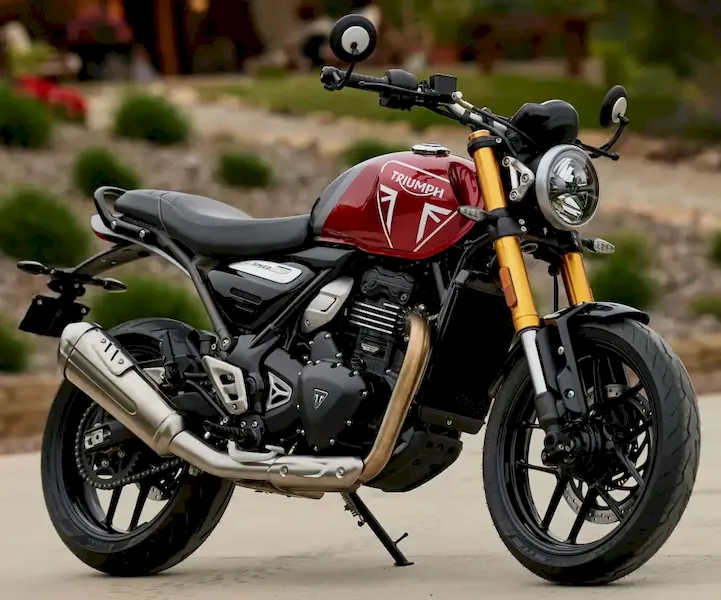
The styling borrows from Hinckley's bigger Modern Classics: a round LED headlight with daytime running light and ten-spoke alloy wheels. The clock is round too, with an analogue speedo and a small LCD for everything else. Reviewers agree on the finish: inSella gives it full marks, and Bennetts reckons it looks far too well made for the money.
The engine
The TR-Series single is an all-new design: liquid cooling, twin overhead cams, four valves, an 89 mm bore and 64 mm stroke. Triumph claims 40 PS at 8,000 rpm and 37.5 Nm at 6,500. With different tunes, it's the engine behind the whole 400 family. In inSella's tests it made 38.8 PS at the wheel, ran 0-100 km/h in 6 seconds and topped out at just under 149 km/h.
It comes alive in the mid-range and towards the top, where it pulls with real enthusiasm. At walking pace in first gear, though, the electronic throttle can be a little snatchy, as both inSella and Bennetts point out. The six-speed gearbox is short-geared: lovely in town, busy on the motorway. The clutch is assisted and slipper-type, so the lever is light and the back wheel stays calm on hurried downshifts.
Chassis, brakes and electronics
The frame is tubular steel with a bolt-on rear subframe, and the swingarm is cast aluminium. Up front sit 43 mm upside-down forks with 140 mm of travel; at the back, a preload-adjustable monoshock with a remote reservoir and 130 mm of travel. The 300 mm front disc is gripped by a radial four-piston caliper, stiffer and more precise than a conventional mount, with a 230 mm disc at the rear.
Electronics run to ABS on both wheels, switchable traction control and ride-by-wire, meaning the throttle is electronic rather than cable-operated. There's no Bluetooth phone link, and the rev counter on the LCD is tiny. On the road, testers describe it as light and precise, easy for novices, with suspension on the firm side over broken tarmac. Very tall riders find it cramped.
Historical context
The Speed 400 is the first fruit of the deal between Triumph and Bajaj Auto, announced in January 2020: a long-term, non-equity partnership in which the two firms develop bikes together while Bajaj handles production and distribution. For Triumph it meant a return to a capacity class it had been absent from for decades, with bikes it described as "aspirational and affordable".
The bike was unveiled in England at the end of June 2023 and launched in India on 5 July, at an introductory price reserved for the first 10,000 customers. Orders passed 10,000 within days. Production began in late July at Bajaj's Chakan plant near Pune, while some markets are supplied from Triumph's factories in Thailand and Brazil. It reached European dealers in February 2024.
The competition is crowded. In India and Europe it faces the Royal Enfield Hunter 350 and Guerrilla 450, the KTM 390 Duke, the BMW G 310 R and the Kawasaki Z400. Compared with the cheaper retros it has nearly twice the power; against the sportier bikes it gives away some adjustability but offers a more relaxed character. In Europe the A2 licence, capped at 35 kW, matters a great deal, and the Speed 400 fits within it as standard.
In Triumph's range it is the foundation of a family: the Scrambler 400 X arrived alongside it, followed by the Scrambler 400 XC, the Thruxton 400, the Tracker 400 and the Bonneville T40, all sharing the same single.
Main versions
- Speed 400 (India 2023, Europe 2024): the original version, 398cc and 40 PS at 8,000 rpm, 43 mm upside-down forks, radial front caliper, ABS and switchable traction control.
- Speed 400 model year 2025: an update unveiled in India in September 2024, with Vredestein tyres, adjustable levers and four new colours. The sources we checked don't confirm that the same changes reached European bikes unaltered.
- Speed T4 (2024): a gentler sibling unveiled in India alongside the update. Same 398cc engine tuned for about 31 bhp at 7,000 rpm and 36 Nm at 5,000, a cable throttle instead of ride-by-wire and conventional 43 mm forks. Aimed at riders who cruise at a steady pace rather than chase the revs.
Trivia and anecdotes
The name carries a lot of Triumph history: before the Speed 400 came the 1937 Speed Twin, Edward Turner's parallel twin, and more recently the Speed Triple.
For the Indian launch Triumph set a special price for the first 10,000 customers only, and orders passed that mark within a few days. For European riders the more useful figure is another one: with 29.4 kW and 170 kg it sits under both A2 limits, maximum power and power-to-weight ratio.
In inSella's test, with 0-100 km/h in 6 seconds and 33.5 km/l on country roads, the single proved it can be both lively and frugal.
What it's worth today
Indicative prices, November 2026
New, it costs €5,745 on the road in Italy, excluding registration. On the used market, in November 2026, Italian dealer listings on Moto.it and Dueruote range from about €3,700 for a 2024 bike with 10,000 km to about €5,500 for a nearly new 2026 example, close to the price of a new one. Prices are for the Italian market and only a guide: condition, mileage, service history, remaining warranty and fitted accessories all count.
What to check
- Services at an official dealer: the interval is 16,000 km or 12 months, and the 24-month warranty depends on it.
- Signs of a drop on the levers, footpegs, engine covers and silencer.
- Wear on the chain and sprockets, condition and date of the tyres.
- Aftermarket accessories and exhausts must be road-legal.
- A test ride at low speed, to feel how the throttle responds.
Strengths and weaknesses
- Quality finish, better than you'd expect in this class.
- Lively engine in the mid-range and up, with low fuel use: inSella measured 24.6 km/l at 120 km/h.
- Strong, easy-to-modulate brakes.
- Light and agile, with a low seat.
- Full kit: traction control, slipper clutch, ride-by-wire.
- A2 licence-friendly with no modifications.
- Short gearing: the engine is always busy on the motorway.
- Snatchy throttle at walking pace in first gear.
- No Bluetooth, small rev counter on the display.
- Firm suspension over broken surfaces.
- Cramped for tall riders.
- Little under-seat space and no wind protection.
Riders on an A2 licence who want a proper motorcycle from day one. Riders returning after years away who want something light and easy. Anyone who rides mostly in town and on country roads and wants the look of a Triumph Modern Classic without paying for a twin.
Riders who cover long motorway stretches, especially two-up: the short gearing and lack of protection soon tell. Very tall riders will feel cramped. And anyone after the character of a twin, or the charm of a genuine classic, should look elsewhere.
Used 2025 and 2026 bikes with low mileage cost almost as much as a new one, so compare them with dealer offers on new stock. Look for an original example with a documented service history and warranty still running. Genuine Triumph accessories fitted by a dealer add value; non-homologated exhausts don't.
It's a recent bike and the sources we checked report no recurring faults. US NHTSA public data shows no recalls for the 2024 and 2025 models, and few complaints. In Motorrad und Reisen's test the range display suddenly dropped to zero on the motorway, and it wasn't clear whether this was a one-off. Long-term reliability at high mileage is still to be proven.
Triumph specifies a service every 16,000 km (10,000 miles) or 12 months, with a 24-month warranty. MCN puts annual servicing at around £260 in the UK. The rest is routine: clean and lube the chain, check the coolant, brake pads and tyres.
The bike is in current production and parts come through Triumph's official dealer network. The genuine accessory range is wide, and many components are shared with the other bikes in the 400 family. Tyres are 110/70 and 150/60 on 17-inch rims, among the most common sizes, so any tyre shop can supply them.
€3,700-5,500 (November 2026, Italy)
This is its strongest suit. At €5,745 in Italy it offers chassis, brakes and electronics that similarly priced retros lack, plus the finish of a dearer bike. Bennetts called it the best new bike you can buy for under £5,000, and Autotrader a steal.
The Speed 400 doesn't try to pass itself off as a period bike: it takes the look of classic Triumphs and puts it on a modern, light and well-made base. For newcomers it's a serious way into the Modern Classic world; for riders with a twin already in the garage it can be the second bike for town and back roads. Its limit is obvious, and it's the motorway, not the quality.
Accessories
Fly screen or small windscreen
Protection
The Speed 400 has no wind protection at all, and above 110 km/h your neck starts to work. A small fly screen is enough to take the pressure off your chest. Choose one that doesn't cover the round headlight or spoil the bike's lines.
Frame sliders
Protection
On a bike aimed partly at newer riders, a tip-over at a standstill is likely at some point. Sliders protect the engine covers, tank and levers. Pick a kit made for this frame, with mounts that don't require drilling.
Tank bag or soft panniers
Luggage
There's next to no space under the seat, so anything beyond a short ride needs luggage. On a bike this light it makes sense to stick with soft, compact options that don't upset the balance and come off in seconds.
Rear paddock stand
Maintenance
The bike only has a side stand. For cleaning and lubing the chain, checking the tension and pumping up the tyres without fuss, a rear paddock stand with swingarm supports is the most useful buy. Make sure it suits the cast aluminium swingarm.