Triumph
United Kingdom · Bikes since 1902
A history spanning 124 years
Triumph: from Coventry to Hinckley, by way of a parallel twin
Ask someone to draw a British motorbike from memory. Nine times out of ten you get a teardrop tank, a round headlamp and two cylinders side by side. Without knowing it, they are drawing a Triumph. Few marques have fixed the image of an entire motorcycling tradition the way this one has, and the oddest part is that its founder was not even English.
The origins: a German in London
Siegfried Bettmann arrived in England from Nuremberg and in 1885 began importing and selling bicycles. With his partner Mauritz Schulte he moved production to Coventry, which at the end of the nineteenth century was Britain’s capital of precision engineering, and soon afterwards gave his bicycles the Triumph name. Engines followed in 1902: the first motorcycle was little more than a strengthened bicycle with a Belgian Minerva engine bolted in. From 1905 the engines were built in-house, and during the Great War the Model H, nicknamed the "Trusty Triumph", served with the British Army in its tens of thousands. That is where the marque earned its reputation for bikes that do not leave you stranded.
Edward Turner and the Speed Twin
In the 1930s the motorcycle division came close to disappearing. Jack Sangster took it over and in 1936 put Edward Turner in charge of design, an engineer with very clear ideas and a decent talent for marketing. His calling card was the 1937 Speed Twin: 500 cc, two parallel cylinders, around 27 horsepower and a top speed close to 90 mph. It weighed no more than the single-cylinder rivals, vibrated less and went better. For the next thirty years half the British industry built variations on that idea.
In a German air raid in 1940 the Coventry works was flattened. Triumph rebuilt at Meriden, in the Midlands, and everything we now call a vintage Triumph came out of that factory. In 1949 came the Thunderbird 650, which a few years later became Marlon Brando’s bike in the film The Wild One: the cinema did the rest. In 1951 Triumph joined the BSA group, a marriage that would in large part prepare its downfall.
The Bonneville and the golden years
1959 was the year of the Bonneville T120: 649 cc, twin carburettors, around 46 horsepower. The name came from the Utah salt flats where in 1956 a Triumph engine had reached 214 mph, and the T120 badge promised 120 miles per hour. You can find the full story on the blog; here it is enough to say that the Bonneville became the Triumph by definition, and the rest of the range, from the Tiger 100 to the Trophy TR6, lived in its orbit. In 1968 came the Trident, a 750 triple and twin of the BSA Rocket 3: handsome, technically modern, but launched just before the Honda CB750 rewrote the rules.
The collapse and the Meriden co-operative
In the 1970s the group, by then part of Norton Villiers Triumph, announced the closure of Meriden. The workers occupied the factory and held it for roughly eighteen months; in 1975 a co-operative was born that kept building Bonnevilles, the T140, until 1983. They were bikes built with pride and on a shoestring. Today they are being rediscovered, and rightly so, but for a collector the most sought-after still tend to be the ones from before 1970.
Hinckley: the second life
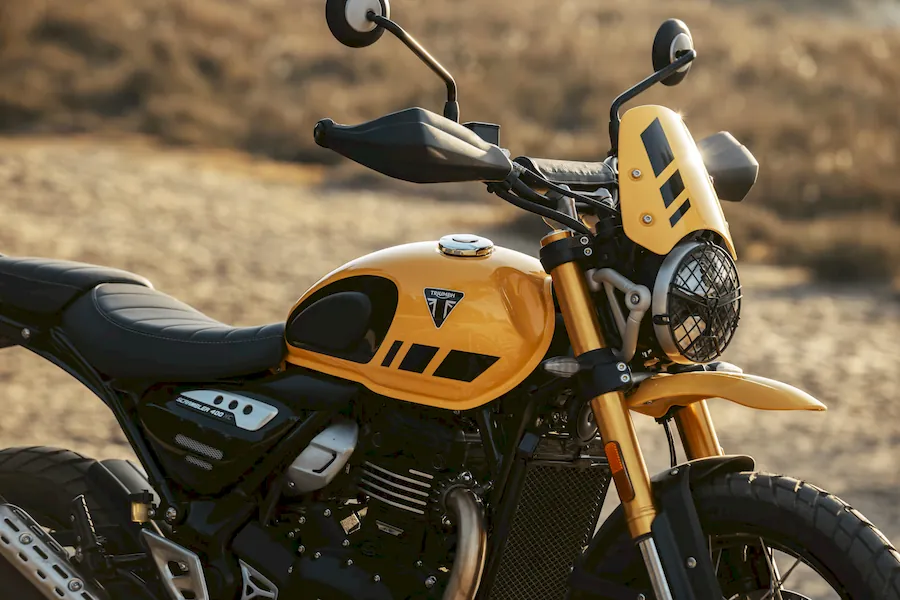
In 1983 the name was bought by a builder, John Bloor. For seven years he worked quietly on a clean-sheet project at the new factory in Hinckley, Leicestershire; the first models were shown in 1990 and had little vintage about them, being modern three- and four-cylinder machines. The Bonneville returned in 2001 as an air-cooled 790 cc twin, growing to 865 cc in 2007. Since 2016 the Modern Classic range (Bonneville T100 and T120, Thruxton, Street Twin, Speed Twin, Scrambler) has moved to liquid-cooled 900 and 1200 cc engines, with decorative cooling fins on the cylinders and throttle bodies disguised as carburettors. Part of the production has been in Thailand since 2002.
What owning a vintage Triumph means
Three things to know. The first: Triumphs up to 1962 are pre-unit, meaning the engine and gearbox sit in separate cases; from 1963 the unit-construction models arrive, which are more compact. Purists hunt for the earlier ones, but the later ones are perfectly enjoyable. The second: spares. For vintage Triumphs there is a supply of new and reproduction parts that many other marques can only dream of, and that alone is worth part of the price. The third: character. Oil leaks are almost a tradition, the Lucas electrics have a reputation that is not entirely unfair, and the twin vibrates. If you know that beforehand, it is entertaining. If you find out afterwards, it is irritating.
When buying a used Triumph, check carefully that the frame and engine numbers match (matching numbers count for a lot of the value) and look closely at the wiring, because that is the first place a nasty surprise hides.
Triumph today, for those who do not want to spend their evenings in the garage
If you want the look without the workshop routine, the Modern Classics are a real alternative. The first fuel-injected Bonnevilles have a rather abrupt throttle response, a well-known flaw that a good remap can solve. The most recent generations are more refined, with ABS and traction control, and on the road they go better than their looks suggest. In the end the difference is simple: one you love even when it will not start, the other starts every time.