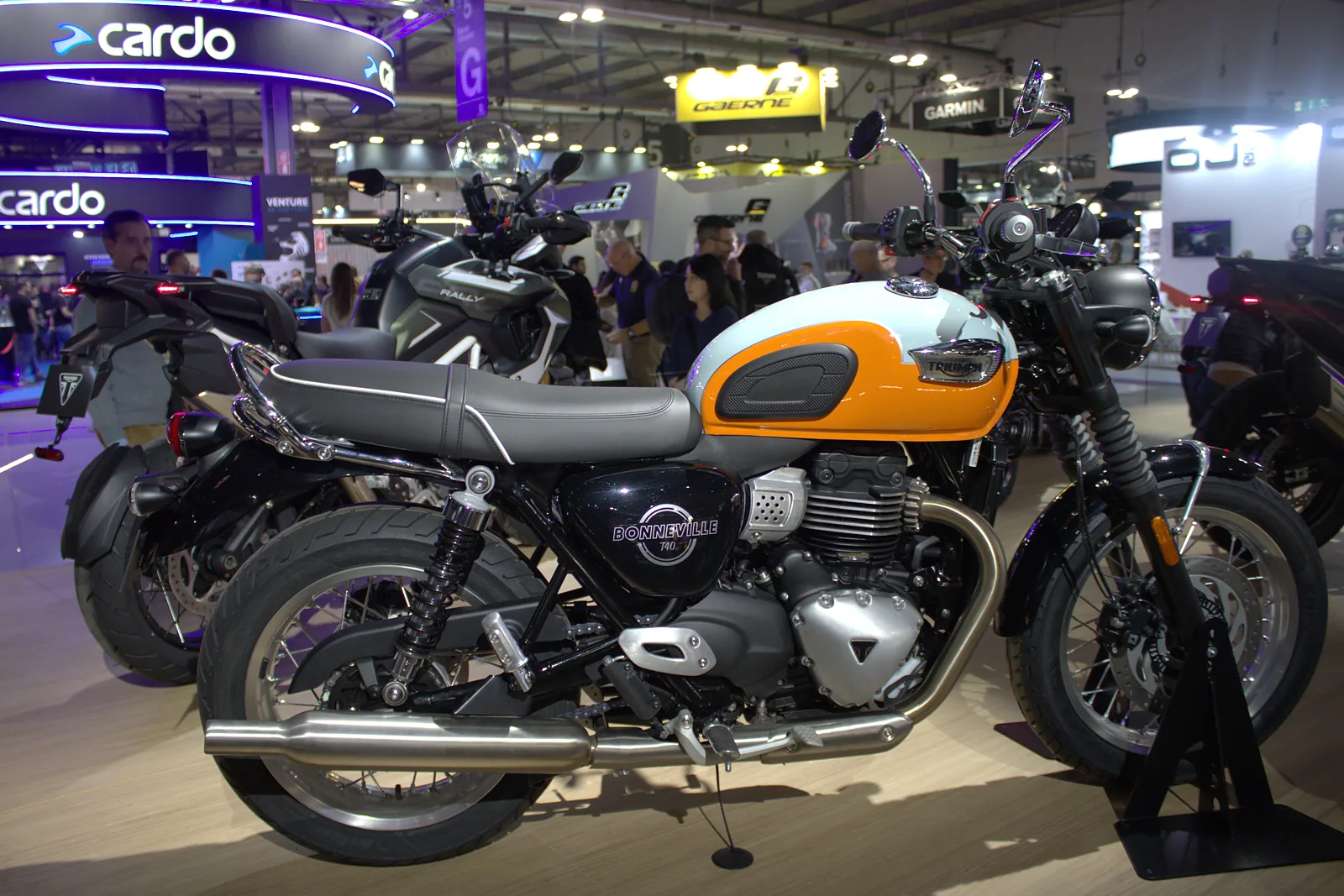
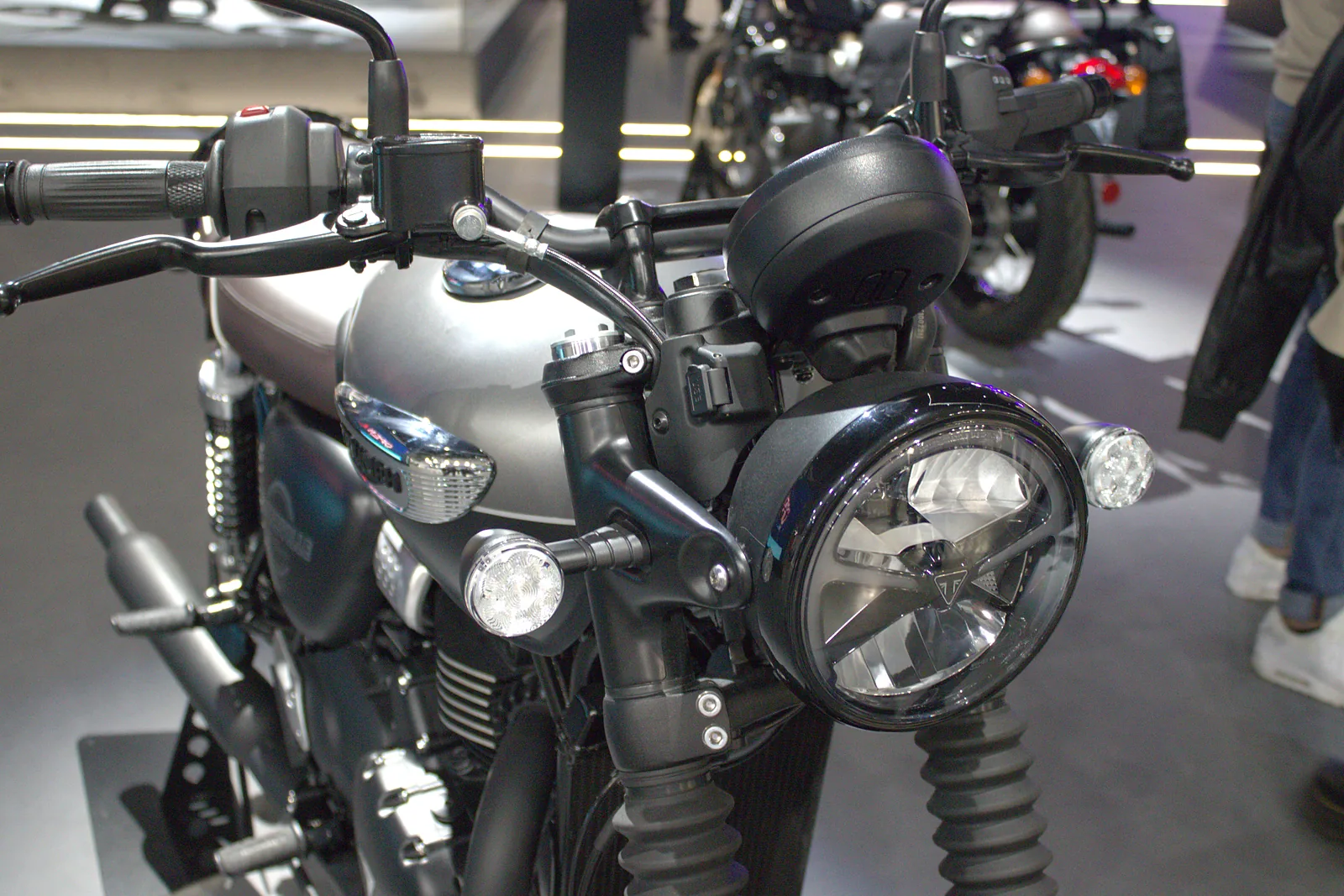
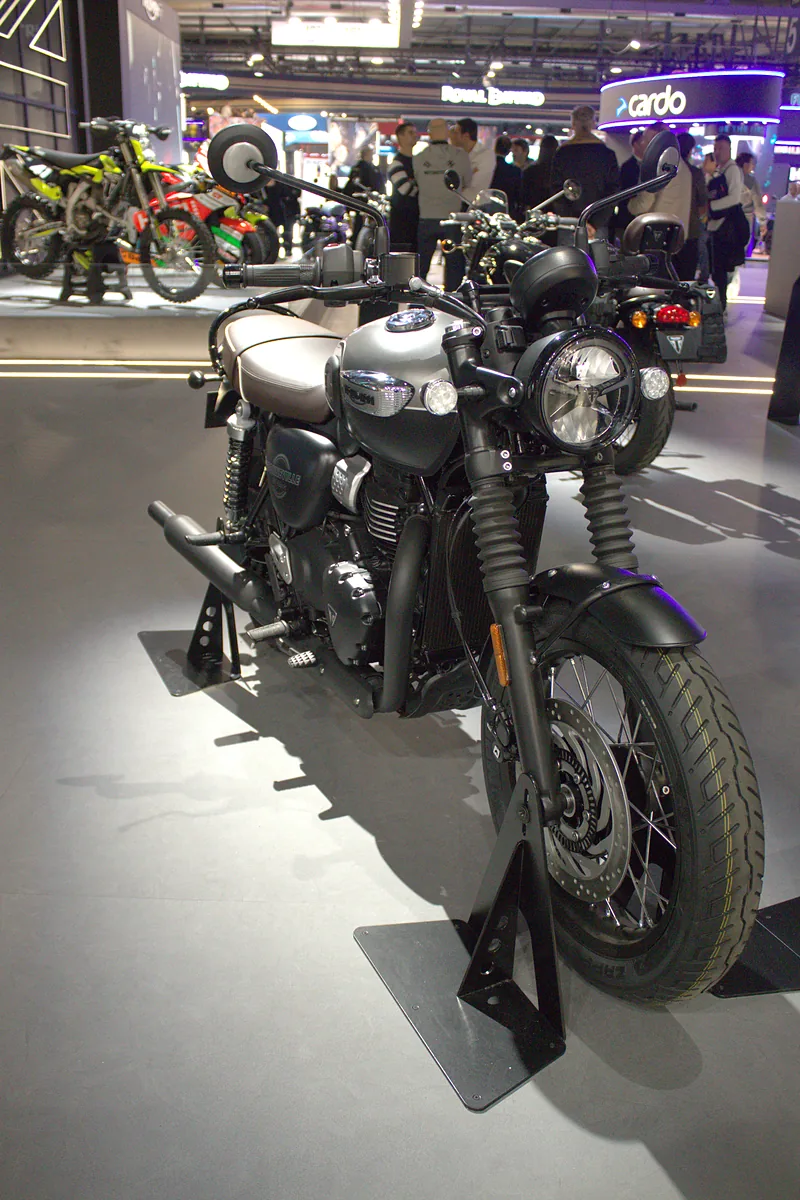
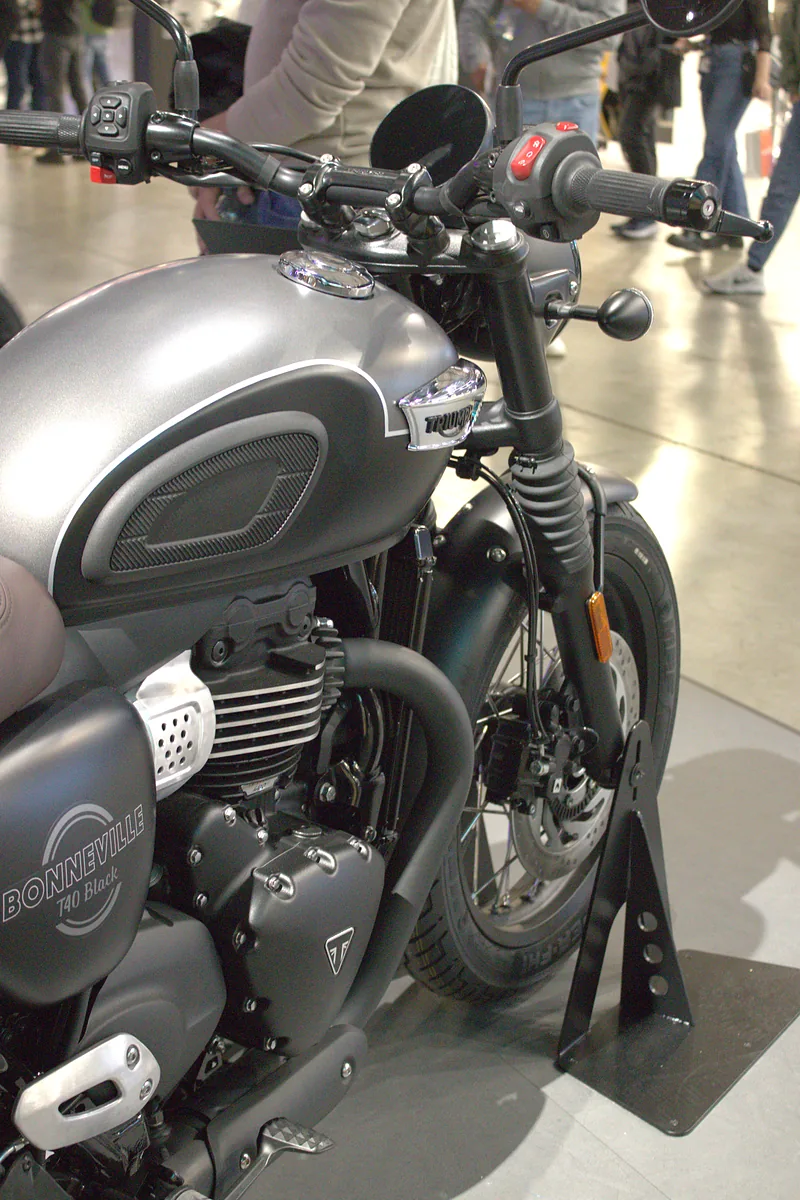
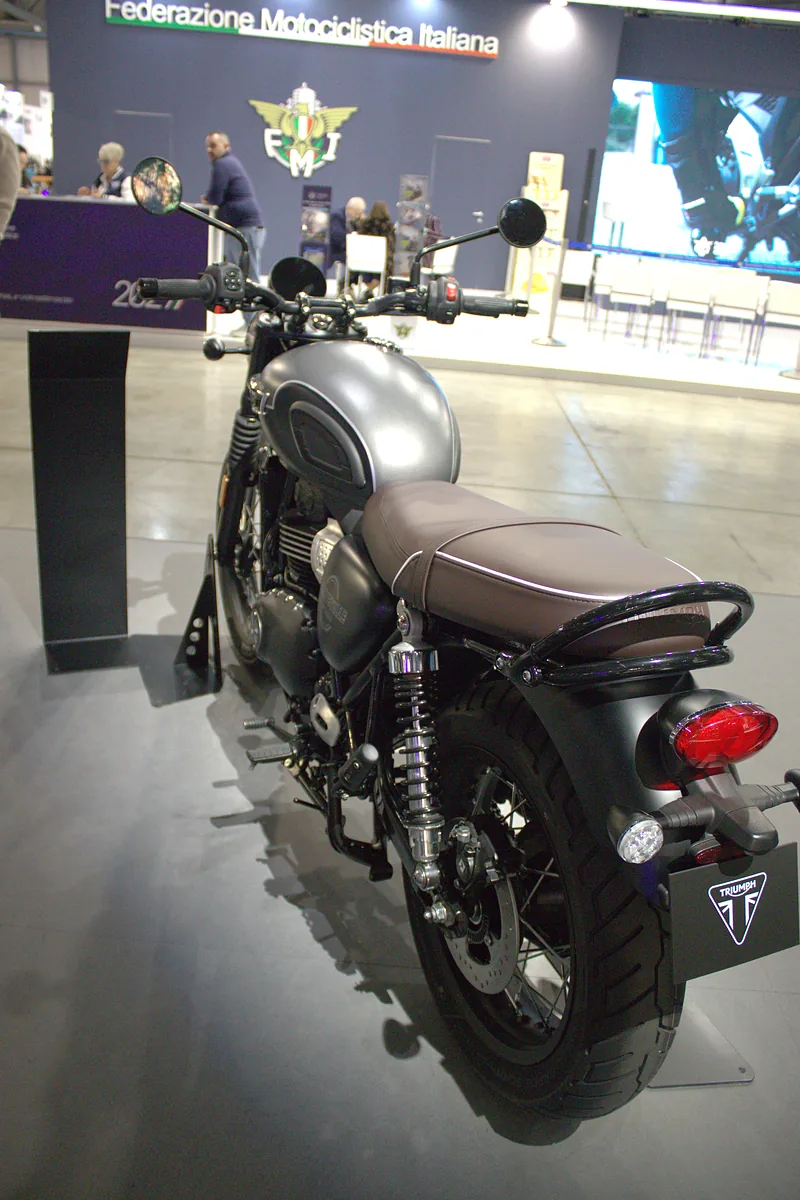
The Triumph Bonneville T40 is the Bonnie with the 398cc single from the 400 family, the same one used by the Speed, Scrambler, Thruxton and Tracker. I saw it in the flesh at EICMA 2026, alongside the T40 Black. It's A2 licence-friendly and will reach dealers in spring 2027. The price should be around €6,500-7,000, but I have no confirmation: for that we'll have to wait for the official price list, which Triumph will announce in early 2027.
The bike looks very good and the colour schemes are intriguing, especially the Black: matt grey and black, a brown seat, engine and exhaust painted black. The standard T40 comes in three period-flavoured two-tones, Meriden Blue with Tangerine Orange, Aegean Blue with Fusion White, New England White with Jet Black, all with a hand-painted coach line.
From a distance it's a Bonneville
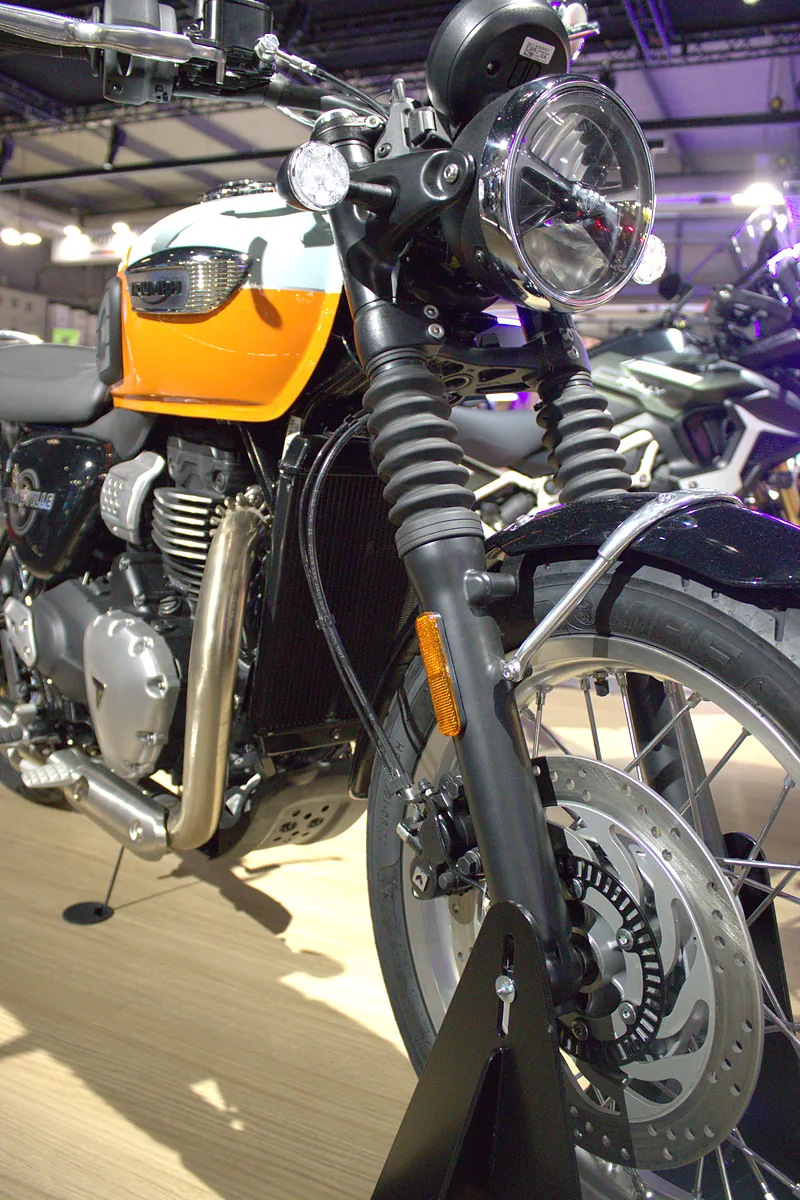
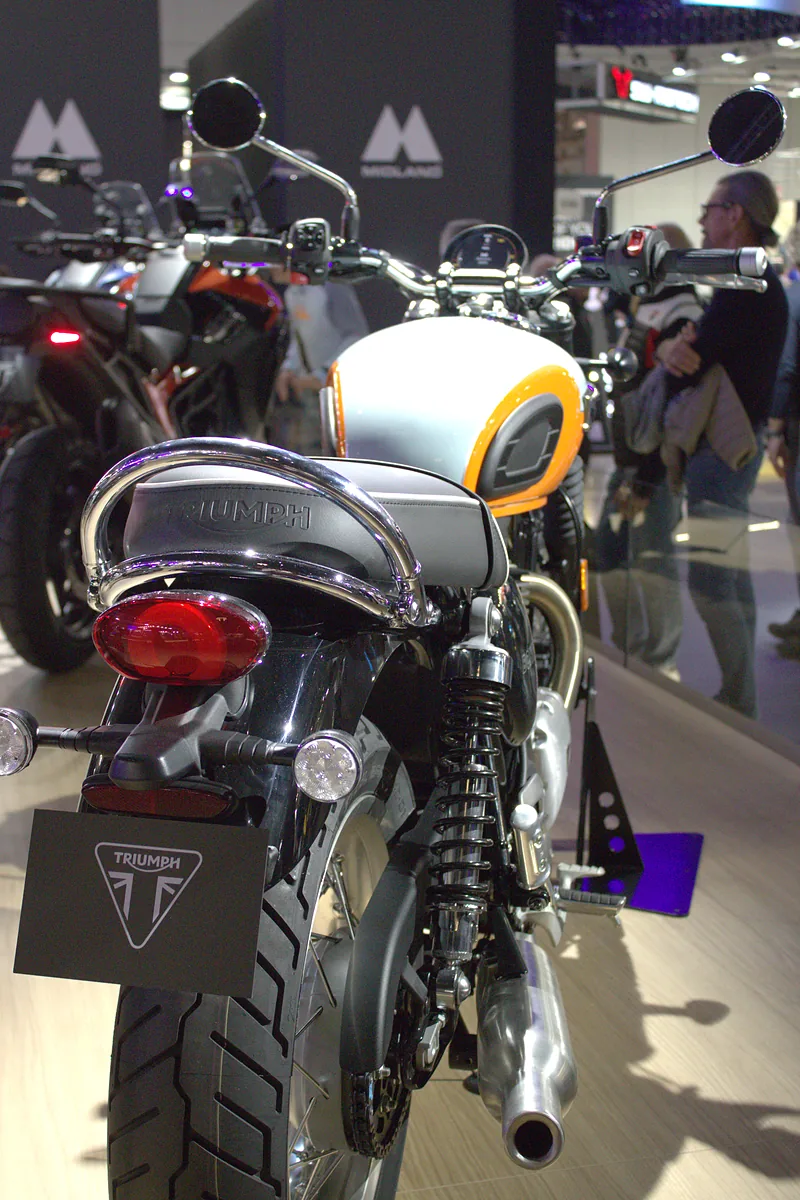
From a few metres away you can't tell it from its bigger sisters: teardrop tank, round headlight, spoked wheels, twin shocks. Instead of the twin there's a single cylinder, there's one exhaust rather than two, and a single disc does the work up front. The character of the single is exactly what only a road test can tell me.
1 / 6
Engine and chassis
The 398cc has a new cylinder head and its own tune, milder than the other 400s: 32 PS at 7,000 rpm and 36 Nm at 5,000. It weighs 191kg ready to ride, the seat is 790mm high and drops to 770mm with the accessory low seat.
The wheels are 18-inch front and 17-inch rear. Up front there's a 310mm disc with a twin-piston caliper and braided lines, at the back a 255mm disc. On paper it's the typical setup for this class, and I expect safe, balanced braking from it. The 43mm fork and the preload-adjustable twin shocks have 130mm of travel. For a real verdict on brakes and suspension I'll wait until I've tried it.
Triumph claims 3.5 litres per 100 km: with 14.5 litres, on paper, the range is over 400 km. Services every 16,000 km.
Instruments, lights and connectivity
The dash is a 4-inch round colour TFT, simple but complete, with a "Heritage" layout that mimics analogue dials. Smartphone connectivity for calls and music is standard, and with the Triumph app full-map navigation appears on the display. The lighting is all LED, with an automatic daytime running light and a brake light that flashes under emergency braking.
Riding modes
There are five riding modes, all standard. Each one sets throttle response, traction control and ABS together, and the last two also work when leant over.
Road: the everyday mode.
Rain: for wet or slippery tarmac, with a softer throttle and more cautious aids.
Eco: designed to save fuel.
Two custom modes: set them up as you like.
You pick them with the handlebar controls from a quick-access menu on the dash. According to the first tests they can also be changed on the move, with the throttle closed. Cruise control and a centre stand are standard too.
Without a road test I can't give a complete verdict. Seen up close at EICMA, though, the Bonneville T40 left me pleasantly impressed. As soon as I manage a test ride I'll update this page with my riding impressions.
Historical context
The Bonneville was born in 1959, named after the Bonneville Salt Flats in Utah, where a Triumph-powered machine had set a speed record. Ever since, Bonneville has meant a parallel twin and a clean British line to everyone: teardrop tank, round headlight, flat seat.
The 400 family arrived in 2023 from Triumph's partnership with India's Bajaj, starting with the Speed 400 and Scrambler 400 X, on sale in Italy since 2024. The Scrambler 400 XC, Thruxton 400 and Tracker 400 followed. The T40 is the sixth, unveiled on 6 October 2026 and shown at EICMA in November.
For the first time the Bonneville name goes on an A2-licence bike with a single cylinder. Within the family it stands out for finish and equipment, and in the Bonneville range it sits below the 900cc T100. The idea is clear: bring the Bonneville style to new riders, to those returning to bikes and to anyone who wants something light and easy without giving up that name on the tank.
Main versions
Bonneville T40 (from 2027): 398cc, 32 PS at 7,000 rpm and 36 Nm at 5,000, 191kg ready to ride. Chrome mirrors and grab rail, brushed aluminium, brushed stainless exhaust. Three two-tone schemes: Meriden Blue with Tangerine Orange, Aegean Blue with Fusion White, New England White with Jet Black.
Bonneville T40 Black (from 2027): same mechanicals and equipment. Matt Pewter Grey and matt black tank, brown seat, black rims with steel spokes, powder-coated engine covers, blacked-out cylinder head fins and exhaust.
Indian version (from 2026): in India the T40 uses the 350cc single, with 29 PS and 31 Nm according to Autocar India. Alongside it sits the simpler Bonneville T4, without cruise control or an inertial platform. Neither is planned for Europe.
Trivia and anecdotes
The Bonneville name was born in 1959 and has meant a parallel twin ever since: the T40 is the first Bonnie with a single cylinder. Triumph developed it working closely with India's Bajaj, as it did for the whole 400 family.
The colours look back too. Meriden Blue recalls Meriden, the village near Coventry where Triumph built the classic Bonnevilles until 1983, and the tank coach lines are hand-painted as they were back then.
India got the T40 before us, with a 350cc single. There's also a simpler sister there, the Bonneville T4, which isn't planned for Europe. You'll find the story of my visit to the Triumph stand in the article Bonneville T40 at EICMA 2026, in the News & Reviews section of the blog.
What to check before buying one
The Bonneville T40 isn't on sale yet and the price list will arrive in early 2027. For now, all we can do is think about what to look at once it can be tested.
The engine: the Bonneville has always been a twin. The single's 32 PS needs a calm test ride, in town and out of it, to see whether it pulls enough and how much it vibrates at a steady speed.
Long-term durability: the 398cc has been on sale in Italy since February 2024 in the Speed and Scrambler 400. Before signing, ask the dealer how those bikes are holding up and what the 16,000 km services involve.
The weight: 191kg is a lot for a 400. Try it in slow manoeuvres.
The brakes: a single disc with a twin-piston caliper, worth trying two-up too.
The seat: 790mm, 770mm with the low seat. Shorter riders should try it first.
If you want a good balance between Bonneville style, quality of finish and an easy, A2-friendly bike, it's a serious candidate. If you want the character and pull of a twin, the right choice is still the T100.
Analysis
Strengths and weaknesses
Overall rating
8/10
Strengths
A true Bonneville look, with hand-painted coach lines and a careful finish.
Well-chosen colours, especially the T40 Black.
Full standard equipment: five riding modes, cruise control, and lean-sensitive ABS and traction control.
Connectivity and full-map navigation on the dash, with no options to buy.
A2 licence and a low seat, 790mm or 770mm with the low seat.
Services every 16,000 km and a claimed 3.5 litres per 100 km.
Weaknesses
32 PS, less than the other Triumph 400s: on paper the mildest of the family.
191kg ready to ride, a lot for a 400.
A single front disc with a twin-piston axial caliper.
Non-adjustable fork.
Spoked wheels with inner tubes: a puncture is harder to fix.
Expected to cost more than the other 400s.
Who it is recommended for
Riders on an A2 licence who want a bike that really looks like a Bonneville. Anyone returning to riding after years away who wants something light to handle, with a low seat and electronic aids as standard. Anyone who will mostly ride in town, to work and on Sunday outings.
Who it is not recommended for
Anyone after performance or the character of a twin: that's what the T100 is for. Riders who often take the motorway or carry a passenger and luggage, where 32 PS may feel tight on paper. Anyone wanting a sportier 400: in the same family the Tracker and Thruxton have 42 PS and less weight.
Buying advice
Wait for the official price and a proper test ride before deciding. Ride it in town and out of it, calmly, to see whether the single is enough for you. If you're short, ask to try the low seat. And compare it with its 400 sisters at the same dealer: they cost less and have more power, but not the same look.
Known issues
The T40 isn't on sale yet, so there's no data on faults or recalls. The engine is derived from the 398cc unit of the other Triumph 400s, on sale in Italy since February 2024, with a new cylinder head and its own tune. Reliability can only be judged once owners have put some miles on it.
Maintenance
Triumph quotes services every 16,000 km (10,000 miles), a long interval for the class. The rest is the routine of a chain-driven bike: clean, lube and adjust. Spoked wheels need their spokes checking now and then. The standard centre stand helps a lot. For details, the Triumph handbook is the reference.
Spare parts availability
It's a new bike from Triumph's official network and most of the mechanicals are shared with the other 400s, so the main parts shouldn't be hard to find. The tank, seat, exhaust and wheels are specific to the T40. The 100/90-18 and 150/70-17 tyres are the same sizes as the Bonneville T120's and easy to find.
Used market value
Not on sale yet: list price expected in early 2027
Value for money
There's no official price yet. If the rumoured €6,500-7,000 is confirmed, the T40 will cost more than the other 400s and have less power. In return it offers the Bonneville look, a better finish and full electronic equipment as standard. I'll give a real verdict once there's a price list and a road test.
Final review
My score is a rough verdict, given after seeing it up close at EICMA 2026 and without having tried it yet. Finish, colours and equipment convince; engine, brakes and suspension I'll judge on the road, and the score may change after the test ride.
Equipment
Accessories
Low seat
Comfort
Recommended
The standard seat is already low at 790mm, but riders who struggle to reach the ground can fit the lower version, which drops to 770mm. Try it at the dealer before buying: twenty millimetres change how secure you feel at a standstill, but also where your legs end up.
Classic-style panniers
Luggage
Recommended
For commuting and weekends away you'll want a pair of bags. Waxed canvas or leather suits a Bonneville, with dedicated frames that keep them clear of the exhaust and shocks. Go for a modest capacity so the bike doesn't feel weighed down.
Heated grips
Comfort
Recommended
If you ride through winter you'll appreciate them from the first cold morning. Choose grips compatible with the T40's switchgear and electrics, and have them fitted by someone who knows how: a bad wiring job on a bike with this much electronics only causes trouble.
Engine protection bars
Protection
Recommended
Everyone has a tip-over at a standstill sooner or later, especially in the first miles. Bars protect the engine covers and tank without spoiling the look, if you choose slim ones painted to match. Pick ones made for this frame, with mounts that don't require drilling.
We and selected third parties use cookies or similar technologies for technical purposes and, with your consent, for other purposes (analytics and statistics) as specified in the privacy policy and the cookie policy. You can consent to the use of such technologies by accepting this notice.
Tracking options
Customise your cookie preferences by purpose.
Technical and Session Cookies (Necessary)
Essential for using the site.
Analytics and Statistics
They help us understand how users interact with the site.