

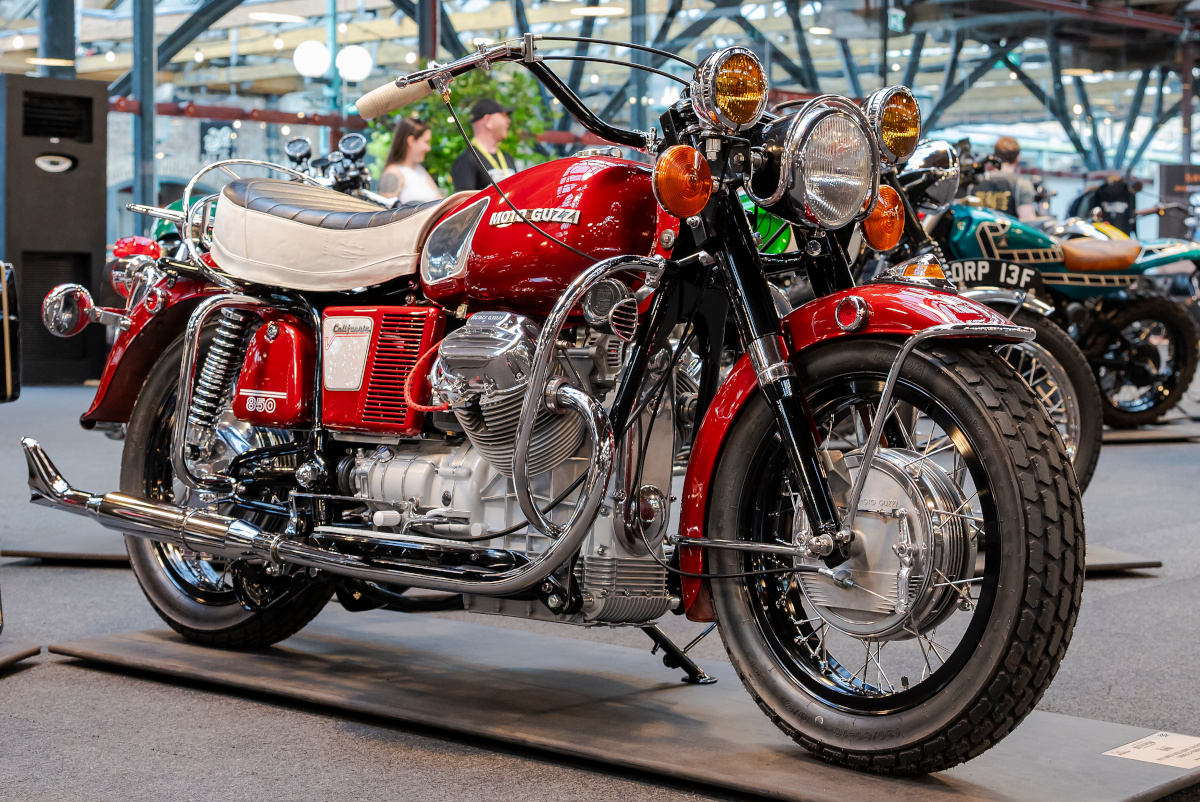
Moto Guzzi 850 GT: The Story of Mandello's Grand Tourer
Moto Guzzi · 1971-1974 · 844 cc
Features and technical evolution
An Italian grand tourer with the character of the Guzzi twin
The Moto Guzzi 850 GT is one of the great Italian roadsters of the early 1970s: a motorcycle built to eat up the miles, with a generous engine, a traditional chassis and a technical solution that has accompanied the history of the Mandello del Lario marque for decades. Its appeal does not depend on exaggerated styling or record-breaking performance, but on the balance between solid construction, mechanical personality and touring vocation.
The chronology commonly given for the model is 1972–1974; 1971 is relevant for the technical documentation and the introduction phase. The 850 GT sits in the evolution of the family born around the V7, taking displacement to around 844 cc and adopting a five-speed gearbox. It is a bike that approaches road touring with concrete tools: torque, the protection offered by the riding position, range and a shaft final drive that avoids the maintenance typical of a chain.
The transverse V-twin
The heart of the 850 GT is the classic Moto Guzzi 90° V-twin, mounted transversely to the direction of travel and air-cooled. Actual displacement is 844.05 cc, obtained with an 83 mm bore and a 78 mm stroke. The valve gear uses overhead valves operated by pushrods and rockers, a solution consistent with the design and with the philosophy of a robust big roadster that is easy to service with traditional mechanical know-how.
Fuelling is handled by two 29 mm Dell'Orto VHB carburettors. Ignition uses a car-type distributor with contact breaker and two spark plugs, while starting is electric. The maximum power reported in the technical documentation consulted is 51 bhp at 6,500 rpm, with a compression ratio of 9.2:1. These figures should be read as a reference for the documented configuration: engine condition, tuning and market differences can affect the output of a surviving bike today.
Five-speed gearbox and shaft drive
An important difference from earlier, smaller-capacity Guzzis is the five-speed gearbox. Final drive is by shaft and bevel gears, a solution well suited to touring because it reduces the periodic work a chain drive requires. The clutch is a dry twin-plate unit and the gearbox is separate from the engine unit, following the family's traditional layout.
On the European 850 GT the gear lever is on the right, as in the original configuration. It is a detail that deserves attention on a test ride today: anyone coming from a modern bike needs to get used to the arrangement of the controls and check that the bike has not been modified during its life.
Grand-touring chassis
The tubular double-cradle frame supports a classic layout, with hydraulic telescopic forks at the front and two rear shock absorbers adjustable for preload. The wheels are wire-spoked, with traditional 18-inch tyre sizes. The geometry and considerable mass favour stability and composure over the quick reactions of a modern sports bike.
The braking system changed during the model's life. The first configurations used a front drum; in 1973 the documentation notes an evolution to a twin-cam drum. In 1974 a 300 mm Brembo front disc arrived, with the drum retained at the rear. The presence of the disc is therefore a useful element for recognising and dating a configuration, but it must be checked together with numbers, components and paperwork for the individual bike.
The 850 GT's place in Guzzi history
The 850 GT represents the step towards a larger-capacity grand tourer, able to sit alongside the versions more oriented to the American market and relaxed riding. The related 850 Eldorado and 850 GT California share part of the technical base, but should not be considered mere alternative names: layout, controls and equipment can differ. The European 850 GT remains recognisable for its role as a traditional roadster, less specialised in custom styling and closer to the idea of a versatile touring bike.
Key technical data
- Engine: 90° V-twin, four-stroke, air-cooled.
- Displacement: 844.05 cc.
- Bore x stroke: 83 × 78 mm.
- Compression ratio: 9.2:1.
- Valve gear: overhead valves, pushrods and rockers.
- Fuel system: two 29 mm Dell'Orto VHB carburettors.
- Maximum power reported: 51 bhp at 6,500 rpm.
- Gearbox: five-speed.
- Clutch: dry twin-plate.
- Final drive: shaft.
- Frame: tubular double cradle.
- Suspension: hydraulic telescopic forks at the front and two rear shock absorbers adjustable for preload.
- Brakes: front drum on early versions; 300 mm Brembo disc in 1974; rear drum.
- Reported dry weight: approx. 249 kg.
- Fuel tank capacity: approx. 22.5 litres.
Historical context
The big Guzzi in the era of ever-larger roadsters
At the start of the 1970s the motorcycle market was changing fast. The big European twins had to compete with Japanese bikes that were increasingly present, often featuring multi-cylinder engines and a performance-oriented image. Moto Guzzi took a different road, playing up its longitudinal V-twin, shaft drive and a chassis designed to give stability and durability in road use.
The 850 GT fits into this evolution as a development of the V7 family. The increase in displacement to 844 cc, obtained by lengthening the stroke compared with the V7 Special engine, and the adoption of the five-speed gearbox, answered the need to make the bike better suited to long journeys and high-level touring. It was not just a matter of adding cubic centimetres: the design kept a recognisable mechanical approach, with power delivery meant to support cruising and a final drive that needed less attention than a chain.
A shared technical base, different identities
The 850 family was split into models aimed at different needs and markets. The 850 Eldorado was tied to the US market, while the 850 GT California took the touring interpretation with American styling, a more relaxed riding position and specific equipment. The European GT remained instead the traditional grand tourer: a bike suited to travel, without giving up the classic layout of the Italian roadster.
Sharing a technical base does not mean all these models are identical. Controls, specification and configuration details change, and the differences matter today to anyone who wants to keep a correct example. For this reason too, the exact model name and provenance are important factors when valuing a restored or imported bike.
The final years of the 850 GT
Specialist chronology normally places the 850 GT in the period 1972–1974. 1971 should be treated with care: the existence of technical documentation dated that year testifies to the preparation and introduction phase, but is not enough on its own to show that every bike or every market followed the same commercial start date.
During 1974 a significant update arrived at the front end, with the adoption of the 300 mm Brembo disc brake on part of the production. At the end of the year the 850 GT gave way to the 850 T, marking a further step in the evolution of Mandello's big twins. The GT thus remains tied to a transitional phase: it keeps the solidity of the Guzzi tradition, but introduces solutions that prepare the next generation of the marque's big tourers.
Main versions
Documented versions and evolutions
- Moto Guzzi 850 GT, first configuration: the European version of the grand tourer, generally dated 1972–1973. It uses the 844 cc 90° V-twin, five-speed gearbox, shaft drive and a front drum brake. The precise drum configuration should be checked against the year and the components fitted.
- 1973 braking system evolution: the technical documentation notes a twin-cam front drum with two expansion levers. It is a useful detail for telling production evolutions apart, but it is not enough on its own to identify a model year with certainty: the whole bike must be checked.
- Moto Guzzi 850 GT 1974: in 1974 the solid 300 mm Brembo front disc brake appears, while the drum remains at the rear. The technical documentation also notes updates to the forks, with new aluminium fork legs. Before attributing these features to a given bike, check its actual configuration and its originality.
- Moto Guzzi 850 Eldorado: a model closely related to the GT and aimed at the US market. It shares the engine base, but differs in specification and in the layout of the controls. It is not simply an alternative name to be used for every 850 GT.
- Moto Guzzi 850 GT California: a touring variant with layout and equipment inspired by American tastes, including wide handlebars, forward-set footrests or touring-type footboards and, depending on configuration, a windscreen and accessories for travel. It should be identified as a distinct model and not as a specification automatically equivalent to the European GT.
The documentation consulted does not justify creating further official 850 GT versions based only on colours, accessories or modifications present on individual bikes today. Aftermarket conversions and updates made during restorations should be described as such, without attributing them to original production.
Trivia and anecdotes
A displacement that doesn't tell the whole story
The 850 GT name rounds up an actual displacement of 844.05 cc. The figure comes from an 83 mm bore and a 78 mm stroke: compared with the V7 Special engine, the longer stroke contributed to the increase in capacity. It is an example of how, in the motorcycle naming of the time, the number on the tank or in the model name did not necessarily match the exact value in cubic centimetres.
A gear-change layout that's unusual for today's riders
In the European configuration of the 850 GT the gearbox is operated with the right foot. The Eldorado and GT California variants instead used a different layout, with the lever on the left. For a modern enthusiast it is not just a historical curiosity: before setting off on a vintage Guzzi it is essential to get used to the controls and check that the bike still has its intended configuration.
The front brake as a chronological clue
The change from drum to 300 mm Brembo disc in 1974 is one of the most recognisable elements in the model's evolution. It should not, however, be used as the only criterion for dating a bike: replaced components, restorations and conversions can alter the original appearance. Identification numbers, paperwork and overall consistency remain indispensable.
A family of models, not one bike with different names
The 850 GT, the 850 Eldorado and the 850 GT California share an important part of their mechanics, but answer to different markets and layouts. The technical similarity can mislead anyone looking for parts or assessing a restoration: compatibility must be checked on the specific component and the exact version, without relying only on displacement or on the kinship between models.
What it's worth today
Indicative prices, October 2026
A grand tourer to enjoy with your eyes open
The Moto Guzzi 850 GT keeps the charm of the great Italian roadsters built around a recognisable mechanical design. The transverse twin, the shaft drive and the traditional chassis give it a personality quite unlike that of the contemporary Japanese multi-cylinder classics. It is a bike that can appeal to those who appreciate engine character, mechanics that suit specialist maintenance, and the chance to tackle touring routes on a significant-capacity classic.
Riding and use today
The mass and layout of the 850 GT make it better suited to the open road than to quick manoeuvres in traffic. The engine and five-speed gearbox suit relaxed riding, while the shaft drive removes the periodic chain maintenance. That does not mean the transmission has no needs: bevel box, joints, lubrication and any play must be checked against the correct documentation.
Braking, tyres, suspension and lighting should not be judged by the standards of a contemporary bike. Even a well-preserved example needs safe following distances and riding appropriate to the age of the design. Before using it regularly it is important to check the efficiency of the brakes, the condition of the tyres, the working of the forks and shock absorbers, and the stability of the chassis.
Maintenance, parts and reliability
The relatively traditional mechanics are a strength for those who know classic Guzzis, but age demands careful checks. It is not right to assume a bike is reliable just because the model has a good reputation: what counts is the quality of maintenance, the history of the individual bike, the correct adjustment of the fuel and ignition systems and the quality of any earlier restorations.
Parts availability should be checked component by component. Consumables and some common parts can be easier to find than items specific to bodywork, finishes, instruments or less common versions. Before buying a bike to restore, it pays to identify the missing parts and ask for concrete quotes, rather than relying on the generic idea that every Guzzi component is still easily available.
What to check before buying
- Identity and paperwork: compare frame and engine numbers, documents and the declared configuration.
- Originality: check that controls, brakes, forks, tank, exhausts and instruments are consistent with the year and version.
- Engine: check cold starting, noise, smoke, leaks, smoothness of running and the state of maintenance.
- Transmission: try the gearbox and check the clutch, propshaft and bevel box for noise, play or leaks.
- Chassis and brakes: check bearings, alignment, suspension, wheels, tyres and the condition of the braking system.
- Restoration: ask for photographs of the work, invoices and details of replaced components, distinguishing functional restoration from preserving originality.
Collector interest and price
The 850 GT holds particular interest for those looking for a classic touring Guzzi without moving up to a more specialised sports bike. The correctness of the version and the quality of preservation count as much as cosmetic appearance. As a market reference, AutoBelle reports an estimate of €4,900 as of July 2026, with an indicative range of €3,300–6,500. It is not a guarantee of sale nor a valuation of an individual bike: documentation, originality, mechanical condition, restoration quality and the local market can change the value significantly.
The Boomer Classic advice is simple: buy the 850 GT for its personality and for the pleasure of owning a big vintage Guzzi, not just for its displacement or a promise of appreciation. A correct, documented and mechanically sound bike is preferable to a showier one that is incomplete or modified without judgement. Before deciding, an inspection by a mechanic experienced in classic Moto Guzzis can stop an initially attractive price turning into a demanding restoration.