

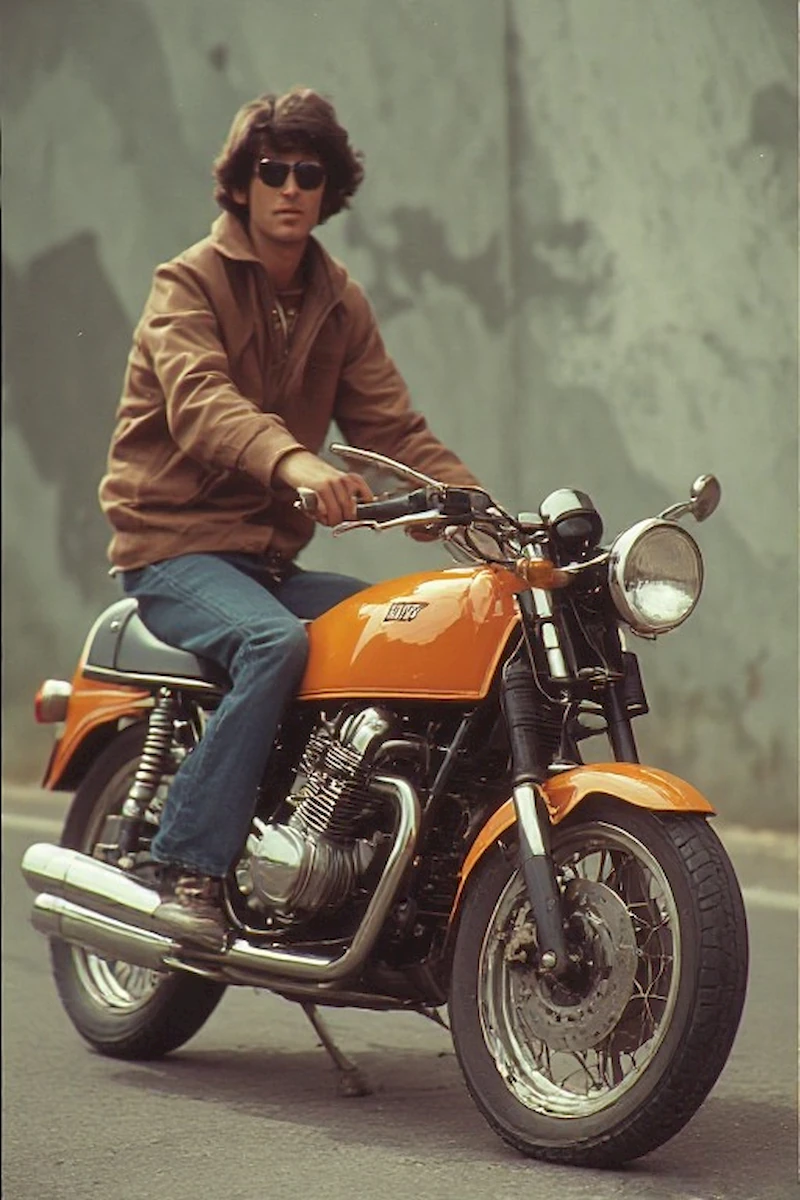
Laverda 650 GT (1968)
Laverda · 1968 · 654 cc
Features and technical evolution
The Laverda 650 GT is the bike with which a small Breganze company, until then known for agricultural machinery and extremely tough lightweight motorcycles, decided to play in the big-capacity category. Built in 1968 in only around fifty examples, it is the starting point of the whole Laverda twin family: without it there would have been no 750 GT, no 750 S, no SF and, later, the SFC.
Looking at this bike today, it is striking how different it was from the Italian bikes of the time. No horizontal single, no 1950s styling: a tall, squared-off parallel twin, with an overhead camshaft and the starter motor as the only way of starting it. It was a bike designed to travel fast and far, with an openly declared eye on the American market.
Design and chassis
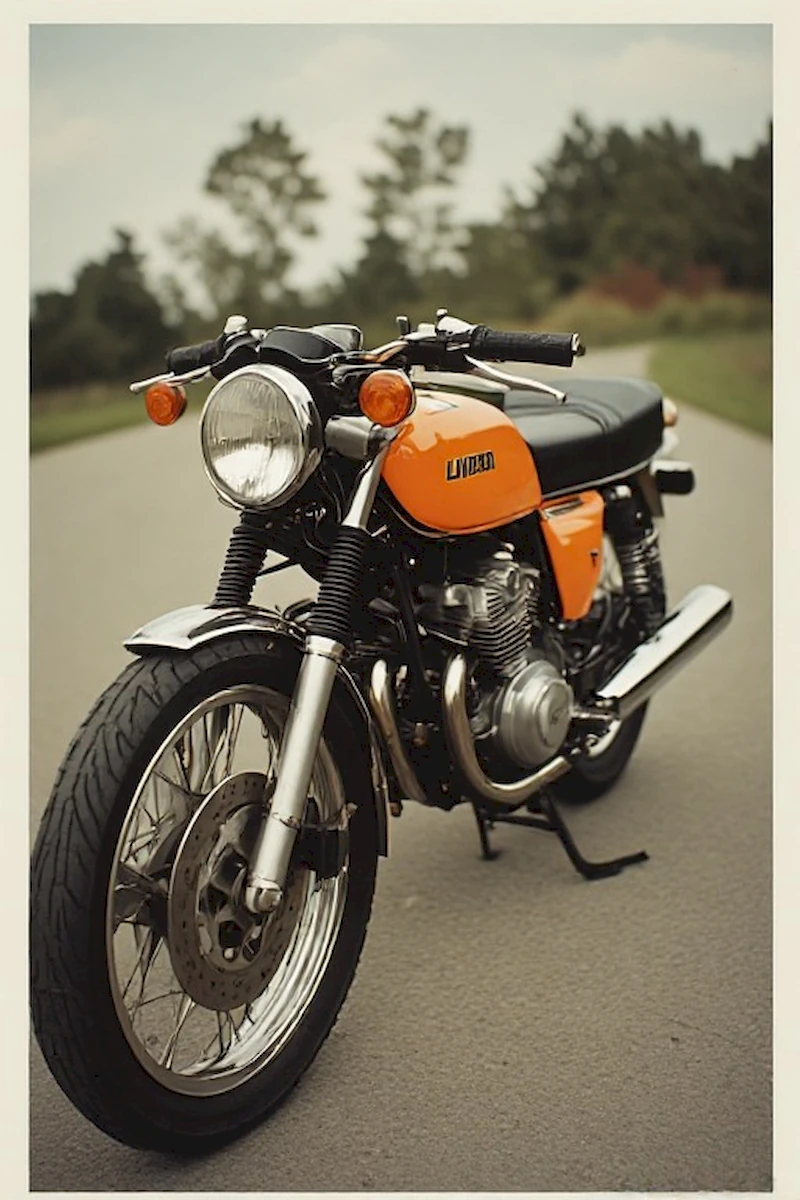
The lines are those of a sober grand tourer: large tank, long dual seat, generous mudguards and an engine that dominates the side view. The dense fins and angular crankcase shapes closely recall the Honda twins of those years, and it is no coincidence: the declared reference model was the Honda CB77.
The frame is a steel-tube top-beam design, with the engine hung beneath the beam rather than enclosed in a traditional cradle. At the front is a telescopic fork, at the rear a swinging arm with two shock absorbers; the brakes are drums on both wheels, as was normal for a 1968 production bike. The riding position is upright and relaxed, touring-style, consistent with the GT designation.
The SOHC parallel-twin engine
The heart of the bike is a 654 cc four-stroke parallel twin, with a bore and stroke of 75 x 74 mm, so practically square. Valve gear is single overhead camshaft with chain drive, and cooling is by air. At the time, pushrods and rockers still dominated big European twins: the overhead camshaft allowed higher revs and more precise valve timing, bringing the Laverda closer to the more modern Japanese bikes.
The project, overseen by Luciano Zen, came about after Massimo Laverda had a Honda CB77, a Norton 650SS and a BMW R69S stripped down and studied at the factory. The engine layout comes from the Honda, but the crankshaft was changed to 360°, as in the classic British twins: the prototype shown in 1966 was a 180°, then the timing was changed to improve low-rev delivery.
Electric start and Bosch electrics
Here is an interesting detail: the 650 GT has no kick-start lever, it starts only with the electric starter. In 1968 that was a bold choice, because motorcycle electrical systems were often the weak point. To make it credible, Laverda chose Bosch components, considered more reliable than those then available in Italy, while the instruments were supplied by Smiths. This approach was kept on the 750s derived from it.
Key technical data
- Bore x stroke: 75 x 74 mm
- Frame: steel-tube top beam, engine hung from it
- Front suspension: telescopic fork
- Rear suspension: swinging arm with two shock absorbers
- Brakes: front and rear drums
- Clutch and gearbox: wet clutch, 5-speed gearbox
- Final drive: chain
- Starting: electric only, Bosch system
Historical context
In the mid-1960s Laverda was a solid but small business: 75, 100 and 125 cc bikes, appreciated for their toughness and stars of long-distance races such as the Milano-Taranto, and a first 200 cc twin presented in 1962. The biggest Italian bikes in the catalogues were still placid machines, far from the capacities American and northern European riders were starting to ask for.
In 1964 Massimo Laverda, son of the founder Francesco, visited the United States to understand that market. On his return he persuaded his father that a large-capacity twin was needed, fast, reliable and easy to use. From there came the factory comparison with Honda, Norton and BMW, three different ways of understanding the big bike.
The prototype was shown at the Earls Court Show in London in November 1966: a bold choice, because it meant presenting itself in the homeland of parallel twins. It is worth remembering that in those same months MV Agusta and Moto Guzzi were also moving towards big capacities: Italy was preparing for a new season.
In 1967 the American Jack McCormack, with commercial experience at Triumph, Honda and Suzuki, tried the prototype and proposed selling Laverdas in the United States under the American Eagle brand. It was he who suggested taking the displacement to 750 cc, better suited to that market. So the 650 went into production in 1968 almost simultaneously with the 750: the first production bike officially left the factory on 16 May 1968, but its career closed within a few months, making way for its bigger sister.
Main versions
- 1966 prototype: shown at Earls Court in November 1966, with a 180° crankshaft, later changed to 360° before production.
- 1967 prototypes: development bikes with experimental solutions in the engine, exhausts and casings, not intended for sale.
- 650 GT (1968): production version, 654 cc SOHC twin (75 mm bore), electric start, drum brakes. About 52 examples, mostly destined for the French market. Frame numbers from 1001, in the same series as the first 750s.
- 750 GT (from 1968): not a version of the 650 but its direct successor: the same bike with the bore increased to 80 mm. In the United States the first 750s were sold under the American Eagle brand.
Laverda sometimes fitted different components within the same series, depending on supplier availability: small differences between two bikes are not in themselves a sign of poor originality.
Trivia and anecdotes
- Almost all in France: of the roughly 52 bikes built, most went to the French market, not to the American one for which the project was conceived.
- Three bikes stripped down: to define the project, the factory dismantled a Honda CB77, a Norton 650SS and a BMW R69S. The result takes something from each, but the kinship with the Honda is the most obvious.
- A London debut: the prototype was unveiled at Earls Court, home turf of the British twins, with a 180° engine that would never reach production.
- Shared numbering: the 650s were numbered from 1001 onwards together with the first 750s, a sign of how close the two bikes were.
What to check before buying one
Today the Laverda 650 GT is first and foremost a piece of history. With estimated production of around 52 examples, it is one of the rarest Laverdas of all, and its value lies above all in being the forefather of the big Breganze twins.
Appeal and character
The appeal is that of bikes that mark a change of pace: a marque known for lightweights trying to challenge the British and Japanese on their own ground. The 360° twin, the electric start and the squared-off lines tell the story of the late 1960s well, when Italian bikes began to think big.
Usability
By design it is a grand tourer: comfortable position, an engine built for travel. The limits are those of a 1968 bike: drum brakes that demand anticipation and attention, period suspension, no electronic aids. Given its rarity, you are more likely to see it at rallies and concours than in everyday use.
Parts and maintenance
Many mechanical parts are shared with or derived from the first 750s, for which there is an active network of clubs and specialists. The parts specific to the 650, such as the displacement-related components and the finishing details of that first series, are by contrast much harder to find: buyers must allow for long searches and, at times, remanufacture.
What to check before buying
- Identity: numbering is shared with the 750s, so frame and engine numbers and the actual displacement must be checked carefully, because a 750 converted to a 650 is a real risk.
- Documentation: registration papers, history and provenance (many were destined for France) weigh heavily on value.
- Electrics: with no kick-start lever, the starter motor, battery and charging system must be in order.
- Originality: compare components with the Laverda clubs' documentation, bearing in mind that the factory sometimes used different parts within the same series.
Values
We have not found verifiable recent valuations: with so few examples, changes of hands are rare and values depend heavily on originality, documentation, condition and the history of the individual bike. For an estimate it is best to approach marque clubs and specialist auction houses.
The 650 GT had a very short life, but it set the rules of the game for everything Laverda would build afterwards. And that is precisely why, even today, those who love Breganze bikes see it as the point from which everything began.