

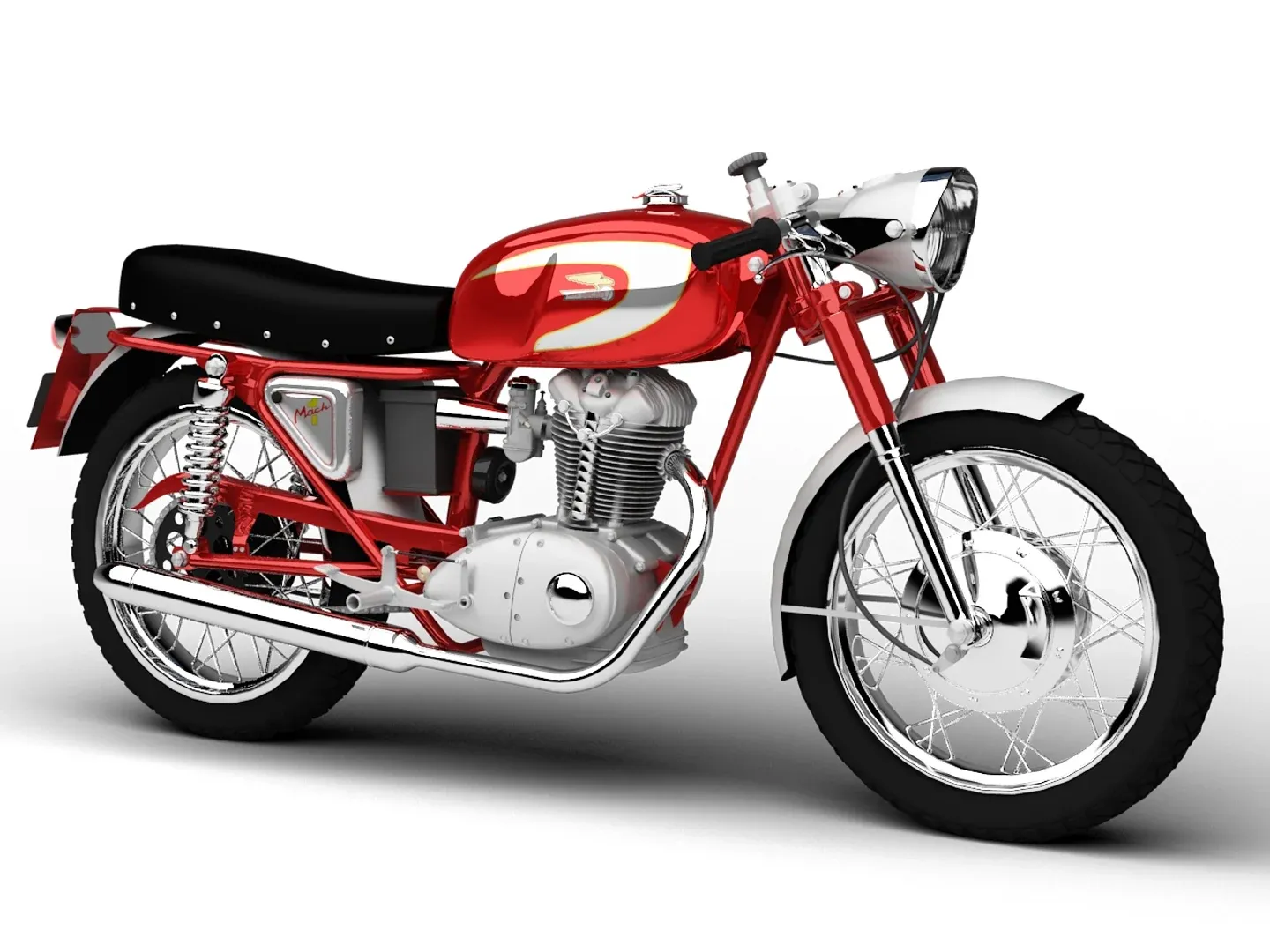
Ducati Mach 1 (1964-1966)
Ducati · 1964-1966 · 248.6 cc
Features and technical evolution
The Ducati Mach 1 is a sporting 250 built from 1964 to 1966, a bike that tells well the direction Ducati took in the years when small-capacity Italian machines were seeking true sports-roadster performance. Its 248.6 cc single, five-speed gearbox and tucked-in riding position defined a bike meant for those who wanted to make the most of the engine and ride with determination.
The lines are lean and functional. The elongated tank, compact seat, clip-ons and rearset footrests give the rider a sporting posture. The frame is in steel tube; the 18-inch wire wheels and drum brakes reflect the technology of the time. A telescopic fork works at the front; at the rear a swinging arm is paired with two shock absorbers.
The bevel-drive single
The heart of the Mach 1 is a four-stroke air-cooled single with an overhead camshaft driven by a vertical shaft and bevel gears. This solution transmits the motion from the crankshaft to the overhead camshaft. It was a distinguishing feature of the Ducati singles of that generation, precise but more complex to assemble and adjust than simpler drive systems.
Valves and valve gear
The production Mach 1 of 1964-1966 should not be confused with the later road-going Ducati 250 Desmo. Its engine uses a conventional SOHC valve gear with spring-closed valves, while desmodromic, which mechanically controls both the opening and closing of the valves, reached the road-going 250 production at a later stage.
A five-speed gearbox
The five-speed gearbox is one of the central elements of the Mach 1's character. It offers more chances to keep the engine in its useful rev range than the four-speed boxes common on many road bikes of the era. The clutch is a wet multi-plate and the final drive is by chain. Displacement is not high, but the light weight and sporting gearing make it important to choose the right gear.
Light chassis, traditional brakes
The relatively light structure and compact wheelbase are consistent with the aim of building an agile 250. Technical sources report a dry weight of around 116 kg, a figure to be read bearing in mind that weighing methods were not always uniform. The brakes are both drums: the front has a stated diameter of 180 mm, the rear 160 mm. Today they require shoes, drums, cables and adjusters to be kept in correct condition.
Key technical data
- Bore and stroke: approx. 74 × 57.8 mm.
- Compression ratio: 10:1.
- Fuel system: Dell'Orto carburettor; designation to be checked on the individual bike.
- Ignition: battery and coil in the commonly reported specifications; 6 V system.
- Clutch: wet multi-plate.
- Gearbox: five-speed.
- Final drive: chain.
- Front suspension: hydraulic telescopic fork.
- Rear suspension: swinging arm with two shock absorbers.
- Brakes: 180 mm front drum and 160 mm rear.
- Fuel tank: approx. 13 litres in the data sheets consulted.
The Mach 1 should not be judged as a modern 250 nor as a replica of a racing bike. It is a sporting roadster of its time, with mechanics that reward care. To identify a bike correctly it is important to check numbers, components and engine configuration: restoration work and modifications inspired by the competition versions may have changed the look and some technical details.
Historical context
At the start of the 1960s Ducati was developing a range of singles increasingly oriented towards performance. The 250 Diana and its evolutions had shown that a small capacity could offer a sporting experience without requiring a more expensive and complex twin. It was in this context that the Mach 1 was born, presented at the end of 1964 and remaining in production until 1966 according to the most widely accepted chronologies.
The American market carried significant weight for small and medium-capacity Ducatis. US enthusiasts looked with interest at light, agile European bikes suited to club racing, while in Europe a sporting 250 could be an alternative to the bigger capacities. The Mach 1 sat precisely in this space: a road-legal bike with a sporting layout, five-speed gearbox and components that recalled the world of racing without being a pure competition machine.
The project formed part of the technical work of Fabio Taglioni, an engineer fundamental to the development of the Ducati singles and to research into desmodromic valve gear. It is important to separate the historical value of the Desmo system from the actual configuration of the production Mach 1. The road-going 250s of that period still used valves with return springs; Desmo road production came later.
The Mach 1 was close in architecture to the 250 Mark 3, but its set-up was different. The clip-ons, rearset footrests, battery-and-coil ignition and road configuration made it suitable for those who wanted a sporting bike also usable away from the circuit. The Mark 3, in its more competition-oriented configurations, followed a different logic. The two bikes share part of the technical base, but are not interchangeable.
Production was relatively short. Published chronologies report a few hundred examples, with annual numbers and US quotas that vary depending on the reconstruction. The limited period and collector interest in sporting Ducati singles have contributed to the Mach 1's reputation among enthusiasts. Exact production figures should, however, be traced back to a primary archive reference before being presented as definitive.
The Mach 1 belongs to a phase in which performance did not depend on displacement alone. Weight, gearbox ratios, power band and chassis counted as much as the stated maximum power. It is this balance that helps us understand its identity: a compact single, built for those who appreciated active riding and accepted mechanics that need to be looked after attentively.
Main versions
- Ducati Mach 1 250, first series: introduced in 1964. Approx. 248.6 cc single, four-stroke, air-cooled, overhead camshaft driven by bevel gears, spring-closed valves, Dell'Orto carburettor, five-speed gearbox and drum brakes. The sporting configuration includes clip-ons and rearset footrests.
- Ducati Mach 1 250, 1965-1966 evolutions: production continued with component variations depending on year and market. Before attributing a specific carburation, electrical part or bodywork element to a single year, you must compare the frame and engine number with the documentation for the corresponding year.
- Ducati 250 Mark 3: a distinct, contemporary and technically related model, with a layout closer to sporting use and club racing in some configurations. It is not a variant of the Mach 1. The Mark 3 and Mach 1 may share some mechanical elements, but differ in specification and intended use.
- Ducati 250 Desmo road bike: a later evolution of the 250 single family. Series-production desmodromic valve gear reached road-going 250 production after the 1964-1966 Mach 1. It is therefore not correct to describe the standard Mach 1 as a Desmo without specific evidence relating to a replaced or modified engine.
Trivia and anecdotes
The Mach 1 name looked to performance. The designation fitted the sporting language of the era, in which speed and aeronautical technology were recurring references. It should not be taken as proof that the bike reached the speed of sound: the name was commercial, not a literal technical claim.
Mach 1 and Mark 3 are not the same bike. The two Ducatis share part of the mechanical base, but the Mach 1 was configured as a sporting roadster, with clip-ons and battery-and-coil ignition. The Mark 3 had its own identity and, in some versions, an orientation more directly tied to club racing.
The production Mach 1 was not a Desmo. The desmodromic system, in which the valves are mechanically controlled both opening and closing, was already part of Ducati's technical history, but was not fitted to the standard production Mach 1 engine.
A short commercial life. The Mach 1 stayed on the market for a limited period, from 1964 to 1966. The small production is often cited as one of the reasons for its collector interest, but the exact figures must be traced back to a reliable archive source.
What to check before buying one
Today the Ducati Mach 1 interests those looking for an Italian sports bike of the 1960s with a well-recognised mechanical personality. The bevel-drive single, five-speed gearbox and tucked-in riding position tell of a season in which a 250 could be designed for lively riding without resorting to larger capacities. Its appeal depends on the balance between lightness, engine and chassis layout.
It is important to approach the Mach 1 with the right expectations. Drum brakes, traditional suspension, narrow tyres and the absence of contemporary safety devices call for attentive riding and scrupulous maintenance. The bevel-drive valve gear is an interesting technical solution, but checking and adjusting the engine requires specific skills. It is not the best choice for anyone wanting a classic to use without bothering with the mechanics, or for anyone without access to a workshop experienced in historic Ducati singles.
Before buying an example, start from the bike's identity. Frame and engine numbers, documents, carburettor, electrical components, controls and specification must be compared with the documentation for the specific year. Clip-ons and rearsets may have been replaced during a restoration; the tank, seat and other parts may also come from similar versions. A carefully restored bike is not necessarily made up of all the parts correct for the declared year.
From the mechanical point of view, you need to check starting, compression, noise, oil leaks, the state of the valve gear and correct lubrication, relying on a technician who knows this type of engine. Also check the gearbox, clutch, electrics, wheel bearings, steering, swinging arm, shock absorbers and brakes. A short ride is no substitute for a thorough inspection, especially on a bike that has stood for a long time or been assembled from the parts of several examples.
Parts availability should be verified before starting a restoration. Some parts can be found through specialists and enthusiast networks, while specific, original or year-correct components may take longer and cost more. It is prudent to distinguish reproduction spares, used originals and aftermarket parts: they may be functional, but do not necessarily have the same value for someone seeking a bike preserved in its correct configuration.
No fixed valuation is given for the Mach 1. Value depends on originality, engine condition, restoration quality, documentation and the market of sale. Adverts with asking prices are not equivalent to auction results, and a genuine Mach 1 should not be compared indiscriminately with a converted Mark 3 or a racing replica.
The Ducati Mach 1 is a choice for those who want to truly get to know a sporting classic. Its identity lies in the combination of a technical single, gearing for active riding and a light chassis, not in any single speed figure. A correct, documented example looked after by competent hands can offer a direct connection with an important phase of Ducati; one rebuilt without attention to the versions risks losing precisely what makes this bike interesting.