

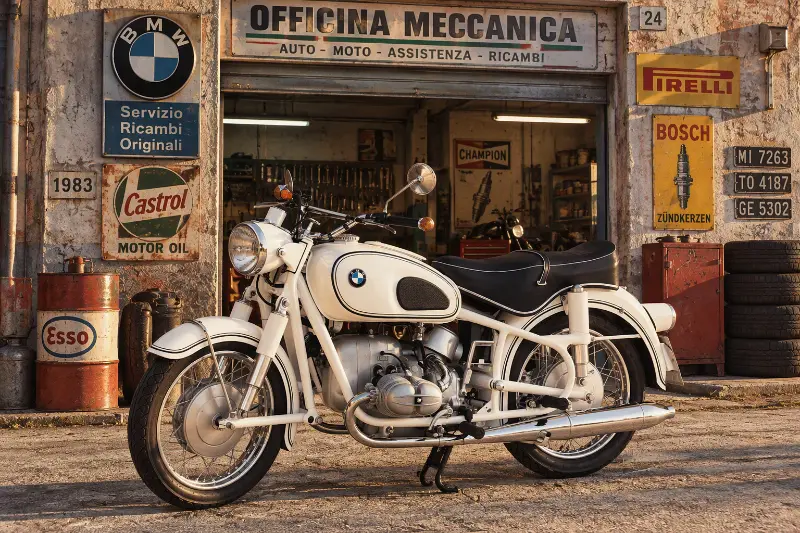
BMW R69S (1960–1969): History, Specs and Value of the Sports Boxer
BMW · 1960-1969 · 594 cc
Features and technical evolution
If there is one BMW that in the 1960s convinced even those who thought BMW meant only comfort, it is the R69S. Introduced in 1960 as the sporting evolution of the R69, it took the 594 cc boxer to 42 bhp and came close to a top speed of 175 km/h (109 mph): serious numbers for the time, which earned it the nickname of a high-performance roadster avant la lettre.
About the bikeAt a glance the R69S stands apart from its siblings through its details: more generous exhausts, shorter final-drive ratios, a seat with a standard-fit grab handle and careful finishes. The chassis keeps the Earles fork, but with specific tuning and reinforcements, while the 200 mm twin-leading-shoe front drum brake was among the best around. In the saddle the riding position remains the upright one typical of BMW, but the power delivery is livelier and the engine revs willingly beyond 7,000 rpm.
Technical data- Engine: boxer twin 594 cc, hemispherical-chamber heads
- Power: 42 bhp at 7,000 rpm
- Gearbox: 4-speed; shaft drive
- Top speed: approx. 175 km/h (109 mph)
- Reinforced Earles fork; rear suspension with twin shock absorbers
- Front brake 200 mm twin-leading-shoe drum; rear drum
The heart is a boxer reworked in its valve gear and cylinder heads, able to rev higher than usual. It is not a revolution, but an example of factory tuning done methodically: compression, fuelling and gearing optimised for pure performance. The R69S showed that BMW's shaft drive and chassis could coexist with spirited riding.
ConclusionThe R69S is proof that BMW knew how to build sports bikes even when "sports bike" was not yet a market category. It is a bike that ages well because its merit was never fashion, but substance.
Historical context
At the start of the 1960s the market is shifting: British twins dominate the sporting narrative, and BMW needs a credible answer without betraying its own identity. The R69S is that answer: same architecture, same shaft drive, but more power and more character. It is also the last expression of the great /2 family, before the big renewal of the /5 series in 1969.
Main versions
The R69S was built in a single basic version from 1960 to 1969, with minimal updates over the years. Examples prepared for racing exist — with a smaller tank, fairings and specific gearing — but these are competition builds, not production versions.
Trivia and anecdotes
The R69S has a solid reputation in endurance races and rallies of the period, where its reliability made up for the power gap with the British competition. Today it is among the most sought-after /2 BMWs, and original, documented examples are scarce compared with demand.
What to check before buying one
It is a high-level collector's bike: it goes fast even by modern rural standards, it is solid and has a special appeal for those who love clean mechanics. Before buying, it matters to check originality — undocumented dismantling is the rule rather than the exception — and the condition of the engine, which originally did not like the wrong oils or neglect. Prices are noticeably higher than for the R50 and R60.