
Motorcycle filtering in Italy: is it legal? What the law says
Is motorcycle filtering in Italy legal? What the current Italian Highway Code says, what the reform approved on 13 October 2026 proposes, who is liable if there's a crash, and practical tips for riders and drivers.
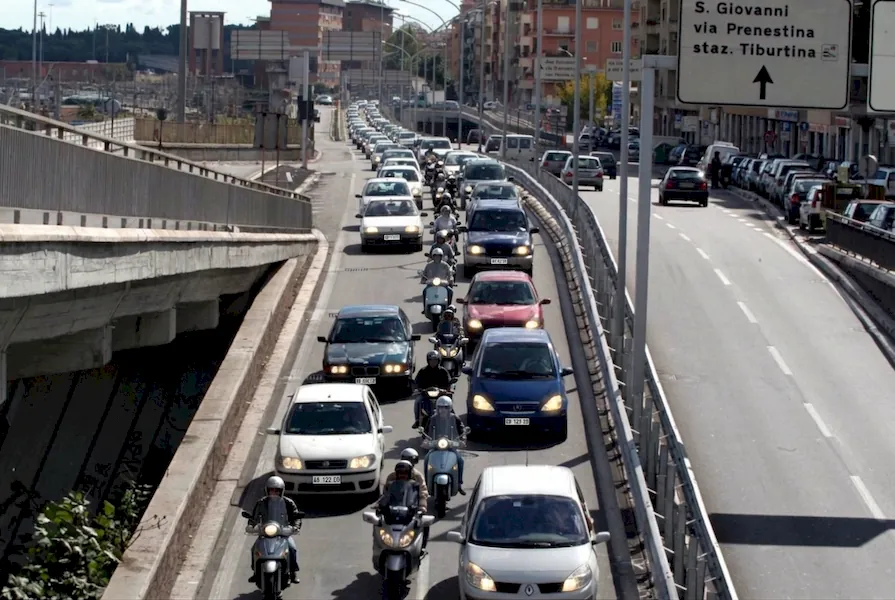
Stationary traffic, cars nose to tail and just a few inches to squeeze through. Anyone who rides knows the scene. But is motorcycle filtering in Italy, riding between the lines of cars, actually allowed? Let's look at what the Italian Highway Code says, what risks you run and what could change with the reform.
The gap between the cars: a situation we all know
If you ride every day, it's happened to you a thousand times. You're in a queue, the cars are stationary and a gap opens up between two lines ahead of you: you could move forward, the drivers can't. And the question comes naturally: are you allowed to?
Today's Italian Highway Code doesn't expressly forbid it. But there's a question that comes even before the law: is that gap safe, for the rider and for the drivers? If the answer is no, the rest hardly matters.
What the Italian Highway Code says today
The Italian Highway Code, the Codice della Strada, has no article on motorcycles passing between queuing cars: there's no permission and no express ban. The manoeuvre is judged by the general rules, above all the ones on overtaking.
Article 148, the one on overtaking, asks for three things: enough visibility and room, no danger or obstruction for others and the ability to complete the manoeuvre safely.
The same article prohibits passing cars that are stationary or moving slowly at traffic lights, level crossings or in a queue when doing so means moving into the part of the road reserved for oncoming traffic. In plain words: no riding up the queue on the wrong side of the road.
So, can I ride between stationary cars?
There's no answer that fits every situation. Rolling slowly through a free gap, without straying into the oncoming lane and without troubling anyone, is one thing. Squeezing between cars packed tight, changing direction suddenly or ending up on the wrong side of the road is quite another.
Here's how I see it. I filter when the cars are stopped or nearly stopped, at walking pace, always thinking about what might happen: a car moving over, a door opening, a scooter popping out of the line. When the traffic gets going again, I move back into the queue.
The reason is simple: between the cars you have no escape route. A mistake, yours or someone else's, is paid for straight away, with your health and with your bike. And the driver is left with a scratched door and a nasty fright.
That's why I don't think of filtering as a rider's right. It's an option, to be used with your head, and in certain conditions it's prohibited or simply dangerous.
Motorcycle filtering in Italy: what does the reform propose?
The subject is back in the news with the draft of the new Italian Highway Code, given preliminary approval by the Council of Ministers on 13 October 2026.
It now needs the opinions of the parliamentary committees, the Council of State and the Unified Conference. Final approval then rests with the Government, by 13 March 2027, and the new rules would apply from 1 January 2028. So be careful: the draft isn't law yet, and until then today's rules apply.
According to the Italian specialist press, two changes concern riders:
- In town: on urban dual carriageways with more than one lane, when traffic is stationary or almost, cars would have to move to the edges of their lanes to leave a space in the middle for motorcycles. Drivers who don't move over would face a fine of 80 to 320 euros and two penalty points on their licence.
- On motorways and roads outside towns: in queues or heavy slowdowns, motorcycles and two-wheeled mopeds could use the hard shoulder, at low speed and ready to make way for emergency vehicles.
But beware of a misunderstanding: neither change is a green light to race between the lines of cars. The gap in town is a duty for drivers, not a licence for riders to go fast.
Who is liable if there's a crash?
If the rider or the driver admits fault, for example on the joint accident report form (the Italian CAI), the insurers usually settle it. If nobody admits it and the insurers can't agree, a civil court decides: the Justice of the Peace for damage up to 25,000 euros, the ordinary court above that.
And if it's impossible to establish what happened, Italian law presumes they are both equally at fault (Article 2054 of the Civil Code). In several crashes in queuing traffic, Italy's Supreme Court has also upheld decisions that split liability between the rider and the driver: the classic case of contributory negligence.
In money terms, neither of them is compensated in full, because each receives only the share of the damage that matches the other's fault. In a queue, in short, caution pays for both.
How to behave when traffic is at a standstill
The rules are one thing, what really happens between the cars is another. And here, before the tips, a word up front: I don't want to lecture anyone. But common sense, civic sense and above all road manners come first.
And they apply to everyone on the road, whatever they're using: riders, drivers of cars, vans or buses, cyclists and pedestrians too. A pedestrian crossing between stationary cars without looking is just as much of a surprise as a door swinging open.
Here are a few precautions to keep in mind.
1. Not every gap is a way through
If there's little room between two cars, don't force it. Mirrors stick out and cars move. If you're not sure you can get through safely, wait.
Losing a few seconds is better than ending up stuck between two vehicles.
2. Keep to a suitable speed
Being on a bike doesn't mean you have to use every little gap to get ahead. The faster you go, the less time you have to react if a car moves. In a queue you must be able to slow down or stop in an instant, without losing control.
And let's do the maths: weaving through the traffic like a daredevil in town gains you one or two minutes, no more. Often, at the next lights, you end up beside the same car you've just passed. It's a ridiculous gain, and it isn't worth the risk of a crash.
3. Watch out for cars changing lanes
A driver might want to take an exit, avoid an obstacle or simply gain a few metres.
Don't assume a car will stay put just because the traffic is jammed. If you spot a suspicious movement, slow down and leave room.
4. Don't forget the mirrors
Mirrors are one of the most exposed points when filtering. Even when the gap looks wide enough, judge the real width of your bike, handlebars included.
If getting through means leaning the bike over too far or risking clipping a car, give up.
5. In rain and poor visibility, take extra care
In the wet, grip and braking distances change. Road markings, manhole covers and metal surfaces turn as slippery as soap.
In these conditions I'd avoid squeezing into tight gaps between cars, especially if I can't see clearly what's happening further ahead.
When it rains, visibility gets worse on both sides: you see less, because your visor gets wet and mists up, and others see less of you, behind misted windows and raindrops on their mirrors.
And if you drive a car? A little extra care
Riders' safety also depends on the people driving cars. Before the tips, I want to tell you about something that happened to me.
A car door opened without looking
One day a driver opened their car door without noticing me arriving on my bike. The impact fractured the fifth metacarpal in my hand. The bone was displaced and I had to have surgery at the CTO, the trauma and orthopaedic hospital, to realign it.
It wasn't just a fall to forget about quickly. When you find yourself in hospital because of a crash that a moment's attention could have prevented, you realise how thin the line is between an ordinary day on the bike and a serious injury.
There's one detail of this story, though, that deserves to be told. The driver took responsibility for what happened. They didn't just admit they were at fault: they also came to visit me at the CTO, where I was in for the operation.
It was the behaviour of a decent person, which I appreciated and haven't forgotten.
That doesn't change the fact that the crash could have been avoided by checking before opening the door. But it shows that owning up to a mistake and behaving humanely after causing harm makes a difference.
That's why, when we talk about road safety, we shouldn't reduce everything to fines, right of way and liability. Rules matter, but so do attention and respect for the people we share the road with.
Before you open a car door, always check your mirror and make sure nobody is coming. For someone on a bike, that simple gesture can prevent far more than a dent in the bodywork.
Five habits for drivers
- Check your mirrors well, no, really well, before changing lanes. A motorcycle can be in a less visible position than a car.
- Indicate in good time. Signalling a manoeuvre doesn't make it safe on its own, but it lets others understand your intentions.
- Avoid sudden moves. If you're in a queue, don't change position without checking the space is clear.
- Don't open the door without checking. Before getting out, make sure no motorcycle or bicycle is coming. In Italy the Highway Code requires it too (Article 157, paragraph 7).
- Leave room when you can. Today you're not obliged to create a gap that would compromise safety, but you can avoid pointless, unpredictable movements. Under the reform, on multi-lane urban roads, moving over could become compulsory.
It isn't about deciding who has more rights on the road. It's about making behaviour predictable, especially when space is tight.
My view: getting there first isn't worth any risk
A motorcycle lets you move differently from a car, but it doesn't make you immune to other people's mistakes. Quite the opposite: when room shrinks, one unexpected movement is enough to lose your balance or hit a vehicle.
For me the practical rule is simple: if I can't see clearly what's happening ahead, if the gap is too narrow or if getting through means relying on luck, I wait. It's not about being more or less experienced, it's an extra safety margin.
And if you ride a classic, you also know how annoying and expensive it can be to put right a silly fall. But the main point is another one: people always come before the bike.
To sum up
- today the Italian Highway Code neither allows nor expressly forbids riding between queuing cars: how you do it is what counts;
- the reform isn't in force yet: if it stays as it is, in town queuing cars will have to leave a gap and on motorways bikes will be able to use the hard shoulder in queues;
- until then, the hard shoulder on Italian motorways can't be used to get past a queue;
- always: available space, visibility and the ability to stop must guide our decisions.
Motorcycle filtering in Italy remains a subject where the law and riding habits need to be kept clearly apart. I'll follow the reform and update this article when the text is final. Meanwhile, knowing the rules and riding without forcing things remains the best way to get home with your bike and your bones in one piece. If you have experiences or questions, drop me a line.
Ride safe, everyone.