

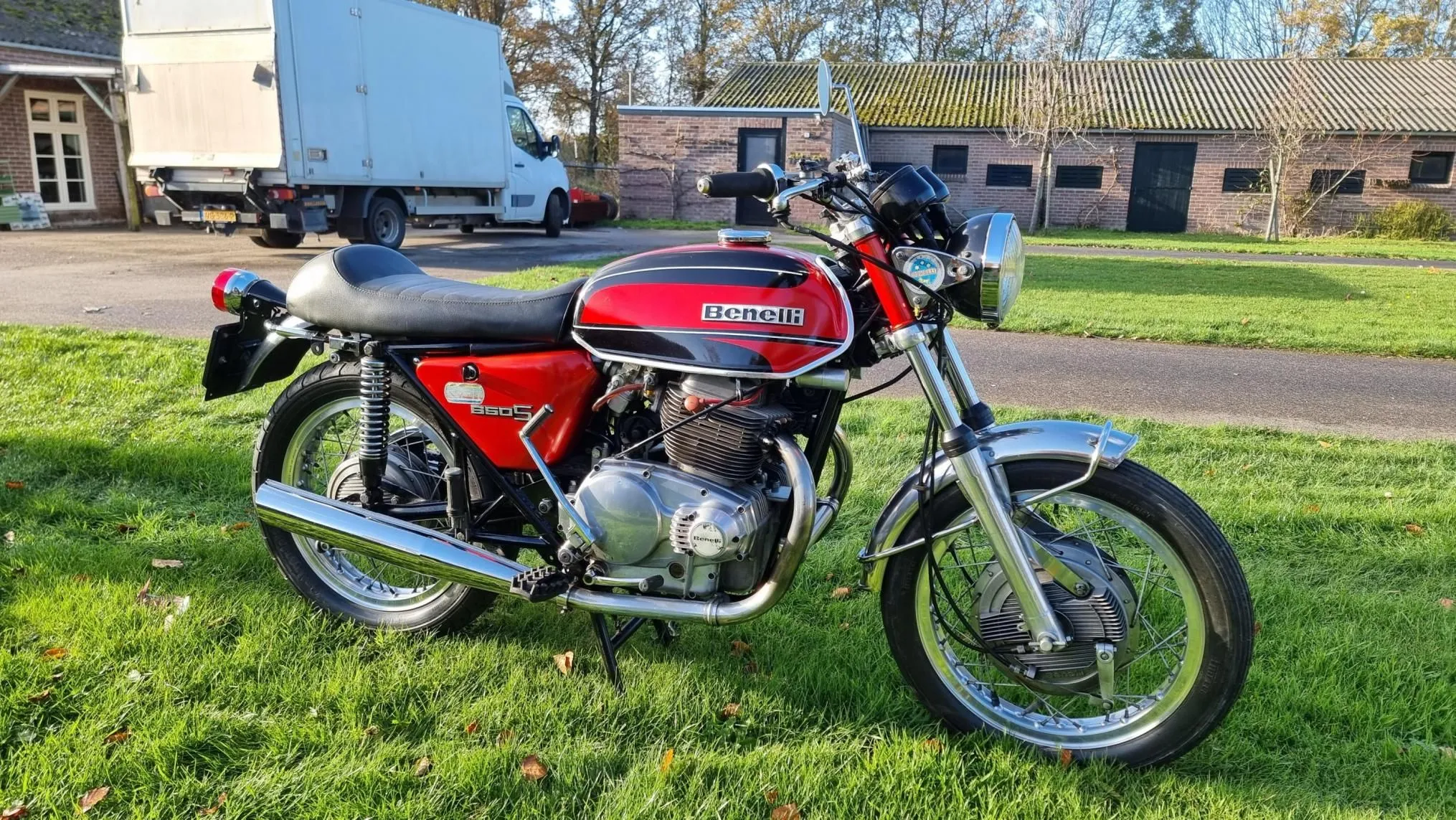
Benelli Tornado 650: The Story of Pesaro's Big Twin
Benelli · 1967-1970 · 642 cc
Features and technical evolution
The Benelli 650 Tornado is an Italian roadster twin built to take on the big British bikes of the early 1970s. Designed in Pesaro, it combined an air-cooled four-stroke engine, a five-speed gearbox and a sporty-minded chassis. Its production history runs between 1970 and 1975, including the later Tornado S and S2 evolutions.
The heart of the design is a parallel twin with pushrod-and-rocker valve gear, built to offer a substantial displacement and a recognisable mechanical personality. The Tornado represents a significant chapter in Benelli's growth towards big-capacity motorcycles, in a market that was becoming ever more competitive.
Historical context
In the 1960s the US market was a strategic target for European manufacturers. British twins had won an important position there and Benelli decided to respond with a new motorcycle of around 650 cc. The project, entrusted to Piero Prampolini for the engine and Luigi Benelli for the frame, took shape through prototypes shown from 1967 onwards.
Industrial preparation took time and the Tornado reached the US market in 1970, before reaching Europe in 1971. In the meantime, Japanese multi-cylinder bikes were raising the bar for performance, equipment and technical refinement. Benelli thus found itself competing not only with the traditional English twins, but also with a new generation of motorcycles.
The corporate turning point of 1972, with the arrival of Alejandro de Tomaso at the head of the company, accompanied the model's evolution. The Tornado S introduced technical changes also aimed at improving everyday usability; in 1973 came the more distinctive S2. The family stayed in production until 1975 according to one of the most widespread chronologies, although some sources give different end dates for specific variants.
Main versions
- Benelli 650 Tornado — 1970–1971: first production version, initially aimed at the US market and later sold in Europe. Air-cooled four-stroke parallel twin, five-speed gearbox and kick start.
- Benelli 650 Tornado S — from 1972: evolution introduced under De Tomaso's management. Changes included electric start, a rebalanced crankshaft, a revised compression ratio, updated gear ratios and Veglia instruments. Flexible mountings were also adopted to contain vibration.
- Benelli 650 Tornado S2 — from 1973: a variant with a sportier approach, recognisable by its seat with a raised tail and the small transparent flyscreen on the handlebars. Further changes aimed to improve low-rev response and reduce vibration.
Dates may vary slightly depending on the sources consulted and the criterion used to distinguish production year, sales year and individual version.
Trivia and anecdotes
- A prototype as early as 1967: the Tornado was shown at the Milan Show several years before it was actually put on sale. The delay was also due to the need to prepare the production tooling.
- A consultation with Steve McQueen: during development the actor, then linked to Benelli's promotion in the United States, was also asked for his opinion. Suggestions attributed to him include indications on the frame and bodywork.
- Vibration at the centre of the updates: the 360° crank parallel twin had a marked mechanical personality. The Tornado S introduced rebalancing work and flexible solutions to limit vibration transmitted to the rider and components.
- Two markets, small differences in detail: some bikes destined for the United States were distinguished from European ones by items such as handlebars and seat. To identify a restored bike correctly it is therefore important to consider year, destination and original configuration.
What to check before buying one
The Benelli 650 Tornado is evidence of the Italian motorcycle industry's determination to take on the big international twins. The generous-capacity engine, the traditional construction and the later technical revisions make it an interesting model for anyone who wants to understand the transition between the classic European roadsters and the new Japanese competition.
It was not a bike without compromises: weight and vibration were important aspects of its character and helped steer the updates of later versions. The S and S2 show how Benelli tried to answer these issues without giving up the Tornado's identity.
Today its historical interest also lies in being able to read, through the different versions, the technical and industrial evolution of the Pesaro marque in the early 1970s. For a collectable example, correct identification of the variant, consistency of components, documentation and the quality of any restoration are particularly important.