

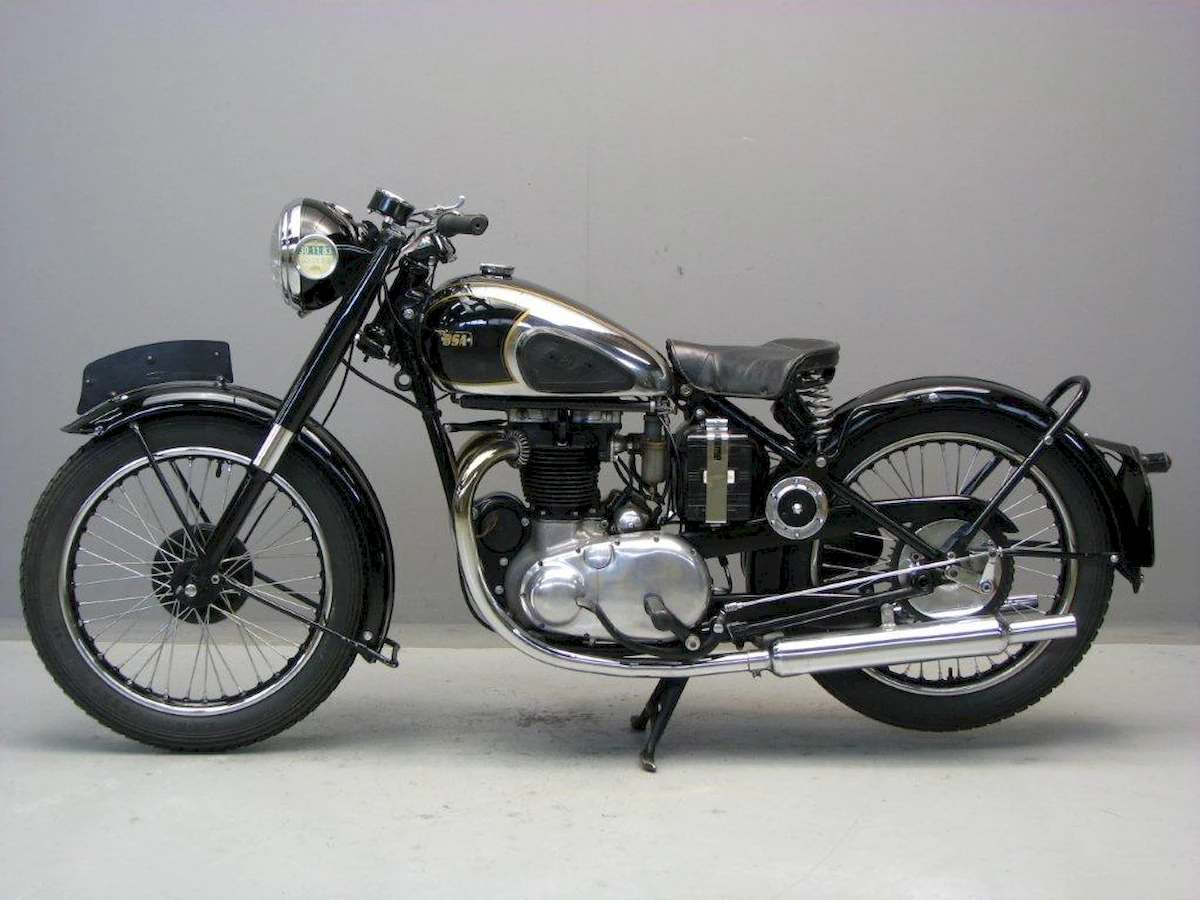
BSA A7 (1947-1962)
BSA · 1947-1962 · 495 cc / 497 cc
Features and technical evolution
The BSA A7 is the British 500 cc twin with which BSA entered the post-war era, bringing to the road a formula destined to become central to its range. Introduced in 1947, it combined a four-stroke parallel engine, overhead-valve gear and a chassis that changed appreciably during production. It is precisely this evolution that makes it interesting today: behind the A7 name you find rigid-frame bikes, versions with plunger rear suspension and more mature models with a swinging arm.
At first glance the A7 belongs to the British school of the period: rounded tank lines, wide mudguards, a relatively plain seat and the engine in full view. It does not seek the theatrical effect of modern sports bikes. Its identity rests on proportions, mechanics and a construction that favours substance. The differences between years can, however, be considerable: an early rigid-frame A7 conveys a very different approach from a Shooting Star of the final years of production.
A parallel twin built for the road
The engine is an air-cooled vertical parallel twin, with OHV valve gear driven by pushrods and rockers. In the first configuration displacement was around 495 cc, obtained with a long stroke. From 1951 a revision arrived with a shorter stroke and a displacement of around 497 cc, linked to the development of the larger A10 engine. It is therefore not a single unit that stayed identical for fifteen years, but a mechanical family progressively updated.
Semi-unit construction
A particular feature of the early A7s is the semi-unit construction: the gearbox was bolted directly to the back of the engine, instead of being completely separate as on many earlier British motorcycles. The engine-gearbox assembly nevertheless remained distinct from the frame. The solution made it possible to bring the components together in a compact whole without reaching the full unit construction that would spread later. When the new swinging-arm frame arrived in 1954, the layout of the transmission was revised along with the chassis.
From rigid frame to rear suspension
The first A7s had a rigid rear end: a choice still found on several machines of the immediate post-war years, but ever less suited to expectations of comfort and control on rough roads. From 1949 BSA also offered plunger rear suspension, in which the wheel assembly moved vertically through sliding elements. It was an intermediate step, not the definitive solution. In 1954 the range moved to the swinging arm, which allowed the rear wheel to follow road irregularities better.
The difference between the A7 and the sports versions
The standard A7 was designed for general road use; the Star Twin and Shooting Star developed its sportier side. The engine, compression ratio, some valve-train components and, depending on version and year, the cylinder head and fuelling changed. The presence of two carburettors should not be taken for granted on every sporting example: configuration and components must be verified on the specific version. With the Shooting Star, introduced in 1954, the design reached a more evolved combination of engine and swinging-arm rear suspension chassis.
Key technical data
- Architecture: vertical parallel twin, four-stroke, air-cooled.
- Valve gear: OHV, with pushrods and rockers.
- Initial displacement: approx. 495 cc.
- Later displacement: approx. 497 cc.
- Gearbox: four-speed, with differing construction details depending on the model's evolution.
- Chassis: rigid frame, plunger-suspension frame or swinging-arm frame, depending on version.
For anyone looking at a BSA A7 today, the decisive detail is not just the year stated on the paperwork. Frame, engine, cylinder head, fuelling and finishes help to understand which version you are looking at and whether the whole is consistent. It is a bike to be read as an evolving family, not as a single configuration that stayed unchanged.
Historical context
The BSA A7 was born in the period when British industry was returning to concentrate on civilian motorcycles after the war years. BSA had an important industrial presence and a range that included models of different capacities and layouts. The arrival of a 500 cc parallel twin answered a concrete need: to offer a road bike suited to covering serious distances, but with livelier mechanics than many everyday singles.
The vertical twin was already an established formula in the United Kingdom. Triumph had shown how effective it could be, and BSA chose to develop its own solution, with a single camshaft for the valve gear instead of the two separate camshafts of the reference Triumphs. The A7 project was announced in 1946 and reached the market in 1947. The war had slowed development, but the need for a modern twin was by now obvious.
The first A7 still reflected post-war compromises. The rigid frame simplified construction, while the long-stroke engine favoured power delivery suited to the road. With the gradual improvement of economic conditions and customer expectations, however, interest grew in brisker performance and a more comfortable chassis. In 1949 came the Star Twin, a sportier variant; in 1951 the engine was revised following solutions also developed for the larger A10.
Competition with other British twins, in particular the sporting Triumphs, helped push BSA towards higher-performance versions. The Star Twin and then the Shooting Star represented this response, with greater attention to power and mechanical detail. The Shooting Star, introduced in 1954, coincided with the move to the swinging-arm frame, a change that substantially altered the bike's behaviour compared with the early versions.
The market was not the same in every country, however. In the United States the standard swinging-arm A7 was also sold under the name Flash, while interest in bigger capacities often favoured the larger A10. In the United Kingdom, by contrast, a well-built 500 could represent an attractive compromise between cost, practicality and performance. This difference in expectations helps explain why the A7 had a varied range and why some names are tied to specific markets.
A7 production ended in 1962, when BSA introduced the new A50 family with unit-construction engines. The A7 thus remained tied to the previous generation, in which engine and gearbox were still separate components. For today's enthusiast its story tells of a period of transition: from the simpler solutions of the post-war years to an increasingly refined road twin, without losing the mechanical character typical of British bikes of those years.
Main versions
- BSA A7 rigid frame: from 1947. The first configuration of the family, with an engine of around 495 cc and a long stroke, cast-iron cylinder and head and an unsprung rear end. It is the version most tied to the immediate post-war layout.
- BSA A7 with plunger suspension: from 1949. It kept the general layout of the A7 but offered plunger rear suspension. The introduction of this solution does not mean all later bikes had the same chassis: frame and year must be identified carefully.
- BSA A7 with updated engine: from about 1951. The engine moved to a shorter-stroke configuration, with a displacement of around 497 cc, derived from development of the A10 family. It is one of the most important technical differences to recognise between the early bikes and the later ones.
- BSA A7S Star Twin: introduced in 1949 and built until 1954. A sporting variant with a higher compression ratio and a revised engine. Cylinder head and fuelling configurations changed over the years; twin carburettors are documented on some configurations, but should not be assumed on every bike. Different frame configurations were available, including a rigid frame on special request.
- BSA A7SS Shooting Star: from 1954 to 1962. A sporting version that replaced the Star Twin, pairing a livelier engine with the swinging-arm frame. Specifications evolved during production: sources report around 30 bhp for the higher-performance versions, but the exact value must be tied to the year and configuration.
- BSA A7 Flash for the US market: a name used in the United States for the standard A7 in later versions, in particular after the introduction of the swinging-arm frame. It is a market trade name, not a mechanically separate model to be applied to every exported A7.
- BSA A7 with alternator: from 1961 the alternator was offered as an alternative to the dynamo on some versions. It is an electrical-system difference to be checked on the individual bike, not a feature to attribute to all A7s of the final years.
Trivia and anecdotes
BSA's first production parallel twin. The A7 is generally recognised as the marque's first series-production parallel twin. Its arrival broadened the range beyond singles and gave BSA a direct response to the established British twins.
A single camshaft. In the A7 design the OHV valve gear was driven by a single camshaft placed behind the cylinders. It is a technical difference from some rivals of the era and a useful detail for understanding the engine's layout.
The hinged rear mudguard. On the early versions there was a practical feature to make rear-wheel removal easier: part of the mudguard could be lifted on a hinge. It is a detail linked to maintenance, not a purely decorative element.
Star Twin and Shooting Star are not synonyms. The two names identify different phases of the A7's sporting development. The Star Twin arrived in 1949; the Shooting Star replaced it in 1954, along with the range's move to the swinging-arm frame.
The Flash name was tied to the American market. The standard A7 was called Flash in the United States. When examining an imported bike it is therefore important to distinguish the trade name used in the destination market from the actual mechanical version.
What to check before buying one
Today the BSA A7 interests above all those looking for a classic British bike with a readable technical history and a family of versions broad enough to make identification of the individual bike important. It is not a bike to be valued solely on the marque on the tank: an early A7, a Star Twin and a Shooting Star can differ in chassis, engine, components and collector value. Even two bikes of the same apparent year can call for different checks, especially if they have been restored or assembled from parts of several periods.
On the road, a well-tuned A7 must be judged in the context of its era. The parallel twin and four-speed gearbox belong to a mechanical conception far from modern bikes: vibration, braking, suspension, lighting and behaviour in the wet are not comparable with current standards. The versions with rear suspension offer a different layout from the first rigid one, but you should not expect the comfort or precision of a contemporary classic designed with modern technology.
Before buying, the priority is to understand what you are buying. Check that frame and engine numbers match, the identity of the version, the presence of components consistent with the year and any restoration documentation. An engine that starts is not enough to show it is in good condition: it is important to assess compression, mechanical noises, oil pressure and circulation using the appropriate procedures, leaks, carburation, gearbox and clutch. On the electrics you need to check whether the bike uses a dynamo or an alternator and whether any modifications were done properly.
The chassis deserves equally careful inspection. On a rigid version the integrity and alignment of the frame must be checked; on a plunger the sliders, wear and play need examining; on a swinging-arm model bushes, spindle, shock absorbers and wheel alignment are important. Drum brakes, rims, spokes and tyres must be assessed for wear and correctness of configuration. Fresh paint or shiny chrome is no substitute for documentation of the work done.
As for spares, there is an international community of enthusiasts and specialists in classic BSAs, but availability and compatibility must be checked against the part number and the version. Some components may be shared with other BSAs of the same family; others differ between the early A7s, the sports versions and the final models. It is best to avoid buying a part just because it is described generically as "for A7".
No single valuation is given here: the price depends on originality, mechanical condition, restoration quality, documents, provenance and the market in which the bike is sold. Before making an offer it is worth comparing examples of the same version and distinguishing asking prices in adverts from actually completed sales.
The BSA A7 makes sense for those who appreciate a vintage bike to get to know and maintain, not for those seeking the uncompromising convenience of a modern roadster. Its interest lies precisely in the transformations it went through: following the passage from the rigid frame to the Shooting Star means seeing how a post-war twin adapted to riders' expectations. It is a classic to choose with the head before the heart: the right version, documented and mechanically sound, is worth more than an eye-catching but inconsistent restoration.