

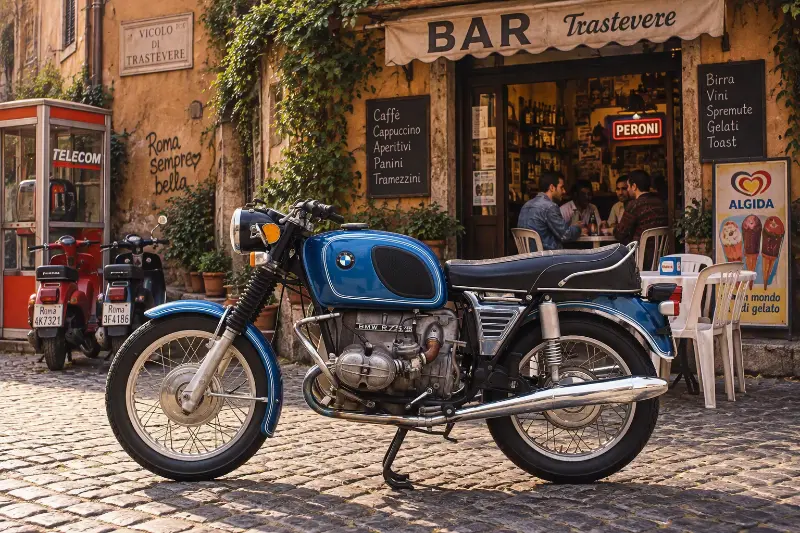
BMW R75/5 (1969–1973): History, Specs and Value of the /5
BMW · 1969-1973 · 745 cc
Features and technical evolution
BMW R 75/5: the boxer that opened a new season
Presented in the autumn of 1969, the BMW R 75/5 marked an important turning point for the Munich marque. It was not just the larger-capacity version of the new /5 family: it represented an attempt to bring the BMW motorcycle back to the centre of a changing market, with higher performance, a modern chassis and greater attention to road use.
Its character comes from the meeting of a recognisable technical tradition and a renewed design. The air-cooled boxer twin keeps the architecture that had made BMWs famous, but adopts new constructional solutions compared with earlier generations. The opposed cylinder layout helps define the bike's profile and leaves the finned cylinder heads clearly visible, which became one of the most characteristic aesthetic features of the German twins.
A 745-cubic-centimetre boxer
The engine has a displacement of 745 cc, with an 82 mm bore and a 70.6 mm stroke. Valve gear is pushrod-and-rocker, with overhead valves, while fuelling is by two Bing constant-vacuum carburettors. Stated power reaches 50 bhp at 6,200 rpm: a figure that placed the R 75/5 at the top of the new /5 range, above the R 50/5 and R 60/5.
Among the mechanical innovations are the crankshaft forged in a single piece, running on plain bearings, and the timing driven by a duplex chain. The design also introduces a four-speed gearbox and electric start, alongside the traditional kick-start system. These are details that describe a bike designed for more versatile use, not only for traditional touring but also for more dynamic riding.
Essential chassis, road-going layout
The /5 series abandons the earlier Earles front fork layout and returns to an updated telescopic fork. The tubular double-cradle frame is designed specifically for the new family and goes with a mechanical package that is relatively easy to maintain. At the rear, suspension is by swinging arm with shaft final drive, a solution typical of the BMW tradition.
The result is a big roadster with a sober look, a tank with clean shapes, a long seat and the engine in full view. The top speed stated by BMW Group Classic is 175 km/h (109 mph). As with every motorcycle of this generation, performance should be read in the context of the period: brakes, tyres and wind protection do not match the standards of a modern bike.
The R 75/5's place in the BMW range
Produced from 1969 to 1973, the R 75/5 is today one of the most recognisable expressions of BMW's transition to modern road-going twins. Its importance depends not only on displacement or speed, but on how it joins an instantly recognisable mechanical identity to a renewed design. It is a classic BMW to be understood as a whole: boxer engine, gearbox, shaft drive and traditional chassis form a coherent package in which apparent simplicity and build quality play a central role.
Key technical data
- Production: 1969–1973, according to BMW Group Classic.
- Engine: four-stroke boxer twin, air-cooled.
- Displacement: 745 cc.
- Bore x stroke: 82 x 70.6 mm.
- Valve gear: overhead valves, pushrods and rockers.
- Fuel system: two Bing constant-vacuum carburettors.
- Stated power: 50 bhp at 6,200 rpm.
- Gearbox: four-speed.
- Final drive: propshaft.
- Stated top speed: 175 km/h (109 mph).
- Chassis: tubular double-cradle frame and telescopic fork.
Historical context
The BMW R 75/5 and the rebirth of the road-going motorcycle
At the end of the 1950s the European motorcycle market was going through a difficult phase. The spread of the car was reducing the motorcycle's role as everyday transport and forcing manufacturers to rethink their offering. BMW too had to face this change: the technical reputation of its twins was not enough, on its own, to guarantee growth in an ever more competitive market.
Towards the end of the 1960s new signs of interest emerged, above all for motorcycles able to offer performance, riding pleasure and a strong identity. The US market helped reinforce this trend. The motorcycle was no longer just an economical way of getting around: it was also becoming a recreational product, intended for touring and sporting road riding.
The /5 series was born in this setting. Presented in the autumn of 1969, it comprised three models: R 50/5, R 60/5 and R 75/5. The project introduced a profoundly renewed boxer engine, a new frame and a chassis closer to the expectations of contemporary customers. Production of the new motorcycles began at BMW's Berlin-Spandau plant, which became an important reference point for the marque's motorcycle manufacturing.
A new generation without disowning tradition
The R 75/5 was the pinnacle of the family and showed that the boxer architecture could evolve without losing its identity. Air cooling, opposed cylinders and shaft final drive remained distinctive features; at the same time, the plain-bearing crankshaft, renewed valve train, constant-vacuum carburettors and electric start pointed to a more modern design.
Its historical importance lies precisely in this balance. The R 75/5 did not try to imitate the competition, but updated BMW's technical language to respond to a public that wanted a higher-performing and more versatile bike. The series helped relaunch the image of the BMW motorcycle and prepared the ground for later evolutions of the road-going boxer family.
Main versions
Versions and evolution of the BMW R 75/5
The R 75/5 was produced from 1969 to 1973. It is important to distinguish the series launch, which took place in 1969, from the model years reported by some specialist sources, which start the R 75/5's sales in 1970. BMW Group Classic documentation in any case gives the overall period as 1969–1973.
- First short-wheelbase series: the initial bikes are associated with the short-wheelbase frame. Differences between individual years and specifications must be verified against the frame number and the relevant parts catalogues.
- Long-wheelbase evolution: during production a longer-wheelbase configuration was introduced. To identify a bike correctly you need to check frame, components and production year, without relying on outward appearance alone.
- Tank and specifications: the R 75/5 is also known through several tank configurations, including the one with chrome side panels often nicknamed the “Toaster”. The presence of this tank should be assessed in relation to the market and the bike's original configuration.
The R 75/5 should not be confused with the other capacities in the same family: the R 50/5 and R 60/5 were distinct models, with different displacements and power outputs. Likewise, single seats, touring accessories, fairings and cosmetic modifications found on some bikes today may post-date production and do not automatically identify an official version.
For a faithful restoration, the most reliable check starts from the frame number and a comparison with BMW documentation for the year and destination market.
Trivia and anecdotes
Trivia about the BMW R 75/5
- A new factory for a new generation: the /5 series was among the first BMW motorcycle families built at the new Berlin-Spandau plant, marking an important step in the marque's production organisation.
- The boxer changed profoundly: while keeping opposed cylinders and air cooling, the /5 series engine adopted a crankshaft forged in a single piece and supported on plain bearings. It was a different solution from earlier generations.
- The /5 designation identifies a family: the range comprised the R 50/5, R 60/5 and R 75/5. The latter was the largest-capacity version and developed a stated 50 bhp.
- “Toaster” is a nickname: the informal name, used mainly in English-speaking circles, refers to the tank with chromed side surfaces. It is not an official technical designation of the model.
These details show how the R 75/5 is interesting not just for its 745 cc engine, but also as evidence of the moment BMW deeply updated its road motorcycle without abandoning the boxer.
What to check before buying one
The BMW R 75/5 today: a classic to ride and to know
The BMW R 75/5 is a bike that can speak to two kinds of enthusiast: those looking for a historic twin to use with some regularity and those interested in the technical evolution of post-war BMW. Its appeal does not depend on spectacular solutions, but on the consistency of the design: air-cooled boxer, shaft drive, four-speed gearbox and an uncluttered line that leaves the engine in evidence.
On the road it should be judged by the standards of its era. The stated power of 50 bhp and the quoted top speed of 175 km/h (109 mph) were significant figures for a big roadster in 1969, but they should not obscure the differences from a contemporary bike. Brakes, tyres, suspension and lighting call for a cautious approach, especially in modern traffic and on fast routes. Before using it regularly, it is essential to make sure the braking system is in full working order and that tyres and suspension are suitable and in good condition.
Maintenance and restoration
The mechanics are relatively accessible for an enthusiast with experience and suitable equipment, but the age of the machine makes the condition of the individual bike decisive. An engine that starts and idles is not necessarily an engine in good condition. You need to check compression, noise, oil seals, oil leaks, valve train, carburettors and smoothness of running. Clutch, gearbox and final drive must also be examined carefully.
The Bing carburettors need cleaning, diaphragm checks and correct adjustment. If the bike has stood for a long time, the tank, fuel system and the condition of rubber components must also be checked. On the electrical side, it is advisable to check charging, wiring, starting and the state of the connections. Faults found on one bike should not automatically be attributed to all R 75/5s: maintenance, storage and previous repairs make a big difference.
Parts and historical value
The widespread presence of the BMW boxer family and the existence of an enthusiast community are favourable factors for anyone who wants to keep an R 75/5 going. Specialist sources report significant availability of original and aftermarket parts for the series, but availability, quality and cost must be verified for each component. Specific parts, original cosmetic items and components correct for the early production period may take more time and searching than consumables.
Before buying, it is advisable to compare frame and engine numbers, documents, chassis configuration and the match of the main components. A sensibly restored bike can be preferable to one that looks polished but has been assembled from mismatched parts. Conversely, a full restoration can become costly if problems emerge inside the engine, gearbox or structure.
The Boomer Classic verdict
The R 75/5 is an interesting choice for anyone who wants an authentic vintage BMW, with mechanics representative of a fundamental phase in the marque's history. It offers personality, strong recognisability and the chance to enjoy a classic bike without relying on overly complex technology. It is not, however, a shortcut to cheap motorcycling: a neglected example can require major work, and a historic bike deserves preventive maintenance, not just repairs when something breaks.
The best choice is a documented example with a consistent configuration and verifiable maintenance. For those who want a project to restore, the R 75/5 can be a stimulating base, provided the budget also covers the unexpected. For those who mainly want to ride, mechanical quality should take priority over the shine of the paint.