

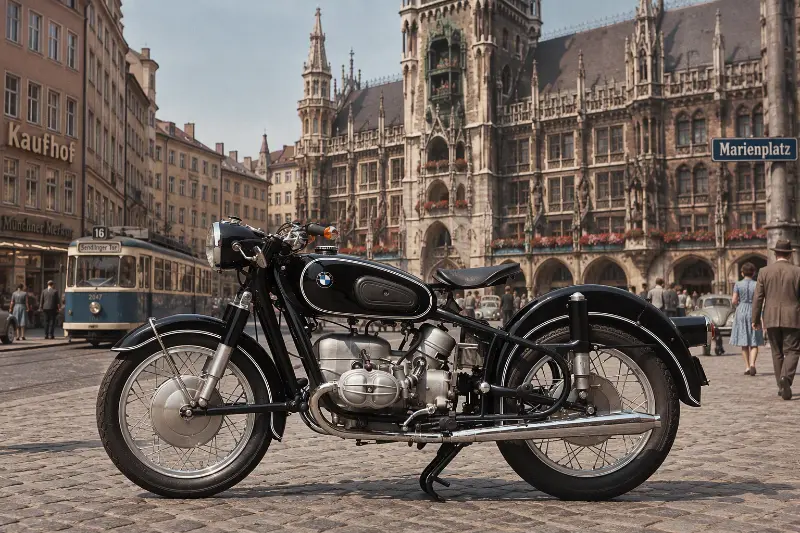
BMW R50 (1955–1969): History, Specs and Versions of the BMW Boxer
BMW · 1955-1969 · 494 cc
Features and technical evolution
The BMW R50 is the classic starting point for anyone wanting to understand what made the Munich marque great in the 1950s: a sober, reliable boxer built to cover miles without drama. Produced from 1955 to 1969 — first as the R50 and then as the R50/2 — it is the entry point to the BMW road range of the era, below the higher-performance R60 and R69.
About the bikeThe R50 has a functional, well-proportioned design: teardrop tank, wide seat, deep mudguards and the characteristic boxer with its cylinders sticking out at the sides. The chassis is typical late-1950s BMW: double-cradle frame, Earles fork with swinging arms, twin rear shock absorbers and shaft final drive. The riding position is upright and relaxed, designed for touring and sidecar use. The brakes are drums on both wheels, in line with the standards of the period.
Technical data- Engine: boxer twin 494 cc, overhead valves
- Power: 26 bhp at 5,800 rpm
- Gearbox: 4-speed
- Final drive: shaft
- Top speed: approx. 130 km/h (81 mph)
- Front fork: Earles; rear suspension with twin shock absorbers
- Brakes: front and rear drum
- Dry weight: approx. 190 kg
The most interesting technical feature is the Earles fork, adopted by BMW from 1955: swinging arms anchored to pivots on the steering head, with integrated shock absorbers. It offered good control of pitching, stability with a passenger and sidecar, and kept its geometry under load. The traditional shaft drive remained unchanged, requiring very little maintenance compared with a chain.
ConclusionThe R50 doesn't chase glory: it's the BMW that gets on with the job. And that is precisely why, sixty years on, it continues to win over anyone looking for a genuine vintage boxer to ride calmly and with care.
Historical context
The mid-1950s: Germany is in the middle of reconstruction and BMW, back to making motorcycles after the wartime interruption, is betting on solidity and everyday use. The R50 was created for the motorcyclist who wants a durable machine, able to pull a sidecar and tackle long journeys on often rough roads. The main markets are Germany, with strong orders also from police forces and armies in Europe, and the growing US market.
Main versions
- R50 (1955–1960): original version, 26 bhp.
- R50/2 (1960–1969): update within the /2 series, with improvements to brakes, suspension and details.
- R50US (1968–1969): aimed at the US market, it used a telescopic fork.
Trivia and anecdotes
Many R50s survive today in sidecar form: the frame structure and the boxer's full torque made them particularly suitable. It wasn't the fastest BMW in the catalogue, but it is the one that, more than any other, built the marque's reputation for reliability in the post-war years.
What to check before buying one
The R50 is today a sought-after bike for those entering the world of vintage BMW boxers: mechanically simple, robust and backed by an active community. The points to check before buying are the gearbox mechanics, the condition of the shaft drive and the availability of quality spares, especially for cylinders and valve gear. Prices vary greatly with originality, documentation and restoration; a concours-standard example is worth far more than one that simply runs.