
Before the Internet, There Was the Bar
Before YouTube, Google and online forums, there were the bar, the mechanic, magazines and friends. That is how riders learned about motorcycles.
Before YouTube, forums, Facebook groups and Google Maps, there was a place where, if you wanted to, you could find almost any answer you were looking for.
It was the pub.
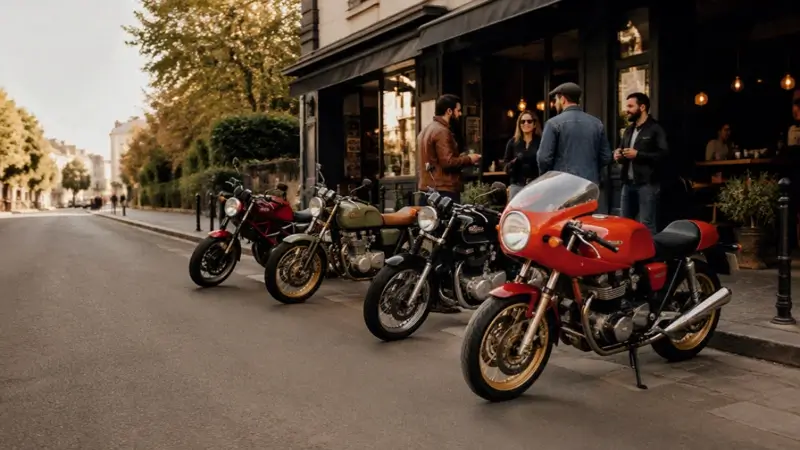
Not necessarily a pub famous amongst motorcyclists. All it took was for there to be three or four motorbikes parked outside and, sooner or later, someone would turn up inside who knew more than you did.
You might have turned up with a problem. A strange noise, the bike not starting properly, a bend you couldn’t take the way you wanted to. Or perhaps you’d simply seen a motorbike and wanted to know what it was.
The question was always more or less the same: “Do you know this motorbike?”
And that’s where it all began.
The café was a sort of social network
Today it seems almost impossible to explain to anyone who’s ‘grown up with a smartphone in their pocket’, but back then, if you wanted to know something, you had to know someone who knew.
There were no tutorials to pause, no videos to watch ten times over, and no online discussions with fifty replies in a matter of minutes.
There was the oldest lad in the group. The one who’d already owned three motorbikes. The one who’d taken his carburettor apart all by himself. The one who’d travelled all the way to France on a motorbike that we already considered old.
You listened to him.
Sometimes you took everything he said at face value. Even when it was nonsense.
Because that’s how it worked: experience was passed from one person to another. It wasn’t organised, it wasn’t certified and, above all, it wasn’t always correct. But it was alive.
The pub became a meeting place. We’d talk about motorbikes, roads, journeys, tyres, petrol, modifications and, of course, which was the best motorbike.
That last discussion, come to think of it, has never changed.
The magazine was our Google
If the café was the social network, the motorbike magazine was the search engine.
We’d buy it, read practically every page and often keep it.
Magazines were used to find out how a motorbike performed, compare models, read road tests, learn about technical specifications and understand what new products were coming onto the market.
But it wasn’t just about the road tests.
There were adverts, letters from readers, accessories, technical features, maintenance, travel features and those pages that might have seemed secondary at the time but which, today, have become a small snapshot of how we experienced motorcycling.
When a new motorbike came out, you couldn’t simply search for a hundred reviews and watch twenty videos.
You bought the magazine.
You’d read it.
Then you’d talk about it with your friends.
And perhaps the next day you’d pop round to the mechanic’s to ask what he thought of it.
The mechanic was a walking encyclopaedia
Before the internet, the mechanic had a huge advantage: he’d seen your motorbike, but above all, he’d seen loads of others.
He could spot certain problems almost by ear.
“Does it make this noise?”
“Yes.”
“Then check that.”
Maybe he was right. Maybe not.
But behind that answer lay years spent with his hands inside engines, not a Google search.
The mechanic knew the recurring faults, the strange noises, the minor modifications worth making and those that were simply a waste of money.
And above all, he knew the history of the motorbikes he’d worked on.
It was common to hear him say: “I know this motorbike.”
And it was a phrase which, when spoken by the right person, was worth more than many pages of a manual.
To learn, you had to get your hands dirty
One of the biggest differences between then and now is probably this: to understand a motorbike, you had to get your hands on it.
You didn’t necessarily have to become a mechanic. It was enough to learn those four or five things that meant you didn’t feel completely lost when faced with a problem.
Checking the oil level. Adjusting or greasing the chain. Changing a spark plug. Checking tyre pressure. Replacing a bulb. Figuring out why a lever had suddenly become stiffer.
And then there were the cables, the fuses, the seals, the grease and that smell of petrol that lingered on your hands even after you’d washed them.
The maintenance of classic motorbikes, now rediscovered by so many enthusiasts of vintage motorbikes and Modern Classics, also stems from that: from necessity.
If you set off on a journey, you couldn’t expect to always find someone ready to sort out the problem.
There were some things you had to be able to do yourself.
The carburettor didn’t have YouTube
Anyone who’s owned a carburettor-equipped motorbike knows what I’m talking about.
The motorbike won’t start.
You try again.
Nothing.
You open the throttle. You try again. Perhaps you go too far. At that point, you flood the engine.
The spark plug isn’t playing ball and you start to wonder if you’ve done something wrong.
Nowadays, it would only take a few minutes to find a video showing exactly what to check. Back then, you’d look for someone who knew more than you did.
Maybe it was a friend.
Maybe the mechanic.
Perhaps the bloke at the pub with that old twin-cylinder who seemed to know every possible mechanical problem.
You learnt by listening.
You learnt by trying.
And, above all, you learnt by making mistakes too.
A simple motorbike didn’t necessarily mean an easy one to maintain. It just meant that, with a bit of patience, you could try to get to grips with it.
The road map bore the creases of your journeys
Travelling was different too.
The road map was kept in a drawer, in the tank bag or tucked away somewhere where it wouldn’t get too badly damaged.
Before setting off, you’d study the route.
You’d make notes with a pen.
You’d decide where to stop.
Then, inevitably, something would go wrong.
A road closed. A wrong turn at a junction. A detour. Someone you met along the way who suggested an alternative route.
And it was precisely that road, perhaps, that became the fondest memory of the trip.
You didn’t have a sat-nav to automatically guide you back on track.
You’d get lost.
And sometimes getting lost simply meant finding the right way.
Word of mouth had its problems too
Of course, we mustn’t turn the past into some sort of golden age.
Word of mouth worked, but it had one obvious flaw: there was no button to check what you were being told.
An experienced motorcyclist might actually be an expert.
Or they might only be one in their own mind.
This is how legends were born: miraculous modifications, carburettor settings ‘that make the bike fly’, gear ratios that would transform any twin-cylinder into a superbike, and tricks passed down from generation to generation without anyone knowing where they’d originally come from.
Someone had tried something on their own motorbike and, after a while, that thing became a universal rule.
The internet, at least in this respect, has changed things quite a lot.
Today we can compare different experiences, look up technical documentation and verify certain information much more easily.
But even today, on closer inspection, you only need to join a motorcycling group to find the same dynamic at work.
How people really learnt to ride a motorbike
The question in the title, after all, isn’t just about technique.
How did people learn to ride a motorbike before the Internet?
You learnt mainly by spending time with others.
You learnt by watching how the more experienced motorcyclist behaved.
You learnt to respect the motorbike, to recognise when something wasn’t right, not to underestimate a wet road, and to understand when it was best to slow down.
You also learnt whilst travelling.
If one of us had a problem, the others would stop.
If someone fell off, the others would turn back.
If a motorbike had a problem, someone would almost always turn up with a tool, a cable, a cable tie or simply a few ideas.
It was a motorcycling culture that developed gradually.
You couldn’t find it all in one place.
You picked it up bit by bit.
Young people today have better tools
It wouldn’t make sense to turn all this into the usual generational conflict.
Today, a young person who wants to learn has access to a wealth of information that we, back then, couldn’t even have imagined.
They can watch a tutorial, read a forum, consult a digital manual, compare the experiences of motorcyclists from other countries, find a map, plan a trip and even diagnose certain problems using electronic tools.
It’s a huge advantage.
But tools don’t make the motorcyclist.
You can have the most sophisticated sat-nav in the world and still not know how to read a road.
You can have a hundred tutorials saved and never have changed a spark plug.
You can know a motorbike’s technical specifications off by heart and still not know what it feels like when that motorbike starts to skid slightly on a wet road.
You still learn that part in the same way.
By doing it.
What we’ve gained and what we may have lost
Technology has given us so much.
Faster information, greater safety, documentation, the chance to compare, support and tools that make travelling and maintaining a motorbike much easier.
There’s no arguing with that.
But perhaps we’ve lost a bit of that slow pace that used to force us to talk to someone.
Once upon a time, to find out if a particular motorbike was reliable, you might have spent half an hour in a pub listening to three people who’d owned one.
Today, you can read thirty reviews in ten minutes.
It’s more efficient.
Not necessarily more enjoyable.
Because there’s still a difference between an answer found on the internet and someone telling you about their own experience.
Technology gives you the information. Experience tells you what to do with it.
The café has never really died
Perhaps that’s precisely the point.
The café hasn’t disappeared. It has simply changed form.
Today it might be a WhatsApp group, a forum, a Facebook group, a YouTube channel or a conversation that starts around a motorbike parked outside a pub.
But the mechanism is always the same.
Someone turns up and asks:
“What sort of motorbike is that?”
“How does it ride?”
“Does it have any problems?”
“What do you think of it?”
And on the other side, someone replies.
At that moment, even though it’s 2026 and we have all the technology in the world at our disposal, we’re doing exactly what motorcyclists did fifty years ago.
We’re sharing a story.
We’re sharing an experience.
Above all, we’re sharing the desire to ride a motorbike.
Before the Internet, there was the pub. And perhaps it was a good learning environment.
Looking back on it today, perhaps we weren’t any better.
We simply had fewer tools and more people around us.
To learn, you had to ask.
To understand, you had to listen.
To get good at it, you had to try.
And sooner or later, you had to make mistakes too.
That’s how a motorcyclist was made.
Not just by learning to ride a motorbike, but by getting to know it, respecting it and sharing what you’d learnt with those who came after you.
The pub, the mechanic, the magazine, the crumpled map in your bag and your grease-stained hands were all part of the same school.
A school with no enrolment, no marks and no certificates.
But with plenty of lessons that are hard to forget.
This isn’t a story about the motorbikes of yesteryear. It’s a story about the people who taught us to love them.