

Carburettors vs Fuel Injection: A Guide to the Engine Myth
Carburettor or fuel injection? From the starting rituals to ECU engine management, we explore how the soul of the engine has changed, the reasons behind the historic switch and the pros and cons of two epic worlds.
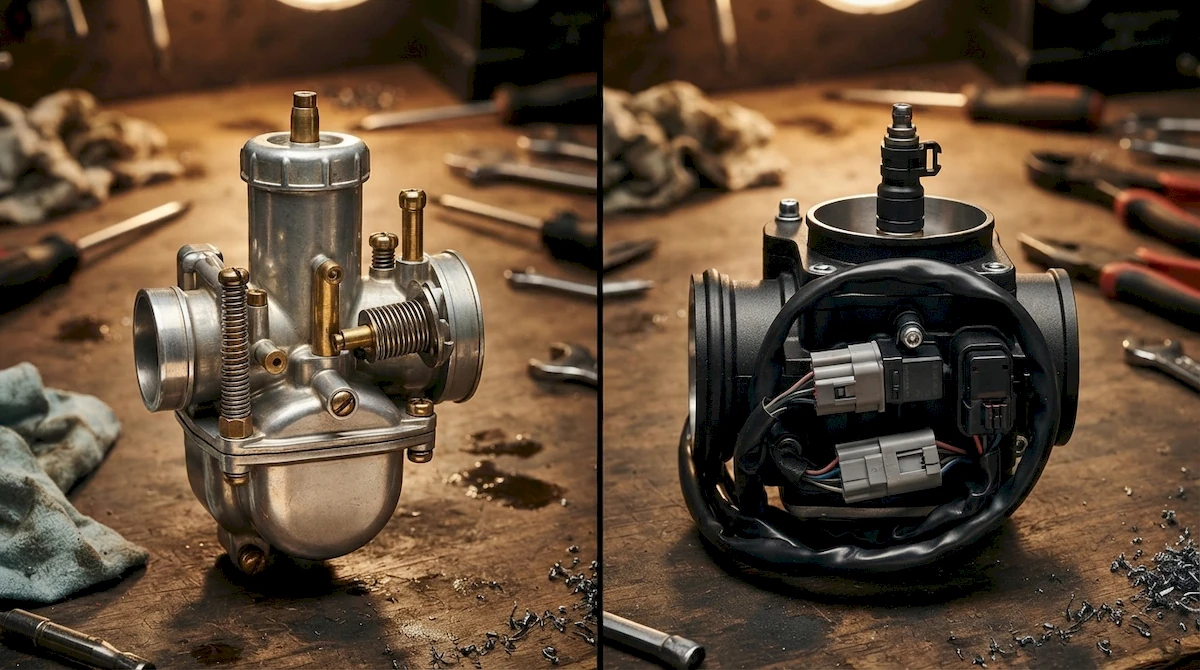
Has it ever happened to you, walking into the garage on a Sunday morning, pulling the choke lever, kicking the starter twice or turning the key, and smelling that unmistakable aroma of unburnt petrol filling the air? If the answer is yes, you know exactly what I'm talking about. It is the smell of our youth, the smell of real engines, the ones that needed a proper initiation ritual just to get going.
Today we turn the key, press a button and the engine starts first time, whether we are at sea level or at the top of the Stelvio in sub-zero temperatures. A miracle of modern technology, no doubt. But among enthusiasts, sitting at the pub table after a good ride over the passes, the question always comes up: were things really better when they were worse?
The ideological battle of carburettors vs fuel injection is not just a technical debate, but a clash between two philosophies of life on two wheels. In this article I want to take you on a journey through time and mechanics, explaining in simple terms how these two systems work, why the world has changed and what the real pros and cons of each solution are. Dust off your leather waistcoat: here we go!
How a carburettor works: the art of the Venturi effect
To understand the magic of the carburettor, we have to take a small step back and forget about microchips and sensors. The carburettor is a purely mechanical device, a masterpiece of fluid dynamics that exploits a principle discovered in the 18th century by the Italian physicist Giovanni Battista Venturi.
Picture the carburettor as a tube through which the air drawn in by the engine's pistons passes. This tube has a narrowing in the middle. As the air goes through this constriction, it accelerates and its pressure drops sharply. It is precisely this low pressure that "sucks" the petrol up from a float bowl positioned just below.
The key components of the carburettor
Inside this metal body a genuine mechanical orchestra is at work:
- The slide (or throttle butterfly): It is connected directly to your throttle cable. The more you turn the twistgrip, the higher the slide lifts, letting a greater flow of air through.
- The tapered needle: It is fixed to the slide and sits in the needle jet. As it lifts, it progressively opens the passage for the petrol.
- The jets (pilot and main): These are small brass screws drilled to a thousandth of a millimetre that calibrate the exact amount of fuel delivered at the different stages of throttle opening.
- The float and the float needle valve: They keep the petrol in the float bowl at a constant level.
The beauty of the carburettor lies right here: there is no electric current guiding the petrol, only pure atmospheric pressure and the laws of physics. The result? A smooth, organic, almost "alive" throttle response, where the rider's hand is connected directly to the heart of the engine by a simple steel cable.
The advent of fuel injection: the digital brain
Let's jump forward a few decades. Electronic fuel injection (EFI, Electronic Fuel Injection) cancels out the Venturi effect and replaces it with the precision of silicon.
In an injection system it is no longer the engine that "sucks" the petrol. On the contrary, the petrol is pushed at high pressure by an electric pump directly into the intake tract (or into the cylinders, in direct injection) through one or more micro-drilled injectors.
The role of the ECU and the sensors in fuel injection
Conducting the orchestra is no longer a mechanical cable, but the ECU (Engine Control Unit), the vehicle's electronic brain. To calculate to the millisecond how much petrol to spray, the control unit constantly analyses the data supplied by a network of sensors:
- Throttle position sensor (TPS): Detects how far you are opening the throttle.
- Air and coolant temperature sensors: Assess the density of the air and the thermal state of the engine.
- Manifold absolute pressure sensor (MAP): Works out what altitude you are at.
- Lambda sensor: Located in the exhaust, it analyses the burnt gases and tells the ECU whether the mixture is too lean or too rich, allowing it to correct the fuelling in real time.
When we twist the throttle on a modern machine, we are simply sending an electrical signal to the control unit. The ECU calculates the perfect amount of petrol, opens the injector for a few milliseconds and ensures ideal combustion in any condition.
The historical causes of the change: why did we say goodbye to the carburettor?
No manufacturer abandoned the carburettor out of spite towards the nostalgics. The transition was driven by regulatory, environmental and market factors that were impossible to ignore.
Anti-pollution regulations (Euro 1 - Euro 5)
The main push came from European emissions regulations. The carburettor is an inherently approximate system: it cannot adapt instantly to changes in temperature, humidity and atmospheric pressure. To stop the engine seizing or overheating, carburettors were often set with a slightly "richer" mixture (more petrol than necessary), producing high quantities of unburnt hydrocarbons and carbon monoxide.
With the introduction of Euro 1 in the 1990s and the escalation to the restrictive Euro 5 and Euro 5+ limits, keeping emissions in check with carburettors became mathematically impossible. Only fuel injection, combined with three-way catalytic converters and lambda sensors, can guarantee such clean combustion.
Efficiency, fuel consumption and market demand
Beyond the environment, there is everyday practicality. The modern rider wants a machine that starts first time after three months in the garage, that uses little fuel and that is ready to go without having to pull the choke or wait ten minutes for the engine to warm up. Injection has cut average fuel consumption by as much as 20-30% compared with carburettor engines of the same displacement, delivering a smoothness of running unknown to the old models.
Carburettor pros and cons: the passion of the old school
Let's be honest: if we love classic machines and vintage models, it is partly because of the carburettor. Let's look at its strengths and weaknesses.
Advantages of the carburettor
- Physical connection and feel: The twistgrip pulls the cable directly. There are no electronic filters, no "Ride-by-Wire". The response is direct, honest, tactile.
- DIY maintenance: With a set of screwdrivers, a 10mm spanner and a little solvent, you can strip, clean and retune a carburettor right on your own workbench at home.
- Repairable on the road: If a jet blocks in the middle of nowhere, a few tools are all you need to remove the float bowl, blow through the jet and set off again.
- Sound and character: The intake noise of a carburettor with a bellmouth or a cone filter is a unique sensory experience, raw and visceral.
Disadvantages of the carburettor
- Sensitivity to atmospheric conditions: An engine perfectly tuned at sea level on a dry day will become sluggish and "rich" if you climb to 2,000 metres in the mountains or if the weather turns very damp.
- Problems during long winter layoffs: If you leave the vehicle standing for months with modern petrol (rich in ethanol) in the float bowl, it will evaporate, leaving sludge and deposits that clog the microscopic jets.
- Higher fuel consumption and emissions: The underlying imprecision means wasted fuel and a greater environmental impact.
Fuel injection pros and cons: the certainty of technology
Injection has turned engines into flawless means of transport. But at what price in terms of charm?
Advantages of fuel injection
- Reliability and flawless starting: No choke lever, no flooding. Press the button and the engine starts perfectly at -5°C as at +40°C.
- Lower fuel consumption and maximum efficiency: The ECU calculates the minimum amount of petrol needed for every engine speed, optimising the range from the tank.
- Automatic altitude compensation: Whether you are on the plain or on the highest Alpine pass, the lambda sensor corrects the fuelling in real time.
- Integration with active safety: Injection makes it possible to integrate engine maps, traction control and engine braking management.
Disadvantages of fuel injection
- On-off effect: On less refined injection systems (especially first-generation ones), the transition between closed and open throttle can be abrupt and jerky.
- No home repairs: If the fuel pump burns out or the ECU crashes in the middle of a trip, no amount of screwdrivers will help. You need a recovery truck and an official diagnosis at the workshop.
- Cost and complexity of parts: An original throttle body or control unit costs far more than a carburettor rebuild kit.
Quick comparison table: Carburettors vs Fuel Injection
| Feature | Carburettor | Fuel Injection |
|---|---|---|
| Operating principle | Mechanical (Venturi effect) | Electronic (ECU + fuel pump) |
| Cold starting | Manual (Choke lever) | Automatic and instant |
| Maintenance | Mechanical and frequent (DIY) | Digital diagnostics (At the workshop) |
| Altitude sensitivity | High (Needs adjusting) | None (Automatic correction) |
| Throttle response | Progressive and organic | Immediate (Sometimes with on-off effect) |
| Roadside repairability | High (Basic tools are enough) | Low (Needs parts and electronics) |
| Environmental impact | High (Euro 0 - Euro 2) | Very low (Euro 3 - Euro 5+) |
The Boomer's verdict: which should you choose today?
We have reached the moment of truth. What is the best choice in the historic dispute of carburettors vs fuel injection?
As an old enthusiast, my answer is: it depends on what you are looking for when you turn the key.
If you want to ride without a care, to commute every day, or if you love modern classics that combine retro looks with the safety of modern brakes and lower fuel consumption, fuel injection is unbeatable. Modern machines are jewels of efficiency that let us enjoy the road in complete peace of mind.
But if for you mechanics is a ritual, if you love spending Saturday afternoons in the garage with grease on your hands, if you want to feel that intimate, purely mechanical bond between your right wrist and the rear wheel... well, then a good carburettor engine will give you emotions that no control unit in the world will ever be able to encode.