

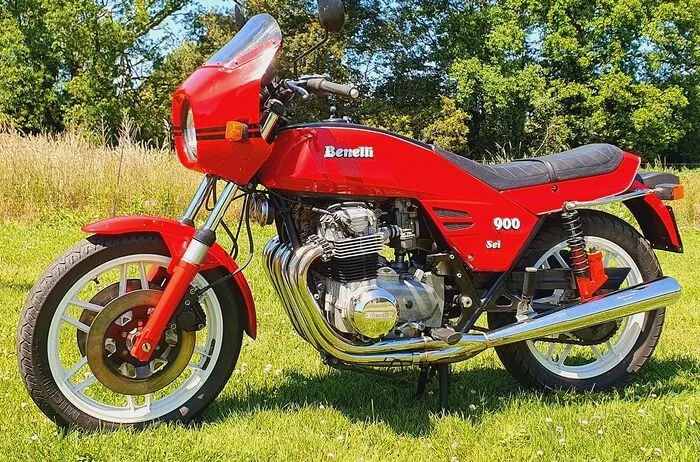
Benelli Sei 900: The Story of the Rare Italian Six
Benelli · 1979-1989 · 906 cc
Features and technical evolution
Benelli 900 Sei: the mechanical charm of an Italian six
The Benelli 900 Sei is one of the most distinctive interpretations of the big Italian road bike between the late 1970s and the 1980s. Its defining trait is obvious even with the engine off: a transverse in-line six, wide and rich in mechanical detail, which sets the Sei apart from the more common Japanese fours and the European twins of the period. It is not just a bigger version of the earlier 750 Sei: the increase in displacement comes with a revised layout and a different stylistic identity.
An extraordinary engine
The powerplant is an air-cooled four-stroke with six cylinders in line and a displacement of around 906 cc. Valve gear is single overhead camshaft, with two valves per cylinder. The technical sources consulted report a 60 mm bore and a stroke of around 53.4 mm. Fuelling is by three Dell'Orto carburettors, a choice that reduces the number of bodies to synchronise compared with a one-carburettor-per-cylinder solution. Stated power is generally given as around 80 bhp, with the rpm figure varying by source and market.
The six cylinders should not be read only as a search for absolute performance. It is a statement of identity: smoothness of running, an unusual architecture and an instantly recognisable exhaust voice. Compared with the 750 Sei, the larger displacement also demands an adequate primary drive system. The 900 is documented with a dry multi-plate clutch and a double-chain primary drive, matched to a five-speed gearbox and chain final drive.
From six-into-six to six-into-two
One of the elements that most helps tell the 900 from the 750 is the exhaust system. The first Sei was famous for its six separate outlets; on the 900 the system is rationalised into a 6-into-2 configuration, with six pipes gathered into two silencers. The change alters the bike's side view and helps give it a tidier look, while keeping the engine's scenic presence.
The bodywork design drops some of the 750's sharper lines in favour of softer surfaces and a small front fairing. The solution draws attention to road use and comfort at sustained speeds, without turning the Sei into a full-fairing sports bike. Some versions are also recognisable by their gold Campagnolo wheels and disc brakes on both wheels; specifications and details may nevertheless differ depending on the series and market.
Chassis and road character
The structure uses a tubular steel double-cradle frame, telescopic front forks and rear suspension with swinging arm and shock absorbers. Specialist sources associate the 900 with Ceriani forks and 18-inch Campagnolo wheels. The braking system comprises two front discs and one rear disc; an integral braking system is also documented, linking part of the rear braking action to a front caliper. Before attributing these details to a specific bike, it is advisable to check the series and the possible presence of later modifications.
The Sei should not be judged by the standards of a modern naked bike: mass, brakes, suspension and tyres belong to another era. Its interest lies in the overall experience, in how the six-cylinder works and in the rarity of the project. In the Benelli range it represents the step from the 750 Sei to the larger-capacity version, keeping a technical solution that makes it instantly recognisable.
Key technical data
- Engine: four-stroke, in-line six, air-cooled.
- Displacement: approx. 906 cc.
- Bore and stroke: approx. 60 × 53.4 mm.
- Valve gear: single overhead camshaft, two valves per cylinder.
- Fuel system: three Dell'Orto carburettors; size and designation to be checked against the version.
- Stated power: approx. 80 bhp; the quoted rpm varies by source.
- Clutch: dry multi-plate.
- Gearbox: five-speed.
- Primary drive: double chain.
- Final drive: chain.
- Frame: tubular steel double cradle.
- Front suspension: telescopic forks, given by sources as Ceriani.
- Brakes: front and rear discs; configuration to be checked against the series.
- Exhaust: six pipes gathered into two silencers.
Historical context
The Sei measured against the big bikes of the 1970s
The Benelli 900 Sei was born in a period when big-capacity machines were becoming one of the most important battlegrounds between manufacturers. The Japanese firms were imposing powerful, smooth multi-cylinder engines, while the European marques sought their own answer through mechanical character, style and distinctive technical solutions. The earlier 750 Sei had already made Benelli a recognisable name thanks to the in-line six; the 900 develops the concept with a larger displacement and a more mature configuration.
Benelli's industrial strategy
The project belongs to the era of Alejandro de Tomaso's ownership, who had acquired Benelli in 1971 and also controlled Moto Guzzi. In this phase the group sought to make the most of its skills and to compete in the big-bike segment, where Japanese output was exerting growing pressure. The Sei offered a different argument from the simple ratio of power to price: it was a series-production Italian motorcycle with six cylinders, a rare and costly solution to build.
The 900 arrived in 1979 as an evolution of the 750, not as a completely separate project. The increase in displacement came with mechanical changes and an updated look. The switch from the six-outlet exhaust to the 6-into-2 solution is the most evident difference, along with the more fluid lines and the small fairing. The dry clutch and double-chain primary drive are other technical elements associated with the larger-capacity version.
A niche model, not a mass-market bike
The Sei 900 faced a generation of big multis, including the Japanese sixes that would broaden the market for this architecture. Benelli nonetheless kept a particular personality: European construction, Italian aesthetics and an engine whose visual and sonic presence was an essential part of the model's identity. It was not built in large numbers. Historical accounts indicate fewer than two thousand 900s, but counts and chronological limits differ between sources.
For this reason its historical importance is not measured only by sales figures. The 900 Sei testifies to Benelli's attempt to stay competitive in the big-roadster segment with a proposition that did not simply imitate the most widespread formula. It is also the result of an industrial period in which innovation, ambition and production difficulties coexisted. The chronology needs reading carefully: some sources end production in 1987, others include bikes attributed to 1989.
Main versions
The Benelli 900 Sei series
Specialist chronologies distinguish four series. The dates are not entirely uniform between sources and may refer to the model year, to production or to the registration of individual bikes: they should therefore be treated as a rough guide, to be checked against the identification numbers and documentation of the bike.
- 900 Sei, series 1 (1979–1980): first phase of the approx. 906 cc version, derived from the 750 Sei. It is associated with the air-cooled six-cylinder engine, the 6-into-2 exhaust and the dry clutch.
- 900 Sei, series 2 (approx. 1980–1982): second phase listed in the Benelli Club Nederland chronologies. The changeover dates may overlap with 1980, so the year alone is not enough to identify a series.
- 900 Sei, series 3 (approx. 1982–1985): the next phase of production. To establish which components and details are original you need to refer to the relevant technical documentation and not only to outward appearance.
- 900 Sei, series 4 (from 1986): the last series listed by the specialist chronological catalogue, with dates given up to 1988. Other sources extend the chronology to 1989, the year to which further bikes are attributed.
Names and variants: “900 Sei” is the model name; the series designations are useful for classifying the evolutions, but should not be confused with any commercial names for particular trims. The sources consulted do not allow a complete list of official changes to be attributed uniformly to each series. Wheels, exhausts, fairing and brake components of a bike for sale today must also be verified on the individual bike.
Chronological note: for a cautious entry, 1979–1987 can be adopted as the period generally reported by the specialist press, noting that some frame-number chronologies include units attributed to 1989. It is not correct to turn this discrepancy into continuous production certain to 1989.
Trivia and anecdotes
Six cylinders, three carburettors and an unmistakable voice
The name “Sei” (six) is not a nickname born among enthusiasts: it refers directly to the engine's architecture, with six cylinders in line. The 900 thus keeps the trait that had made its predecessor the 750 famous, but pairs it with a larger displacement and a different exhaust configuration.
Despite the six cylinders, fuelling does not use six separate carburettors. The technical documentation describes three Dell'Orto units, a solution that reduces the number of units to synchronise and makes things less complex than one carburettor per cylinder. The exact size may be reported differently in the data sheets available, so it is advisable to check it in the manual for the specific version.
Another immediately visible difference from the 750 is the exhaust: the six pipes are gathered into two silencers, rather than ending in six separate outlets. The change does not remove the engine's distinctiveness, but makes the flank less crowded. The 900 also adopts a dry multi-plate clutch, while the 750 is described with a wet clutch.
Finally, the chronology of the 900 is a small case study for anyone collecting historic motorcycles. Some specialist sources give 1987 as the end of production, while tables based on frame numbers attribute units to 1989. In the absence of conclusive factory documents, it is more correct to record the discrepancy than to pick an absolute date without explanation.
What to check before buying one
A six-cylinder to choose with your eyes open
The Benelli 900 Sei interests today above all those looking for an out-of-the-ordinary historic motorcycle. Its strength is not just the displacement: it is the six-cylinder architecture, together with Italian style and the history of a manufacturer that sought its own path in the big-roadster market. It is a bike that turns heads standing still and which, when in good order, offers a mechanical experience unlike that of the more common fours.
Use and maintenance
It is not reasonable to expect from a bike of this kind the practicality of a modern naked. Weight, brakes, suspension, tyres and wind protection reflect the period of design. Before considering it for regular touring, it is worth testing it carefully and considering the riding position, the response of the braking system and the actual condition of the chassis and controls. Data from period tests do not replace a check of the bike's present condition.
The six-cylinder needs servicing by someone who knows historic multi-cylinder engines. It is important to check smoothness of running, the carburation of the three Dell'Ortos, any leaks, the lubrication system, the valve train and mechanical noise. Carburettor synchronisation, ignition tuning and fault-finding can take longer than on a bike with a simpler architecture. These aspects do not in themselves show poor reliability: much depends on the state of preservation, the quality of the work done and the availability of correct documentation.
Originality and restoration
Before buying it is advisable to compare frame and engine numbers, documents, declared year and series details. The 6-into-2 exhaust, wheels, brakes, fairing and instruments deserve specific checking: a restored bike can look convincing while fitted with replaced or adapted components. Checking the integral braking system and that it works properly is particularly important, as is checking for any electrical modifications.
Parts availability cannot be described as uniform for every component. Before buying an incomplete bike it is prudent to identify the missing parts and check the practical possibility of sourcing them, without assuming that every item is available from a catalogue. The six-cylinder-specific parts and original bodywork components can significantly affect how complex the restoration is.
Collector interest and final verdict
The 900 Sei is a choice suited to an enthusiast who appreciates Italian industrial history, unusual architectures and the pleasure of preserving a bike with a strong identity. We would not recommend buying the first example available just because it is rare or striking. It matters more to find a bike that is complete, documented and mechanically sound, even if it requires a higher initial outlay. Prices published online are too inconsistent to give a reliable figure here: year, series, originality, documents and restoration quality can change the value of an individual bike a great deal.
In short, the Benelli 900 Sei rewards those willing to study it before buying. Its appeal is genuine, but so too must be the checks on originality and the quality of maintenance.