

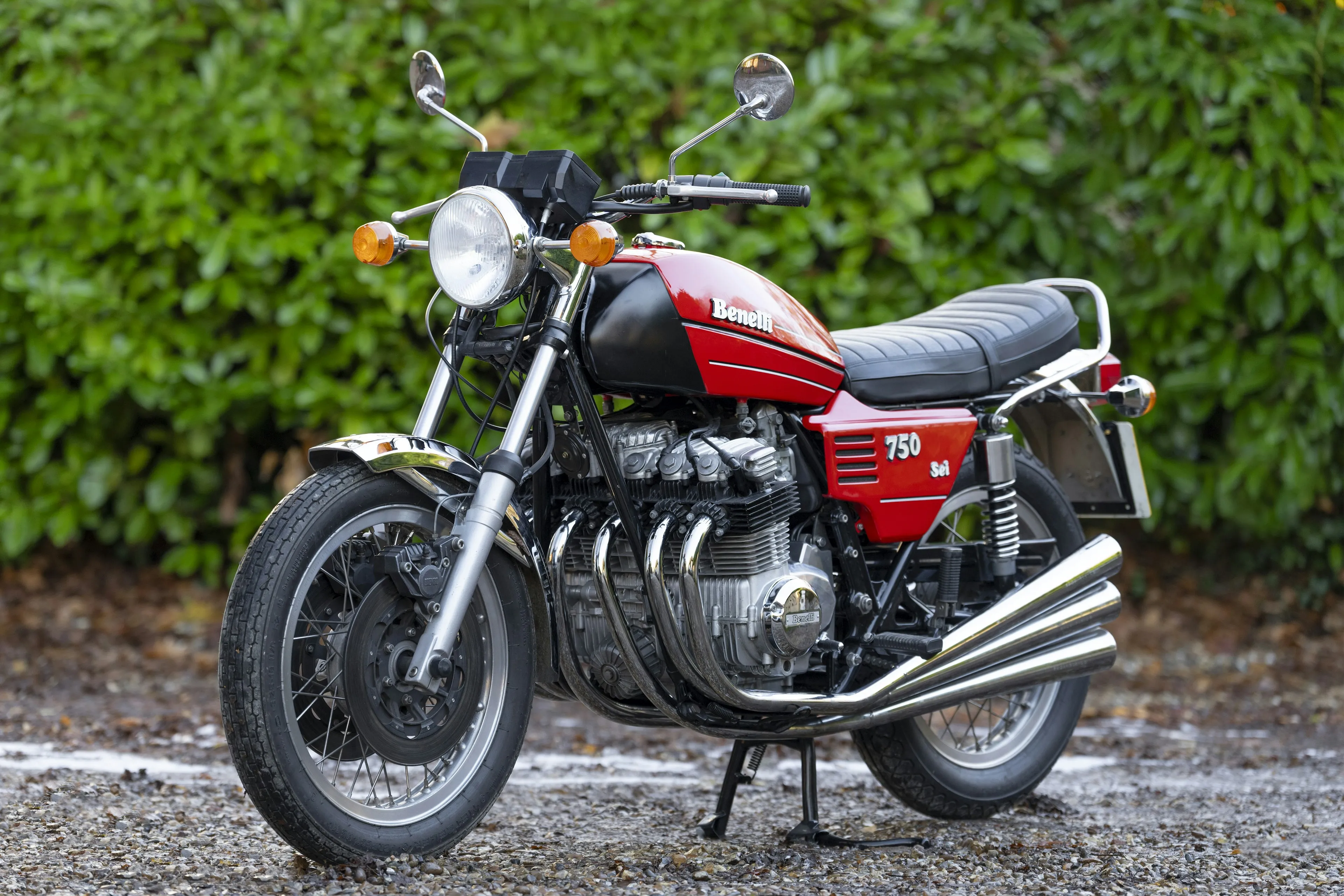
Benelli Sei 750: The Story of the Legendary Six
Benelli · 1972-1978 · 747 cc
Features and technical evolution
Benelli 750 Sei: six cylinders, an unmistakable voice
The Benelli 750 Sei is one of the most recognisable Italian motorcycles of the 1970s. Unveiled at the end of 1972 and reaching series production in 1974, it brought to a road bike an architecture that had until then been exceptional for the market: six cylinders in line, air-cooled and mounted transversely to the direction of travel. It was not just a technical choice. The Sei set out to show that Benelli, the historic Pesaro marque, could compete with the Japanese manufacturers on the ground of big capacity and mechanical sophistication.
Lines that heralded a new era
The design stood apart from the more traditional shapes of European bikes. The tank, seat and bodywork formed a modern whole, with a strong visual presence but without resorting to a full fairing. The engine, wide and rich in detail, became the true aesthetic protagonist: six exhaust headers, a finned cylinder head and the orderly arrangement of the cylinders made the bike instantly recognisable.
The tubular steel double-cradle frame, telescopic front forks and rear swinging arm with two shock absorbers followed a classic scheme. The solution kept a structure that was easy to understand and repair, but weight and size demanded attention in low-speed manoeuvres and in more demanding riding situations. The first configurations had twin front discs and a rear drum brake; brake sizes and components changed during production.
The six-cylinder engine and its personality
The engine is a four-stroke in-line six with a displacement of around 748 cc and air cooling. Valve gear is a chain-driven single overhead camshaft, with two valves per cylinder. Fuelling uses three Dell'Orto carburettors, each connected to a pair of cylinders through split ducts: a less complex solution than six separate carburettors.
The six-cylinder layout favours closely spaced combustion and notable smoothness of running. The test published by Cycle World in 1974 stressed precisely the fluidity of power delivery and the low perception of vibration compared with many bikes of similar capacity. The five-speed gearbox and chain final drive completed a set-up designed for the road and for fast journeys. Stated power varies between sources, so it is preferable to refer to the specific documentation of the individual bike when you want to compare exact values.
Its role in the Benelli range
The Sei was a prestige model, designed to give the marque visibility and demonstrate an out-of-the-ordinary technical capability. It did not achieve the sales of the simpler, more accessible bikes, but it left a mark on the history of multi-cylinder road bikes. Production of the 750 ran through several series until 1978, when the market was already preparing for a new generation of larger-capacity Japanese big bikes.
Key technical data
- Engine: four-stroke, in-line six, air-cooled.
- Displacement: approx. 748 cc.
- Bore and stroke: approx. 56 × 50.5 mm.
- Valve gear: overhead camshaft, chain drive, two valves per cylinder.
- Fuel system: three Dell'Orto carburettors with split ducts.
- Compression ratio: approx. 9.8:1, figure reported in the data sheets consulted.
- Gearbox: five-speed.
- Clutch: wet multi-plate.
- Final drive: chain.
- Frame: tubular steel double cradle.
- Front suspension: hydraulic telescopic forks.
- Rear suspension: swinging arm with two shock absorbers.
- Brakes: twin front discs and rear drum; diameters and components vary by series.
Historical context
Italy's answer to the Japanese big bikes
At the start of the 1970s the motorcycle market was changing fast. Japanese manufacturers had introduced multi-cylinder engines, electric start and ever higher performance, putting European firms under pressure. For Benelli, a marque with a long industrial history behind it, a bike was needed that could grab attention and show that Italian industry too could offer ambitious technical solutions.
It was in this setting that the 750 Sei appeared, unveiled at the end of 1972 during the reorganisation linked to Alejandro de Tomaso. The announcement aroused great interest, but the gap between presentation and sales was significant: series production arrived in 1974. The delay reduced some of the surprise effect and gave the competition time to consolidate its presence in the market.
A technical and image choice
The Sei was not simply a bike with two more cylinders. The in-line six was a statement of design ability, offering smooth running and an instantly recognisable sound. The solution, however, required greater construction complexity and careful tuning, while the price and servicing demands could limit its audience compared with less sophisticated models.
The comparison with the Japanese big bikes became even more demanding in the second half of the decade. Benelli had opened up an important path, but also had to face the consequences of a long gestation and some problems reported on the early bikes. Historical accounts cite issues with the durability of valve-train and gearbox components, aspects which in any case need to be assessed in relation to the series and the condition of the individual bike.
The 750 Sei stayed in production until 1978. Its role was above all that of a flagship and technical ambassador for the Pesaro marque: a bike that helped make Benelli known internationally, albeit without reaching the sales volumes of the more popular models. The later 900 Sei would continue the path with a larger displacement and a different phase in the company's history.
Main versions
The Benelli 750 Sei series
- 750 Sei Series 1 — 1974–1976: the first production version. It keeps the air-cooled six, the five-speed gearbox and the traditional chassis with twin front discs and a rear drum. Some sources report differences in disc diameters and in component details, so a bike should also be identified through documents and identification numbers.
- 750 Sei Series 2 — 1977–1978: represents the bike's evolution in the final part of production. The Benelli chronological catalogue consulted expressly distinguishes this series from the previous one. The differences should be checked against the specific documentation of the vehicle, avoiding attributing unconfirmed changes to every bike.
- 750 Sei Electronica — 1978: the chronological catalogue also lists this designation for 1978. It is therefore advisable to verify the configuration of the electrical system and its match with the original documentation before identifying a bike as belonging to this version.
The 900 Sei, introduced later, is a distinct model and not simply a larger-capacity variant of the 750 to be included in the 1972–1978 period. Any replacement exhausts, updated ignitions and other conversion work should likewise be considered aftermarket modifications, unless their official origin can be proven.
Trivia and anecdotes
Six cylinders, three carburettors
- The first production six-cylinder motorcycle: the Benelli 750 Sei is generally recognised as the first series-production motorcycle with a six-cylinder engine. The design was unveiled in 1972, but the first production bikes reached the market in 1974.
- No need for six carburettors: instead of one per cylinder, Benelli chose three Dell'Orto units with split ducts, each serving a pair of cylinders. A solution that cut the number of carburettors to adjust without giving up the six-cylinder architecture.
- A sound that was part of the design: the engine's smoothness and the sequence of the exhausts contributed to a characteristic tone, so much so that Cycle World's 1974 test paid particular attention to the voice and fluidity of the Sei.
- 1978 as a year of transition: while the 750 came to the end of production, the market was moving towards even bigger machines. The later 900 Sei would pick up part of this legacy, but with its own technical and stylistic identity.
What it's worth today
Indicative prices, October 2026
A classic for those who want something different
The Benelli 750 Sei is a vintage motorcycle chosen above all with the head and the ear. The in-line six has a special appeal: it is a rare mechanical solution, recognisable even to those who do not know the marque's history in detail. Its historical importance is concrete, because it brought to series motorcycle production an architecture that at the time looked almost like a show of technical strength.
On the road, the engine is known for its smoothness and for power delivery that is more fluid than many contemporary twins. But the refinement of the architecture should not be confused with ease of ownership. Six cylinders, three carburettors, a complex valve train and now-ageing components call for a well-maintained bike and careful tuning. Riding feel and actual reliability depend greatly on the condition of the engine, the quality of overhauls and the correctness of the parts fitted.
What to check before buying
The first check should concern the match between frame, engine, documents and declared series. On a historic bike it is important to distinguish a consistent preservation from a restoration that has assembled components of different years. A specialist inspection should include compression and engine noise, the state of the valve train, wear on gearbox components, clutch operation and the smoothness of the six cylinders. The fuel system also deserves attention: the three carburettors and their ducts must be clean, correctly set and balanced.
Frame, forks, shock absorbers, brakes, electrics and exhausts must then be examined. The six-cylinder engine makes it particularly important to assess the overall cost of a restoration before committing to a purchase. It is not prudent to assume that every component is easy to find: availability, lead times and costs should be verified with specialists and suppliers before work begins. An apparently complete bike can hide demanding work if it has stood for a long time or has had undocumented repairs.
Collector interest and value
The 750 Sei appeals above all to those who appreciate the big Italian roadsters of the 1970s, unusual engine architectures and the history of industrial competition with Japan. It is less suited to anyone looking for an inexpensive classic to use without preparation, or a bike to restore relying only on generic parts.
As a rough reference, AutoBelle reported in July 2026 a value of €4,900, with an indicative range of €3,300–6,500. These are not certified actual sale prices: condition, originality, documentation and restoration quality can shift the value of an individual bike significantly. Before making an offer it is therefore worth comparing genuinely comparable bikes and asking for a valuation from someone who knows the model.
The Benelli 750 Sei is a choice for the enthusiast who wants to preserve a particular piece of Italian motorcycling history. Its strength is its technical identity; the caution needed concerns above all the quality of the individual bike, its authenticity and the cost of keeping it in order.