
Benelli Leoncino 125: The Story of Post-War Italy's Motorcycle
Benelli · 1951 - 1962 · 123 cc
Features and technical evolution
Benelli Leoncino 125: The Little Bike That Restarted Pesaro
Launched in 1951, the Benelli Leoncino 125 was one of the most important models in the post-war recovery of the Pesaro-based manufacturer. Light, essential and designed for a wide audience, it answered a real need of Italy in those years: an affordable motorcycle, suited to daily travel but also able to take its owner out of town and offer riding satisfaction. Its success cannot be explained by a single technical solution, but by the balance of simple construction, versatility and running costs that were low by the standards of the time.
A Two-Stroke Single
The heart of the Leoncino is an air-cooled two-stroke single, inclined forward and of simple construction. In the versions documented with a displacement of about 123 cc, the top end uses a light-alloy head and a cylinder with a cast-iron liner. Lubrication is by a petrol-and-oil mixture, a common solution on lightweights of the period, which requires care in preparing the fuel and the correct oil proportion.
The engine's characteristics changed over the course of production. The 1957 technical documentation gives, for the Normale and Sport versions, a bore and stroke of 54 x 54 mm and a displacement of 123.67 cc. The Normale is listed at 5 bhp at 5,600 rpm with a compression ratio of 6.5:1; the Sport reaches 6.5 bhp at 6,600 rpm, with a compression ratio of 7.5:1. These figures refer to the documented configurations and should not automatically be attributed to every example from the early years.
Functional Chassis and Clever Solutions
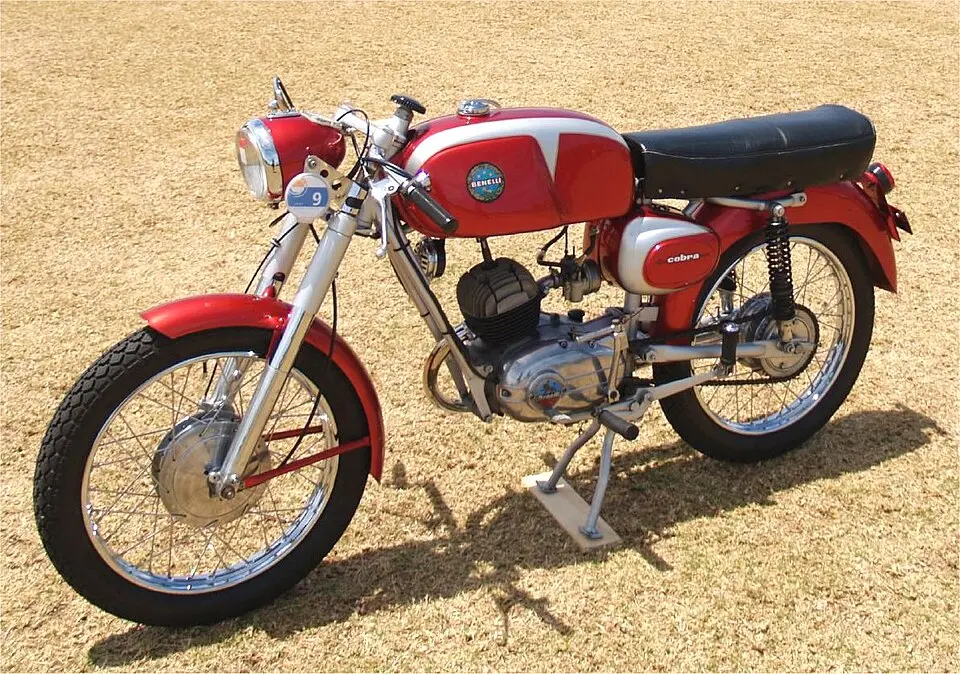
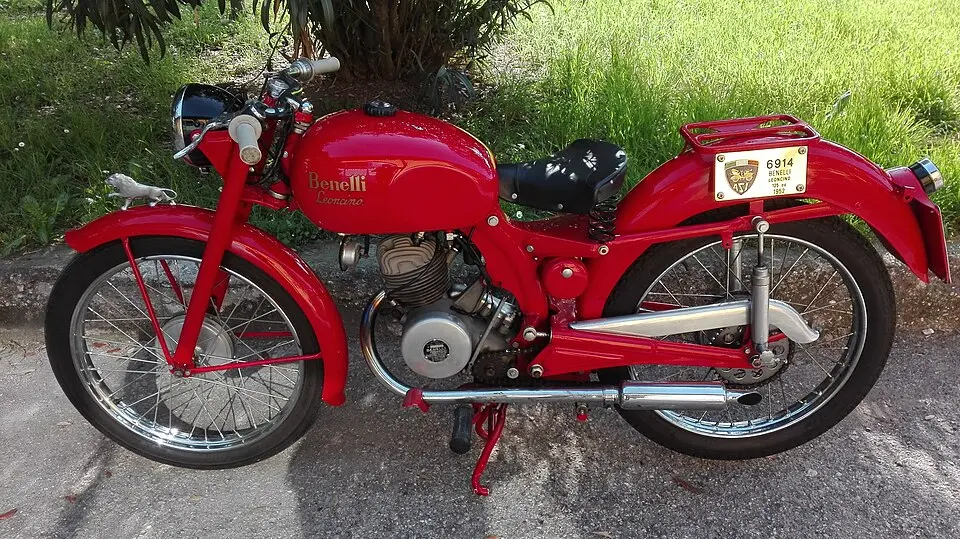
The Leoncino's layout favours practicality. The engine is mounted in a simple frame, with a recognisable upper tubular member and a structure designed to support the rear of the bike. A peculiarity of the suspension is the placement of the rear springs inside the arms of the swinging arm: a choice that sets the design apart and shows the search for compact solutions without resorting to an overly complex structure.
The transmission also evolved over the years. The earliest configurations are associated with a three-speed gearbox, while later versions have a four-speed. For this reason, before identifying an example it is important to check the year, the frame number and the components actually fitted, rather than inferring the configuration from outward appearance alone.
Normale and Sport: Two Different Characters
The Normale was aimed at everyday use and ease of handling. The Sport, by contrast, had a livelier tune, with higher power and a higher engine speed. Around the same base came configurations such as the Carenato (fully faired) and the Lusso (deluxe), which met different needs of style and intended use. Their equipment must be assessed against the specific model year and the documentation available.
The two-stroke Leoncino 125 is therefore more than just a post-war lightweight: it is an example of how Benelli managed to build a family of recognisable motorcycles adaptable to different uses. Its historic value lies precisely in this combination of accessibility, technical ingenuity and racing success, which helped consolidate the name of the Pesaro marque in the 1950s.
Key Technical Data
- Engine: air-cooled two-stroke single-cylinder.
- Displacement: about 123 cc; 123.67 cc in the 1957 technical documentation.
- Bore and stroke: 54 x 54 mm in the documented 1957 versions; other evolutions list different dimensions.
- Top-end materials: light-alloy head and cylinder with cast-iron liner in the configurations described.
- Fuelling: carburettor; lubrication by petrol-oil mixture.
- Normale power: 5 bhp at 5,600 rpm, according to the 1957 documentation.
- Sport power: 6.5 bhp at 6,600 rpm, according to the 1957 documentation.
- Compression ratio: 6.5:1 for the Normale and 7.5:1 for the Sport, according to the same documentation.
- Gearbox: three speeds in the earliest documented configurations; four speeds in later evolutions.
- Chassis: tubular frame and rear suspension with springs housed in the arms of the swinging arm.
Historical context
The Leoncino in Post-War Italy's Reconstruction
In the post-war period the Italian motorcycle industry had to restart in a country that needed accessible means of transport that were relatively easy to maintain. The car remained out of reach for many families, while the motorcycle was a practical solution for getting to work, linking small towns and handling daily journeys. For manufacturers, the challenge was to offer robust, functional products able to meet a rapidly changing market.
Benelli, founded in Pesaro in 1911, had suffered serious damage during the war. Its production recovery was also based on salvaging and converting abandoned military motorcycles. In this context came models aimed at a wider public than the larger-capacity motorcycles. The Leoncino 125, launched in 1951, became one of the protagonists of this phase and contributed to the company's commercial relaunch.
A Lightweight for Real Needs
The two-stroke single met the search for compact, relatively simple mechanics. The layout needed no valve gear and allowed an engine suited to a lightweight motorcycle. The Normale version was aimed mainly at practical use, while the Sport offered higher performance and a set-up better suited to those who wanted to take part in motorcycle events or simply ride with more verve.
The family expanded with different trims, including faired models and Lusso versions. The Leoncino was therefore not confined to the role of a budget machine: the same technical base could be adapted to different uses and levels of presentation. This flexibility was one of the reasons for its success.
Road and Racing
The link with sport helped give the model visibility. In 1953 Leopoldo Tartarini won the first Motogiro d'Italia on a Benelli Leoncino, a result that strengthened the image of the little bike and of the Pesaro marque. Taking part in competitions showed that a small capacity did not prevent riders from tackling demanding events, where lightness, consistency and the ability to handle the machine also counted.
Leoncino production went through a decade of technical and commercial change. Later evolutions of the family also included four-stroke engines, which should not be confused with the versions covered by this page. For the two-stroke Leoncino 125, the historic significance is tied to the recovery of individual mobility and to Benelli's ability to combine an accessible offer with a recognisable racing presence.
Main versions
Versions and Evolution of the Two-Stroke Benelli Leoncino 125
The name Leoncino 125 identifies a varied family, not a configuration that stayed unchanged for the whole period. The variants listed here are those documented as two-stroke versions; the later four-stroke Leoncinos are excluded from this page.
- Leoncino 125, first version: introduced in 1951 with an air-cooled two-stroke single-cylinder engine of about 123 cc. It is the model that started the family's success.
- Leoncino 125 Normale: version intended mainly for everyday use. The 1957 documentation gives 5 bhp at 5,600 rpm and a compression ratio of 6.5:1.
- Leoncino 125 Sport: higher-performance variant, with a declared power of 6.5 bhp at 6,600 rpm and a compression ratio of 7.5:1 in the 1957 documentation.
- Leoncino 125 Carenato: configuration presented in the early years of the family, characterised by a different outer bodywork. The exact equipment must be checked on the individual example and the documents for the model year.
- Leoncino 125 Lusso: version documented in the mid-1950s, aimed at a more refined presentation than the Normale. Not all trim differences can be verified for every year.
- Leoncino Sport S53: designation linked to the sporting version of the early 1950s, also associated with racing. It should be distinguished from any competition preparations made later.
During production there were mechanical updates, including the change from three to four speeds on some later versions. Specifications can vary by year and trim: it is not correct to attribute the technical data of the 1957 documentation to every Leoncino of the period.
Accessories added over time, components replaced during restorations and racing modifications do not automatically count as official versions. To identify a bike correctly, check the frame number, the engine, the historical documentation and the consistency of the parts fitted.
Trivia and anecdotes
Trivia on the Two-Stroke Benelli Leoncino 125
- The name has stayed linked to the Pesaro marque: the Leoncino became one of the most representative models of Benelli's post-war restart and helped make the brand recognisable beyond the racing world.
- A win at the first Motogiro d'Italia: in 1953 Leopoldo Tartarini won the first edition of the event on a Benelli Leoncino. The result gave great visibility to a small-capacity bike.
- Normale and Sport were not just cosmetic trims: in the 1957 technical documentation the two versions have different power and compression ratio. The Sport was set up to reach a higher engine speed.
- An unusual rear suspension: the springs were housed in the arms of the swinging arm, a solution that makes the design interesting from the point of view of motorcycle engineering history too.
The Leoncino family evolved over time and came to include four-stroke engines as well. This distinction matters for collectors and restorers: the outward appearance or the model name alone is not enough to identify the original engine and version with certainty.
What to check before buying one
Benelli Leoncino 125 Today: A Small Classic of Great Significance
The two-stroke Leoncino 125 appeals above all to those looking for a motorcycle representative of post-war Italian motorcycling. It is not a classic to choose for outright performance: its charm lies in the simplicity of the design, the compact dimensions and the link with a period when the motorcycle was still an essential tool of mobility as well as a passion. The Sport version adds a racing dimension, but the Normale too tells the story of the lightweight's role in everyday life in the 1950s.
Simple Mechanics, But Not Without Care
The two-stroke single has a relatively straightforward layout compared with many four-stroke engines of the same period. That does not mean any example is automatically easy or cheap to put back on the road. Age, the quality of previous work and any missing original components can decisively affect the work needed.
Before buying, check that frame, engine and documents match, as well as the presence of the parts specific to the declared version. On the engine, check compression, noise, ignition, carburettor, the seal of the top end and the state of the fuel system. On two-stroke mixture models it is also important to make sure the owner knows the correct procedure for preparing the fuel. Gearbox, clutch, final drive, wheels and brakes deserve an independent check regardless of how well the engine seems to run.
Restoration and Spare Parts Availability
A reliable restoration starts with correctly identifying the version. Normale, Sport, Carenato and Lusso should not be assembled as if they were a single model with no differences. Before buying parts, consult the technical documentation for the model year and compare the characteristics of the components on the bike. The current availability of every original part cannot be taken for granted: some common items may be easier to find than those specific to a particular version or a poorly preserved trim.
It is also worth assessing the quality of any restoration already carried out. A shiny paint job does not guarantee that engine, electrics and chassis are in order. An example with consistent documentation and verifiable work can make a better starting point than a flashier bike rebuilt with parts of uncertain origin.
Modern Use and Collector Interest
The Leoncino suits relaxed rides, historic rallies and routes where you can enjoy the bike without expecting modern pace. Braking, lighting, tyres and handling should be judged against the technology of the time. Before using it on the road, a full mechanical check is needed and you should make sure the vehicle is properly documented and complies with the applicable requirements.
No numerical valuation is given here: the available data is not enough to establish a reliable current price for the various two-stroke versions, distinguishing between bikes needing restoration, preserved examples and documented restorations.
The Boomer Classic Verdict
The two-stroke Benelli Leoncino 125 is an interesting choice for the enthusiast who appreciates historic lightweights and wants to explore an important phase of the Italian motorcycle industry. Before buying, the priority is to work out which version you are looking at and check the consistency of the components. Its value lies not only in its vintage look, but in the chance to keep a machine that tells the story of Benelli's restart and the role of the motorcycle in post-war life.