

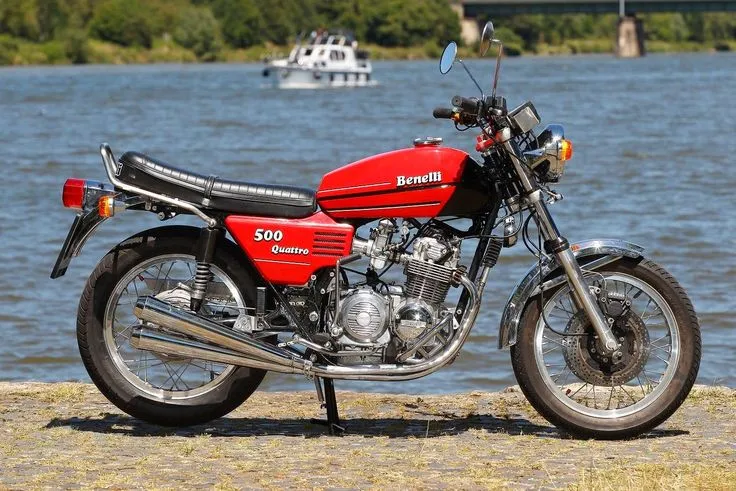
Benelli 500 Quattro: The Story of the Italian Four
Benelli · 1973-1980 · 498 cc
Features and technical evolution
Benelli 500 Quattro: an Italian four for the road
The Benelli 500 Quattro belongs to the period in which the Pesaro marque tried to win a place in the middleweight and big-bike market, taking on the Japanese fours head-on. On sale from 1974, it combined a compact multi-cylinder engine with modern lines and a chassis designed for road use. The project formed part of the industrial relaunch begun after Alejandro de Tomaso's takeover of Benelli.
Design and chassis layout
The lines of the 500 Quattro were drawn by Paolo Martin for Ghia, a company belonging to the De Tomaso group. The result was an imposing-looking bike, with a well-proportioned tank and seat, four separate exhausts and an engine that became an essential part of its visual identity. The steel double-cradle frame was shared in its basic layout with the Benelli 750 Sei: a choice that favoured rationalisation of the model family.
The initial configuration had a front drum brake, a solution that already looked traditional among mid-1970s road bikes. Later evolutions introduced the front disc. For this reason, when identifying a preserved or restored bike it is important to check the year and original configuration, without assuming that all 500 Quattros are identical.
The four-cylinder engine
The engine is an air-cooled four-stroke in-line four with a displacement of 498.51 cc. Valve gear is single overhead camshaft, with two valves per cylinder. Fuelling is by four Dell'Orto carburettors, while the five-speed gearbox and chain final drive complete a technical package that was conventional for the category.
Technical sources report for the 1974 version a stated power of 55 bhp at 9,500 rpm and torque of 4.7 kgm (34 lb ft) at 8,500 rpm. These figures refer to the documented configuration, not automatically to all later versions. Period road tests described a bike with sporty looks and lively performance, but also noted a gearbox that was not always precise in engagement and neutral that was sometimes hard to find.
Its place in the Benelli range
The 500 Quattro was not a racing bike adapted for the road, but a production roadster with sporting ambitions. Its architecture came from the decision to develop a modular family of multi-cylinder engines, from the 350 four to the 750 Sei. Over the years the range split into different configurations, including the 500 LS, which took a lighter approach and a different state of tune. It is important to consider these variants separately when assessing technical data, parts and the authenticity of a bike.
Key technical data
- Engine: four-stroke, in-line four, air-cooled.
- Displacement: 498.51 cc.
- Bore and stroke: 56 × 50.6 mm.
- Valve gear: single overhead camshaft, two valves per cylinder.
- Fuel system: four Dell'Orto VHB 22 B carburettors.
- Stated power: 55 bhp at 9,500 rpm, figure for the documented 1974 version.
- Gearbox: five-speed.
- Clutch: wet multi-plate.
- Final drive: chain.
- Frame: closed double cradle in steel tube.
- Front suspension: telescopic hydraulic forks.
- Rear suspension: swinging arm with two shock absorbers.
- Brakes: initial configuration with front and rear drums; later versions adopted a front disc.
Historical context
The Benelli relaunch in the 1970s
At the start of the 1970s the motorcycle market was increasingly influenced by Japanese fours. The Honda CB500 Four had shown that a multi-cylinder engine could also be offered below the big-bike threshold, with an interesting balance of performance, comfort and everyday usability. For Benelli, facing this competition meant updating its line-up and presenting itself as a manufacturer able to develop a modern range.
In 1971 Alejandro de Tomaso took over the Pesaro company and began an ambitious relaunch project. To speed up development of the new motorcycles, the strategy focused on a family of four- and six-cylinder engines, from which several capacities and models would be derived. The 500 Quattro and the 750 Sei were two of the most visible expressions of this programme.
A family of models and a coordinated look
The 500 Quattro used an engine with an architecture similar to that of its Japanese rivals, but fitted in a bike with an Italian stylistic identity. The design entrusted to Paolo Martin for Ghia and the sharing of structural elements with the 750 Sei answered both aesthetic needs and the need to make development of the range more efficient. The engines were assembled at the Moto Guzzi plants in Mandello del Lario and then fitted to the motorcycles in Pesaro.
The first configuration reached the market in 1974 with a front drum brake. Within a few years the range changed, following the evolution of customer expectations and the growing spread of disc brakes. In 1977 the 500 LS was introduced, less powerful according to published figures, but with more flexible response and an approach geared to weight reduction.
The project shows a moment of strong industrial ambition for Benelli. However, Japanese competition kept improving performance, finish and perceived reliability, making it hard for Italian manufacturers to compete simply with sophisticated technical solutions or distinctive design. The 500 Quattro remains today a testament to that strategy: an Italian road bike that tried to measure up in a rapidly changing segment.
Main versions
The main configurations
- Benelli 500 Quattro with front drum brake — 1974–1975: first production configuration, recognisable by the front drum brake and the initial technical set-up. The data sheets for the 1974 model report a 498.51 cc engine, four carburettors and a stated power of 55 bhp.
- Benelli 500 Quattro with front disc brake — 1976–1978: evolution of the Quattro identified in chronological catalogues with the switch to the front disc. For a specific bike it is advisable to verify the original configuration through documentation and identification numbers.
- Benelli 500 LS Quattro — 1976–1980 according to the Benelli Club Nederland catalogue: a distinct variant, with a lighter and sportier approach. Sources report lower power than the original Quattro, around 49 bhp, and more flexible power delivery. The LS should not be confused with a plain Quattro that has had its front brake swapped.
The 1973–1980 period requested for this entry is therefore an editorial span covering the introduction phase of the family and its evolutions. Chronological sources, however, place commercial production of the original Quattro from 1974, while the LS carries on beyond the end of the standard Quattro. Any changes to exhausts, carburettors, ignition or brakes must be treated as later work unless their factory origin is documented.
Trivia and anecdotes
A Quattro with an Italian signature
- The design came from Ghia: the lines of the 500 Quattro were drawn by Paolo Martin for Ghia, in the period when the company was part of the De Tomaso group. The project paired conventional mechanics with bodywork of strong character.
- A base shared with the Sei: the frame was closely related to that of the Benelli 750 Sei. The choice allowed different models to be developed within the same family, albeit with specific engines and configurations.
- The drum was already a traditional choice: the first Quattro used a front drum brake at a time when many rivals were moving to discs. The later update shows how quickly the technical standard of the category was changing.
- Don't confuse the Quattro and the LS: the LS had a different state of tune and lower stated power, favouring greater flexibility. Visual similarity is therefore not enough to correctly identify the version of a restored bike.
What to check before buying one
An Italian classic with a distinctive character
The Benelli 500 Quattro appeals to anyone who wants an Italian 1970s roadster with multi-cylinder mechanics and a history tied to the attempt to counter the rise of Japanese manufacturers. Its charm does not come only from the four-cylinder engine: Paolo Martin's design and the technical relationship with the 750 Sei also make it recognisable on the scene of the period.
Compared with a modern bike, the Quattro demands more mindful riding and closer attention to the state of the mechanics. The four-cylinder layout offers a different personality from that of contemporary Italian twins, but does not on its own guarantee consistent performance or reliability. Riding impressions depend on the efficiency of the carburettors, correct ignition, the health of the engine and the quality of any overhauls carried out over time.
Checks before buying
The first step is to identify the version precisely: a drum-brake Quattro, a later disc-brake one and a 500 LS should not be valued as if they were the same specification. You need to compare identification numbers, documents, components and the declared year. A front-brake conversion may be later work and does not, on its own, prove that the bike belongs to a more recent series.
A specialist inspection should include cold starting, compression, valve-train noise, any leaks, gearbox and clutch operation, and the smoothness of the four carburettors. It is important to test engagement of all the gears and check carefully how easily neutral is found, a weak point flagged in period tests. Frame, forks, shock absorbers, brakes and electrics must be examined without assuming that a cosmetically restored bike is also mechanically sound.
Before starting a restoration it is prudent to verify the actual availability of the components needed with specialists and suppliers. You cannot take for granted that all parts are easy to find or that costs are low. Carburettors, engine parts and series-specific components can affect the budget and the time needed to put the bike right. Historical documentation and the preservation of correct details are also important for maintaining collector interest.
Who it makes sense for today
The 500 Quattro can appeal to those who appreciate Italian industrial history, 1970s motorcycles and projects born in the De Tomaso era. It is not the best choice for someone looking for a classic to ride without prior checks or to restore with an improvised approach. Its value lies in the combination of design, mechanics and historical context: the best choice is an identifiable, documented bike that has already been through a serious overhaul, rather than an apparently cheap one that is incomplete or made up of parts from different versions.